
Pedro Spruijt
(Pernis, 1924)
Member of the 1st Company DNB
Proud of his nickname until his death
Pieter Marcelis Spruijt, known as Piet, was born on July 4, 1924, in Pernis, near Rotterdam. During the war, he was deployed to Hamburg for the mandatory Arbeitseinsatz (forced labor). Following a heavy bombardment on July 24, 1943, he managed to escape and eventually arrived in Aalten after a long journey on foot. He knew he could find refuge there because Pastor Delleman, who served in the pulpit of the Reformed Church in Aalten until 1939, encouraged young men wishing to evade the Arbeitseinsatz (forced labor) to go into hiding in the Aalten area.
This is how Piet ends up with Hendrik Hoftijzer on the farm “Weidelust” in IJzerlo. (now Rengelinkweg 3 IJzerlo) There he came into contact with Henk van ‘t Lam and Jan Ket and became involved in the resistance work. He joined the resistance group De Bark. His pseudonym becomes Pedro. Piet is so proud of this ‘nickname’ that he uses it as a nickname until his death.
Pedro participates in the various resistance activities, such as the nightly transport of weapons that are distributed in the region after the drops in the Zwarte Veen. In the middle of winter, a group of Barkians also stole grenades from an ammunition depot of the Germans in Aalten. It has snowed and it is slippery. With four crates of grenades each on the bike, the group returns. Due to the slipperiness, Pedro falls. While his heart is beating in his throat, he is helped up by a German soldier, who helps him back on his bicycle.
When the Bark is evacuated after the drama on the Rademakersbroek , the group is split up into different sections. Pedro ends up at Smeets op de Haart, where he comes under the command of Ben ten Brinke.
During the liberation of Aalten on 30 March, the group got into a fierce firefight with Germans near the bridge on the Polstraat. During this action, Ben ten Brinke manages to remove the explosive under the bridge together with Nico Oostelaar , after which it remains intact.
Pedro joined the Dutch National Battalion and, after its disbandment, served with the I-II-8-RI mine clearance service. In April 1947, he left as a volunteer for the former Dutch East Indies to participate in the so-called police actions. Pedro returned to the Netherlands in May 1951.
Pedro becomes a Customs officer, stations in Glanerbrug and later at Grenscrossing Bergh Autoweg near the municipality of Bergh. On February 3, 1954 he married Dini Bolks from Enschede. They had four children.
Pedro dies on April 26, 1977 in Zevenaar.
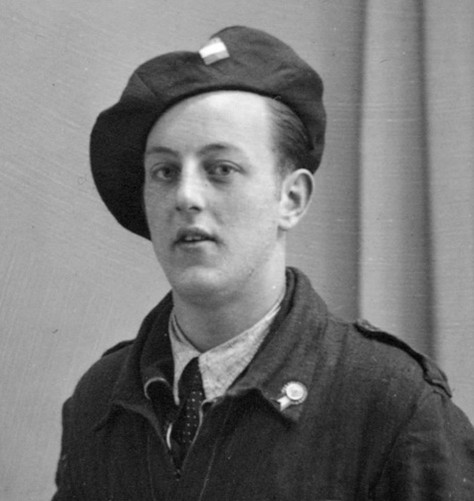
Pedro Spruijt