

Ben te Brinke
(Miste, 1919)
Section Commander, 1st Company DNB
Courageous farmer’s son becomes Section Commander in the Canadian Army
Jan Bernard (Ben) te Brinke was born on 5 February 1919, the seventh child of Jan Hendrik and Janna Berendina te Brinke-Debbink at ‘Diesselbrink’ in Miste, Winterswijk. In 1932, the family moved to a new farm, ‘Nieuw Diesselbrink’, built by his father on Misterweg. Ben’s father had a strong sense of justice, and Ben followed his example. He was friendly to everyone but could switch gears instantly during the war when required. At home, he mastered all aspects of farming and proved exceptionally skilled with horses. At nearly fifteen, he became a live-in farmhand in the Woold and later in Eibergen.
From 1938, he was a senior live-in farmhand for the Krieger family in ‘de Haart’, Aalten. He was very happy there. During the war, many resistance members were hidden around the Kriegerdijk. In 1943, Jan Ket and Arie Looij built a secret hideout inside a haystack near the woods by Krieger’s farm. Ben brought them food and thus became involved in the resistance. He trained with weapons and contributed to raids and sabotage. He regularly visited his parental home, which also sheltered people in hiding and where they listened to a concealed radio.
Ben te Brinke experienced many harrowing situations. In the autumn of 1944, he joined the combat section of the Interior Forces (Binnenlandse Strijdkrachten, BS). Shortly after, he became part of the resistance group ‘De Bark’, while hiding at the Prinzen family’s ‘Somsenhuus’ in IJzerlo. This location also sheltered the downed Allied pilots Dell, Davis, and Brown.
Jan Ket was the commander of ‘De Bark’, with three sub-commanders: Henk van ’t Lam, Co Hettinga, and Ben te Brinke. This armed group prepared for the liberation. Every day, Ben collected a sack of oats from Krieger (free of charge) and had it processed at the ‘Landbouw’. In the autumn of 1944, Ben, along with Jan Driesten and Ton van Maanenberg, survived a raid by the Landwacht at the ‘’t Ruwhof’ farm in Dale. “200 bullets landed in the grass to the left and right of us,” he recalled.
During the Allied weapon air-drops in the ‘Aaltense Goor’, Te Brinke was one of the 20 men present. Shortly after, he transported the weapons by horse and cart from Wieggers in Zieuwent to ‘Somsenhuus’. On the sandy tracks, he had to stop constantly as the weight was too great for the horse. A layer of turnips lay on top of the weapons. In ‘de Wolboom’, he saw two German raid vans. He thought of the pistol in his back pocket: “If they stop me, they won’t take me alive,” he said later. They let him pass.
In the village of Aalten, a raid was also underway. The Grüne Polizei next to Hotel Beskers returned his greeting, allowing him to proceed. On Dinxperloseweg, a V1 rocket flew over low, but fortunately, he managed to calm his horse. His comrades at ‘Somsenhuus’ were waiting for him. Ben knew: if he were caught, they would rescue him immediately. Shortly after, he delivered several Sten guns to Varsseveld by bicycle. At the Bombeek, he had to cross a small bridge where a German soldier was standing. The soldier moved aside for him. Upon arriving in Varsseveld, he saw that the barrel of a Sten gun was poking out of the burlap sack. He had been lucky.
On 26 February 1945, the resistance group ‘De Bark’ left their quarters and went into hiding in three sections across Aalten and Varsseveld. Ben’s section went to ‘de Haart’. He himself was sheltered with nine men at Krieger’s farm. On 30 March 1945, the Allies (the Guards Armoured Division) advanced on Aalten. Te Brinke and his group did everything possible to secure the Polbrug bridge, as all other 19 bridges had been blown up by the Germans. With the support of a Canadian tank, he personally removed the explosives from under the bridge while bullets whistled around him. As ordered, on the first day of liberation, his section appeared at the Krieger farm armed and wearing blue overalls. They cleared Aalten and the surrounding area of German soldiers and arrested Dutch Nazi collaborators (NSB).
In mid-April 1945, Ben joined the Dutch National Battalion (DNB). The dangerous crossing of the IJssel by the Canadians between Gorssel and Wilp made a great impression on him; he saw Canadians being killed. He reached Apeldoorn, Kootwijk, Bunschoten, and Spakenburg, where he mainly performed sentry duty. He declined an offer to become a professional soldier and was discharged in June 1945.
Commander Bob Krul said of him in 1982: “Ben te Brinke was one of the most reliable men in Jan Ket’s company.”
Ben married Annie Wassink on 4 June 1948 and worked for the Customs service in Limburg and Winterswijk until his retirement. He passed away on 8 August 1984.
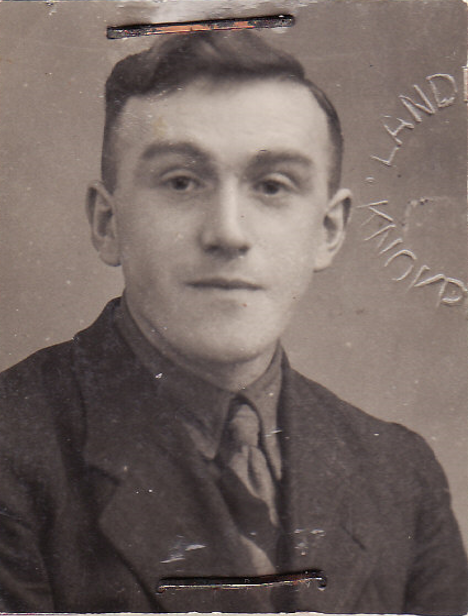
Ben te Brinke