
Word Cloud of Freedom
At first glance, a word cloud looks like a nice picture, made of individual words from a random text. But a word cloud is more. The size of the words says something about how many times a word is used in a text.
Our word cloud was created from the competition ‘What does freedom mean to you?’ We asked residents of the Achterhoek, Liemers, and the German border region to express their sense of freedom through words, drawings, or photographs.
Did you know that you can play a nice game with the word cloud? What thoughts come to mind when you hear a certain word from the word cloud? What ideas do you get, what questions arise? See below for some tips to get started with the word cloud.
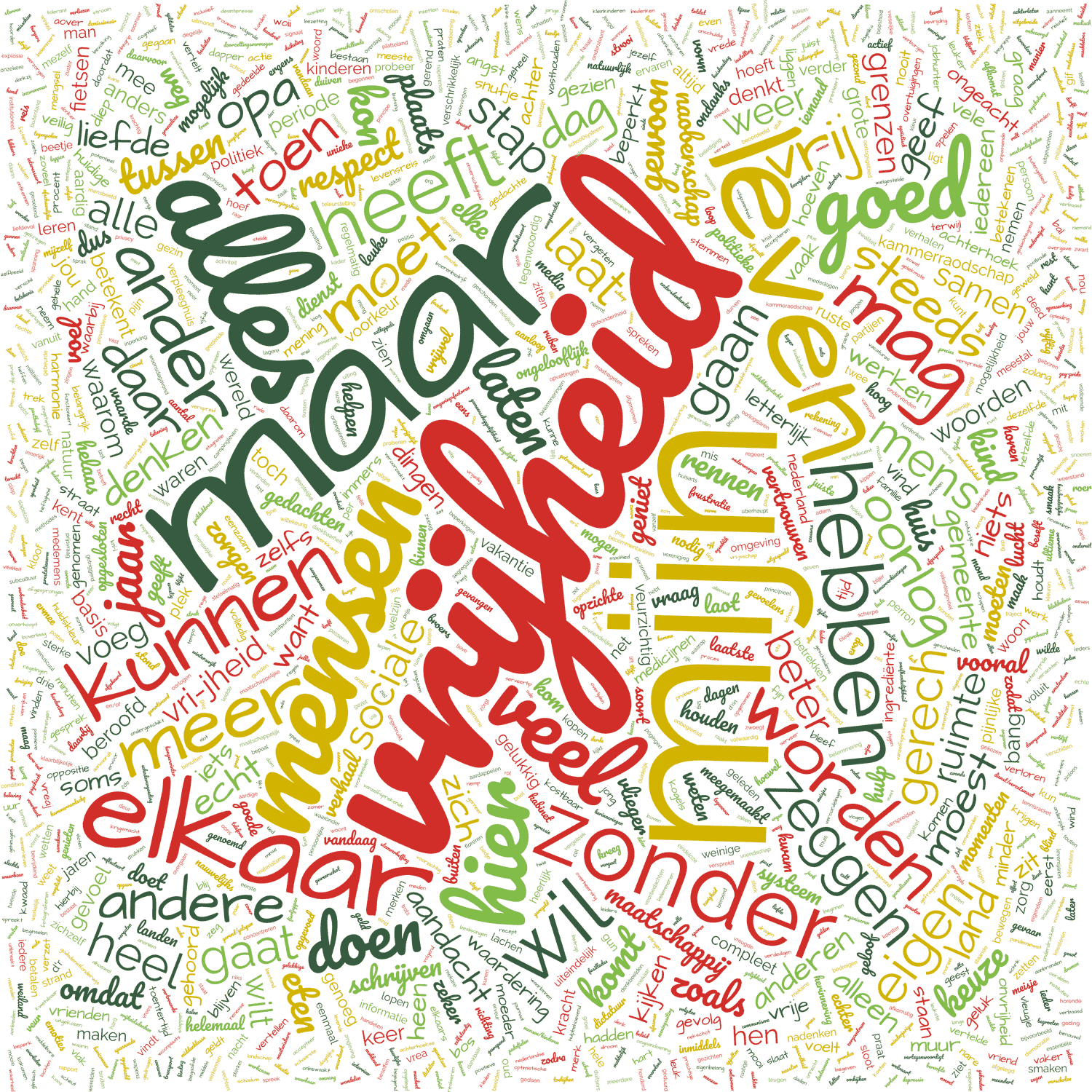
Click on the image to enlarge.
You alone
Sit in front of the word cloud and pin (with a pin or something) blindly on the word cloud. You relate the word you have pricked to the word Freedom by formulating an answer to the question: ‘What connection does the pricked word have with Freedom?’
For example: You pinned on ‘boundaries’. Then you ask yourself what Freedom has to do with boundaries. The trick is to let your thoughts flow. That you try to remember all the thoughts that fly by. And be alert! They shoot past very quickly. It will take some time and practice for untrained people to hold all those thoughts. Even if you work alone. Otherwise, quickly write down some keywords about those thoughts.
For example: Freedom is limited. Without borders, there is no sense of freedom. There are countries without freedom. Freedom has to be conquered. Etc etc.
Each of those flashing thoughts can be developed into extensive stories and ideas about Freedom. You will be surprised how quickly you get used to this quick way of gathering first ideas.
Couple (1)
Put the word cloud between you. You take turns pointing to a word and asking the other person what the connection is between that word and Freedom. Of course, it is most exciting to point out words for which you yourself have no solution 1, 2, 3, such as ‘missing’ or ‘treated’. Again, keep an eye on your first thoughts. Because they are correct.
First comes the suspicion of a connection, then comes the story.
So, for example, when you hear the word ‘bejagend’ (which is a conjugation of ‘bejagenen’ which means ‘to meet’) you might think about how difficult it sometimes is to approach people you don’t know. That requires a certain freedom. Do you feel that freedom or not? And why is that? Have you ever experienced that? Well, again enough material to talk about. Even though you challenge each other a bit with this form, it is mainly curiosity that should be leading here.
Couple (2)
A step further. Again, it is the person opposite you who points out words for you. But now not one word, but two! And freedom remains the basic word. Now it is a matter of thinking a little deeper and perhaps also some construction.
Example: You are presented with the words ‘carry’ and ‘anonymous’. You have to connect them to each other and to ‘Freedom’. This is often where the first stories come up. You have to think of the Second World War. That young people in the resistance were given heavy tasks to perform. Or you think of families who have to flee and literally carry each other to get across a river.
It is miraculous to see that there is (almost) always a solution to be found. And if you don’t succeed, that you can work it out together.
By the way: these ways are also very good to do with your children.
In the classroom (1)
When a large print of the word cloud is permanently present in the classroom, children will always come up with solutions for new combinations of words. As a teacher, you don’t have to do anything for that. At most, occasionally asking who has found a solution for a special combination of words. Then it is easy to have a class discussion about it and you will see, the class will walk away with it. Because actually, the word cloud is a sea of riddles. Special riddles, though, because they are all about something as big as Freedom. It is good to realize that you are philosophizing with children. There is no ultimate truth in that. On the contrary, after fixing a thought like The Truth, all free thinking stops.
In the classroom (2)
In groups of 3 or 4 children. Each group receives THREE words from the teacher or from another group. For example, ‘medicine’, ‘speaking’ and ‘holiday’. Each group makes up a story about these three words and ‘Freedom’.
That story is then told to the class, but can also be played in a scene that is performed in front of the class!
Note: For this, the children must already be trained in associating. But there is nothing wrong with that. Train them, it’s a skill they’ll enjoy for the rest of their lives.
For more ideas and inspiration: info@theaterdokter.nl