
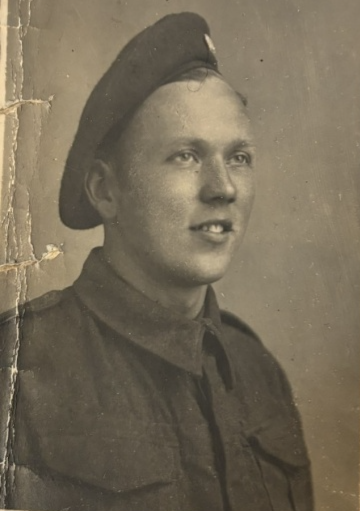
Henk Westerveld
(Aalten, 1922)
Member of the 1st Company DNB
They help the Canadians to jointly liberate the rest of the Netherlands
Hendrik Willem (Henk) Westerveld was born on 17 September 1922. His parents are Arent Jan Westerveld (1891–1958) and Berendina Somsen (1896–1981). Father Westerveld comes from Dale from farm Lammers. At the outbreak of the war, the family consists of father, mother, and the children Henk, Jan, Drika, and Mien (in the family, a stillborn child was also born).
The Protestant family (Reformed) has support in faith, and church attendance is important. They attend the Westerkerk in Aalten. The children follow education at the Chr. Nationale School Lintelo (later de Klimop). The family lives on farm de Kemper at the Halteweg (Lintelo 158, later renumbered to Wolterinkweg 5 and subsequently Halteweg 15a).
Henk is 18 years old when the war breaks out, and as eldest son, he is the intended successor on the farm. His little sister Drika hangs the washing on the clothesline together with her mother outside when aircraft from Germany fly overhead. In the first years of the war, not so much changed in daily life yet.
However, at the start of the war (during summer holidays), children from bombed Rotterdam come to Aalten. On Sundays, during the church service, a call was made to take in children for a few weeks at home. Father Westerveld goes on the day of arrival to the station in Aalten and takes two children from the family van Zanten with him (Corry and Fred). In the following years, more children from the van Zanten family come to farm de Kemper. Mien, Henk’s other little sister, finds it nice to mother the youngest ones. Towards the end of the war, Fred van Zanten comes with his girlfriend Corry (coincidentally the same name as his sister) to the Kemper. He says he is married to Corry, but Father Westerveld believes nothing of it and sends Fred to the neighbours where he can sleep.
Besides these children from Rotterdam, there are also several people in hiding on the Kemper, sometimes even twelve at once. Also Jewish fugitives are welcome, such as Bernard Leezer and Helga Oppenheim.
From Drika’s stories, it quickly becomes apparent that it is not so easy to have all these different ‘nationalities’ in faith and life conviction under one and the same roof.
Quartering of German Soldiers
When German soldiers are quartered on the Kemper, this causes quite a bit of tension. That was certainly so with the quartering of a high German officer. The soldiers have made a sleeping place for him in the cellar. Thus, the officer would spend the night at a safer place. They themselves sleep elsewhere on the farm. The story goes that for this, the bed of grandpa and grandma from the upper chamber was moved to the cellar. The bed was placed on large Cologne preserving jars. The officer and the soldiers thus spent the night on the Kemper. The family endured deathly fears because of the danger that the fugitives would be discovered. Fortunately, the officer had a good night, and the military personnel move on the next day.
One of the German soldiers is Willy Karle (paratrooper and trained in jumping and falling). Neighbour Jan Somsen from farm Wolterink (at that time still a boy) has told in an earlier interview that this Willy jumped out of the hatch of the hayloft. Later, this Willy ‘went stiften’ (deserted) and went into hiding elsewhere in Lintelo. After the war, he marries a girl from Lintelo and lives afterwards on the Schooldijk.
Both Henk and Jan Westerveld are at the age where they must report for the Arbeitseinsatz. They do not intend to report but are discovered during threshing in the barn across the way by the Germans and taken away.
The same Jan Somsen (from Wolterink) sees, when he comes home from school, that Henk and Jan Westerveld are being led away under guard by German soldiers. They have to work in Germany, just over the border at Megchelen. Sister Drika goes there by bicycle to bring supplies (clothing and food). She still has to hurry to be back before Sperrzeit. According to both Henny Navis and Herb Westerveld, they also stayed in Camp Amersfoort, but on the list of this camp they do not appear (yet). They are finally put to work at a farmer(s) in Germany; they could have been worse off.
Son Herb thinks that Henk was in the resistance, but he did not talk much about it. His nephew, friend, and neighbour boy Jan Somsen from farm ‘De Snieder’ was in the resistance, and together they joined the Dutch National Battalion (DNB) after the liberation. Henk’s identity card has always been preserved. He is assigned to the 1st Company and is part of the section in which several neighbours are affiliated such as Jo Lensink, G. Prinsen, Gradus Diepenbroek, and Bernard Fukkink. They help the Canadians to jointly liberate the rest of the Netherlands.
After the capitulation in May, there is less and less to do for the soldiers. There is an opportunity to sign up and take on other activities, such as participation in the Mine Clearance Service. But several members of the DNB are not in favor of extending their commitment. In the book The Forgotten Battalion, page 153, the following is stated about this, recorded from the diary of Jo Lensink and Bernard Fukkink on June 11, 1945: “Various boys did not want to sign and packed their things to hand them in. Around twelve o’clock, farewell was taken from our friends, which weighed heavily on us. G. Prinsen, B. Fukkink, G. Schuurman, H. Westerveld, and G. Diepenbroek left our section. There is enough work to do at home on the farms.”
After the war
Little is spoken about the war; what has been, has been. Possibly also because some events are too painful to speak about. Henk goes to work at home on the farm. The relationship between Henk and his father is regularly under strain, although the outside world often does not notice.
Henk makes a far-reaching decision together with his fiancée Hanna Rensink (from farm ‘t Heegt in Lintelo). They are going to emigrate to Canada to build a life there. They marry on 24 March 1949, and on 22 July 1949 they depart with the SS Tabinta to Québec in Canada where they arrive on 2 August 1949. Together they build an agricultural business in Terra Cotta Ontario and have three sons. Unfortunately, one of the sons dies in an accident. Currently, the third generation is working on the farm.
Henk passed away on 27 May 2000 in Terra Cotta, Ontario, Canada.
Henk Westerveld