

Gradus Diepenbroek
(IJzevoorde, 1914)
Member of the 1st Company DNB
The Diepenbroek family: Active in the resistance
Gradus Frederikus Diepenbroek was born on 7 January 1914 in IJzevoorde, near Slangenburg Castle. Gradus was the second son of Gerrit and Mientje Diepenbroek-Berendsen; he had two brothers and five sisters. His father, Gerrit, worked from early morning until late at night for large-scale farmers and also reclaimed his own piece of wasteland. His father passed away at the age of 35. His mother, Mientje, remarried but spent ten years in a psychiatric clinic in Wolfheze due to illness and grief. Gradus and his eldest brother, Hendrik, worked as farmhands in the area, and the younger children were raised by the eldest sister or placed elsewhere. Gradus was skilled with horses and had a keen eye for nature. He developed a strong sense of justice and appreciated the power of simplicity.
During the war, Gradus worked for the Termaat couple on the Doetinchemseweg in Zelhem. When he was ordered to perform compulsory digging work for the occupier, he decided to go into hiding with his brother Hendrik and sister-in-law Grada in Lintelo (Pasdijk). This hospitable family was deeply involved in the resistance alongside their many people in hiding. The leader of the Aalten Assault Group, Kees Ruizendaal, stayed there regularly, and from mid-April 1944, Gijs van Haaften and Dick Kleisen hid there permanently (having escaped from Kamp Vught). A dugout measuring four by two metres was constructed close to the house.
For Gradus, the war years were a period full of tension and emotion, but also of solidarity and companionship. Van Haaften and Kleisen helped with farm work and, like Gradus, were primarily occupied with forming a strong resistance group capable of attacking. By the end of 1944, this group of the Interior Forces (BS) in Lintelo numbered 50 people. R.A.F. pilots Frank Dell and Joe Davis also stayed at the farm for several weeks, along with four others.
In the night of 22 to 23 October 1944, the first Allied weapons dropping took place in the Aaltense Goor. The site was carefully chosen: a meadow measuring 500 by 400 metres, with its axis pointing northeast. The safe removal of the weapons by twenty people was guaranteed. The man with the light box, tasked with signalling the ‘Z’ to the pilot, stood in the centre of the drop zone. Other signal lamps were placed at the corners. After a long wait, a drone was heard from a distance. The aircraft approached, made a wide turn, and approached again, this time lower. Yellow and orange parachutes were pulled down by their heavy loads. A weight of about 200 kilos hung from a single parachute. In total, 75 parachutes landed with a total weight of 15 tonnes of weapons. Some containers broke upon impact. Weapons lay scattered here and there and were hastily gathered. That same night, the materials were brought to the Diepenbroek family farm. The weapons were hidden in the barn under straw; the containers were buried in the ground. Shortly thereafter, Gradus Diepenbroek and Dick Kleisen loaded the weapons onto a cart, threw cow manure on top, and drove the horse and cart to various addresses of other resistance groups in the Achterhoek. One parachute was hidden and an ammunition box was buried in the yard and later forgotten. Gradus was also present during the next two weapons droppings.
In March 1945, raids increased, and from 13 March, the resistance slept underground every night. At the end of March 1945, Gradus participated in the liberation of Aalten as a sharpshooter and member of the well-armed BS group. His comrade Herman Huinink was killed by German soldiers; two others were seriously wounded. The three BS platoons took 200 Germans prisoner. They immediately began military training for the platoon. In mid-April 1945, the Dutch National Battalion left Aalten to join the Canadian liberating army. Gradus Diepenbroek went with them as a member of the first company.
In 1947, Gradus married Dina Johanna Seesink from Lintelo, the girl next door to his brother Hendrik. They went to live at Pasdijk 1 in Lintelo.
Gradus passed away on 5 July 2005 in Ulft and was buried in Aalten.
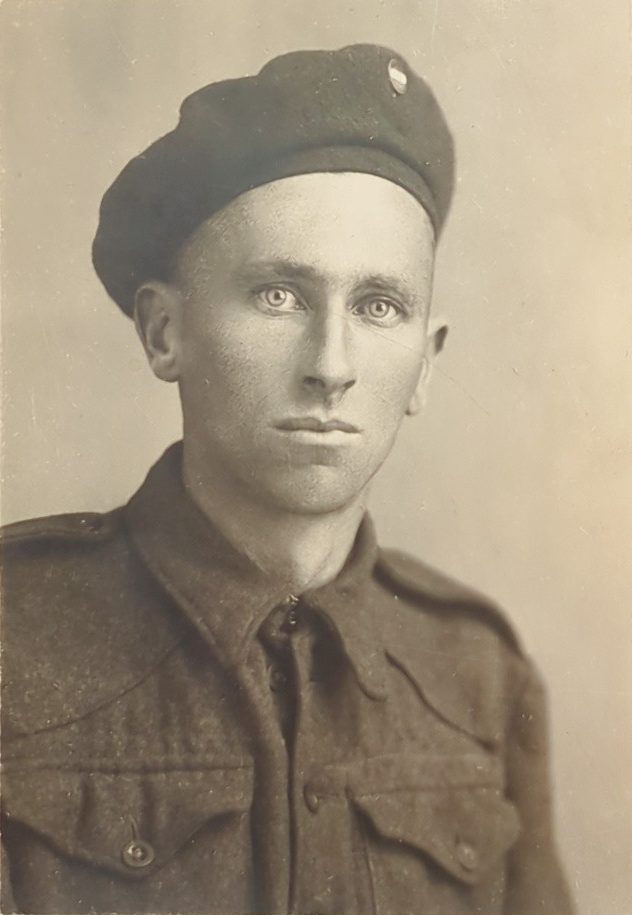
Gradus Diepenbroek