
Gerrit Schuurman
(Heelweg, 1915)
Member of the 1st Company DNB
Gerrit had a strong sense of justice and felt he had to participate in the resistance
Gerrit Schuurman was born on 9 November 1915 at Heelweg E 141 (later Spiekersweg 2) (Municipality of Wisch), son of Klaas Schuurman and Wesselina Aleida Lammers. Gerrit is the third in the family that eventually numbered 9 children. The children were born in the period 1911–1930. Unfortunately, little brother Gerrit Willem died at the age of 4 on 28 August 1926. At the start of WWII, a number of children were already out of the house. The family is Reformed.
At the start of the war, Gerrit worked as a carter for Hesselink in Varsseveld, transporting flour and meal products in the area by horse and wagon. Prior to that, he was also a farmhand for Ter Horst at the Karsjes farm in Lintelo. During the war, his brother Herman worked as a farmhand at Karsjes until the raid in the Westerkerk, after which he went into hiding at the Houwers’ De Bleeke farm in Dale, where he continued to work for a period after the war.
Going into Hiding in Zuidwolde
When the Arbeitseinsatz (forced labor) began, Gerrit did not want to report for duty. With the help of Duthler Varsseveld, he managed to find work in Zuidwolde. There, he joined a company commissioned by the Germans to transport stone materials, where he also served as a carter.
Later, he could return to Hesselink in Varsseveld, who then also had to transport flour and flour products on behalf of the Germans. Gerrit received an Ausweis for this and did not have to go into hiding, just as in Zuidwolde. During this transport, Gerrit regularly hid a loaf of bread behind the hedge at Dr. Hulshof on Spoorstraat, to pick up later for home.
Resistance
Gerrit had a strong sense of justice and felt that he had to participate in the resistance. The children recount that their father did not reveal much about the resistance. They do know, however, that he was involved in weapon drops and was trained in the use of weapons.
After the liberation of Aalten/Varsseveld, Gerrit joined the DNB. He was also involved in the action around the Meihuis on Beunkdijk Lintelo, where Herman Huinink was fatally hit. In the DNB, he is part of the section in which several people from Lintelo are affiliated (including Jo Lensink, Bernard Fukkink, Henk Westerveld, G. Prinsen, Gradus Diepenbroek). Due to the manner of conduct of Jan Ket and Co Hettinga, Gerrit was not a fan of these persons, so the children say.
After the Liberation
In June 1945, Gerrit returns home from the DNB. He is engaged to Sina Westerveld (born 9 Nov. 1921) from Aalten and intends to marry. But unfortunately she dies on 11 January 1946 of diphtheria. His mother also dies in 1946. Quite soon afterwards, he marries on 27 November 1947 Harmina Johanna (Mien) Raterink (1920–2012). Gerrit knows Mien because she is a friend with his sister Menta. Mien worked in that period at Dr. Hulshof, who had his practice near Varsseveld station. Gerrit often came to the station to unload goods for Hesselink.
Gerrit and Mien have three daughters. Father did not talk much about the war, certainly not about the sensitive matters. However, they noticed that annually around the beginning of May father was melancholic and later also had nightmares. Sometimes he tried to suppress that with the bottle of alcohol.
Gerrit and Mien continued to live at Spiekersweg until 2006. The last period of their lives, they lived at care centre de Bettekamp. Apparently, he sometimes shared things at night in the nursing home in Varsseveld. The children look back on a good childhood and say that they inherited father’s sense of justice.
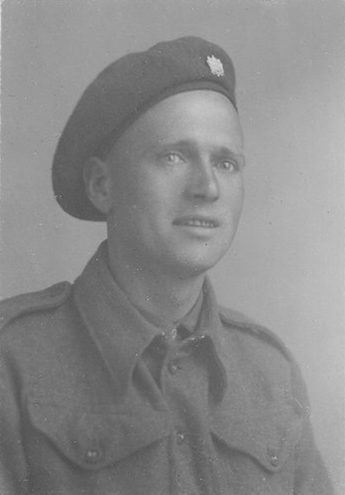
Gerrit Schuurman