

Dries de Visser
Commander of the 3rd Company, 2nd Platoon DNB
Courage, perseverance, and luck in hazardous situations
On 15 July 1940, the Dutch army was disbanded, in which Dries served as Sergeant 1st Class, 5th Infantry Regiment. After that, an ‘Aufbouwdienst’ (Reconstruction Service) was formed. Dries with a number of colleagues decided to stay to maintain a good core of ex-military personnel. They were optimistic. The chances could simply turn? This positive attitude, courage, and perseverance in resistance they held for five long, fearful years.
In October 1940, the Reconstruction Service came under influence of the NSB. Dries de Visser submitted his resignation and sat at home for a few months. He went into the underground in Amersfoort. That one was quite loose-tongued, so he switched to the underground Ordedienst of Colonel Antoni de Vries. Also here it went wrong, for 72 members of the Ordedienst were executed. He tried to flee to England, but could not find the right connection.
In May 1943, the occupier called all officers to report for prisoner-of-war status in Germany. Together with a comrade, Dries travelled to Aalten, where they went into hiding.
Resistance Activities in Eibergen
After considerable time, he came into contact with ‘Ome Jan’ Wikkerink and became a member of the Knokploeg Aalten. The person in hiding, military man Jan Tinge, contacted him. He was head of the Binnenlandse Strijdkrachten Eibergen, Groenlo, and Lichtenvoorde, combat section. Dries de Visser received the question to become commander of the resistance group in Eibergen. He agreed, and Ome Jan also approved it. Dries de Visser came to live with the family Vriezen-Rutgers, Hupsel C25, Eibergen (he originally came from Aalten and lived on the new farm Hanna). Resistance man Jan Schot was the next-door neighbour.
Dries began with a motivational speech for the group of 20 men. He also got acquainted with the men of the Ordedienst Carel Prakke, Johan Smits, and Wim Hageman. The armament in Eibergen was hopeless. Soon German hand grenades and carbines with ammunition were captured. The blacksmith in Hupsel made 1500 angle irons, which were thrown on the roads, so that dozens of German cars broke down.
Special Shock Troops
In the summer of 1944, Jan Tinge asked Dries de Visser to become commander of a special shock troop, which carried out its assignments under the command of Prince Bernhard. It was intended that he would instruct and train the men of the Knokploeg Aalten. Dries discussed this with Bob Krul, the district commander of the Binnenlandse Strijdkrachten, department Achterhoek, who had the assignment to form two of these special shock troops in the Achterhoek. Dries wanted to take on this task, but then with his own group from Eibergen, because he could fully rely on them. Krul agreed.
The requirements that were set for the group were much heavier than before, and also the danger to life was greater. Motorcycles and cars were needed due to possible tasks at bridges in Zutphen and Deventer. Owners gave permission to use material, if necessary. Weapons were not available, but those came after the first Allied weapon drop. De Visser collected them, together with three others, by farmer’s cart in Zieuwent.
The next day, he discovered that it was not the promised heavy weapons and also not the promised emergency rations and medical supplies. However much he urged, he got nowhere. Everything remained in Aalten. So the group now stole the good bicycles from Germans and steel helmets from the fire brigade. Every tip was welcome. Daughter Vriezen gave the tip of a wagon with ammunition in a barn in Haarlo. With four others, De Visser went there. The raid failed, the bullets flew around their ears, but they all came home safe and sound. Thus they survived several dangerous situations more often, in which it barely went well.
Nederlandse Binnenlandse Strijdkrachten (NBS)
As commander of the NBS group Eibergen, combat section, he focused mainly on sabotage and intelligence work. At home with the family Vriezen, he could listen to the hidden radio.
End of December 1944, after the raid on the weapons depot at farmer Derk Pardijs in Warnsveld, Jan Tinge asked him to stop all resistance activity. From that moment on, there was no contact for a few months between the regions of the NBS Achterhoek and the higher leadership. Nevertheless, the help for escaped prisoners of war and pilots was continued. A few days before the liberation, Bob Krul suddenly appeared again.
The day before the liberation, the English tanks arrived, and Dries de Visser found himself with his group between the German and English armies. They were fired upon by the Germans, but could retreat and found shelter on a farm. The following days, he brought in over 500 prisoners of war with his group. The English commander was very pleased with this, as time was saved for subsequent operations. Peijnenburg, liaison officer of the commander NBS Prince Bernhard, spoke in his report of 7 April 1945 to the commander NBS Achterhoek about his “very good impression” of the local group.
Service with the DNB
When ten days later the question came to march with the Canadian Army to liberate the Netherlands, the whole NBS group from Eibergen (except three people) enthusiastically agreed. The third company counted 110 men from Eibergen, Groenlo, and Lichtenvoorde. Under commander Dries de Visser of the 3rd Company, 2nd Platoon, 24 enlisted men and ten (non-)commissioned officers fell. De Visser received the rank of Second Lieutenant.
They departed on 16 April in Canadian vehicles from Aalten towards the area of the IJssel. They came to Apeldoorn and made on 19 April a ‘clearing operation’ through Elburg, Heerde, and Vaassen. There had been no liberators yet. That evening, there was a meeting with Major Archibald and officers of the Canadian Army, in which Jan Tinge with his three platoon commanders (Dries de Visser, Henk Hulshof, and Jan Nahuis) participated.
On 13 May, the 3rd Company was in Dodewaard. The area was sealed off by sentries. They did work at the check-line in the Betuwe. Finally, they had to burn the rifles and goods in Tiel, which had been captured by the Germans throughout the Netherlands. They became large burning and smouldering piles.
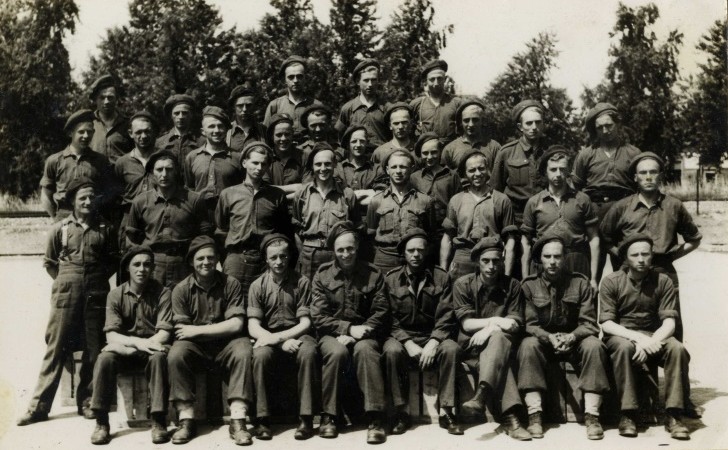
Dries de Visser, fifth from the left