
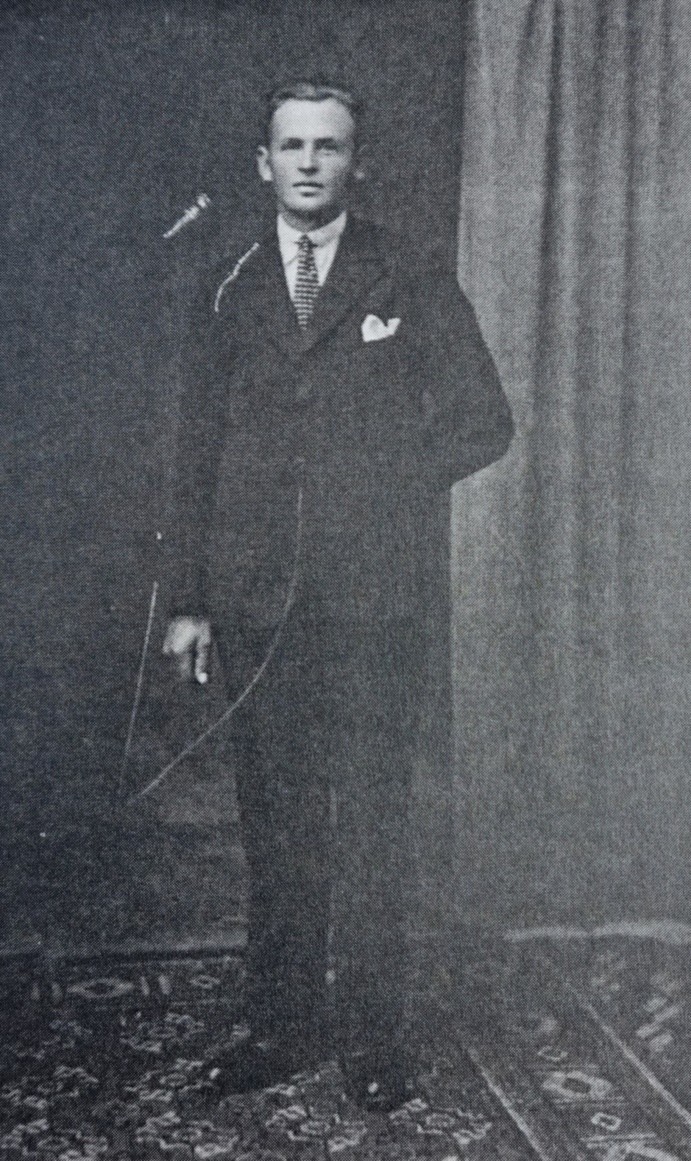
Jan Schot
(Eibergen, 1916)
Member of the 3rd Company DNB
Significant local resistance role in housing Jewish fugitives and securing the safety of pilots and Allied soldiers
Jan Schot was born on 20 April 1916 on the farm ‘Osmunda’ in Hupsel, municipality of Eibergen, as the son of Berend and Janna Schot-Prinsen. He has two older sisters and a younger sister Betsy, who was born in 1932.
During the mobilisation period, he was deployed in Wilp, where he also had to fight during the invasion of the German army. Jan was taken prisoner of war and spent three weeks imprisoned in camp Neu Brandenburg near Berlin. Upon his return, he worked on the farm and immediately joined the underground. His parents’ home provided shelter for some time to a Jewish couple from Amsterdam. They left secretly because they missed their home and belongings. Three young men (who were evading the labour service) remained in hiding for a longer period. The Jewish boy Bob Simons from Enschede (earlier in hiding in Haarlem and Leiden) was a family member for two years and thus survived the war. He was called Henk and was the same age as Betsy.
Jan played an important local resistance role in housing fugitives and securing the safety of pilots and Allied soldiers. In a document for his children, he describes how he collected six French prisoners of war in the Meddose Veen and brought them to a farm in Eibergen. Here, the resistance later picked them up and they were transported by train towards the south, to their homeland.
Spring 1944: resistance friends were arrested after betrayal occurred. Jan Schot then had to go into hiding. Half a year later, he became a member of the Binnenlandse Strijdkrachten. On 28 December, his family experienced a raid by the Landwacht. Jan’s father was taken away and detained for two days in Eibergen. Jan was not at home and from that moment remained permanently in hiding with the family Krajenbrink in Hupsel. Two weeks after the liberation of Hupsel, Jan Schot became a member of the DNB and thus helped the Canadian Army for three months in the liberation of the Veluwe and the Betuwe.
After the liberation, he received many documents and decorations expressing recognition for his resistance work. Letters from Prince Bernhard, from President Eisenhower, the British government, a Polish decoration. In 1949, the French Croix de Guerre from President De Gaulle followed, in 1951 another French decoration, and in 1981 the Resistance Commemorative Cross. He remained modest about it, because – as he emphasised – he himself was also a fugitive, with a family nearby.
Jan Schot died on 8 October 1993.
In 1993, the Yad Vashem award was posthumously presented to Berend and Janna Schot with their son Jan, and also to daughter Mina Hulshof-Schot with her husband Gerrit Jan, who had taken Bob Simons in for some time. Jan’s widow Dina Schot-Hamersteen and his sister Betsy ten Elshof-Schot accepted the award. Bob and Sally Simons were present with their son. They had come over from America for this purpose. Shortly after the war, it was discovered that Bob’s parents had been arrested and killed in Sobibor.
Jan Schot