

Wim Boxhoorn
(Hoek van Holland, 1923)
Member of the 1st Company DNB
Kriegerdijk resistance group devises a sabotage plan for the German railway line
Wim Mijndert (Wim) Boxhoorn was born in Hoek van Holland on 21 March 1923, the eldest son of Pleun Boxhoorn and Neeltje Boxhoorn-Schilt. He grew up with two sisters and three younger brothers: Bram, Johan, and Anton. His father, Pleun, was a railway official by profession, which is why the six children were born in different locations.
During the war, Wim Boxhoorn ignored the summons for the German labor service and went into hiding in Aalten. Initially, he stayed at the Slaaheide farm with the Johan ter Haar family in de Heurne, and subsequently at the Slaahoeve with the widow Leida te Hennepe-Lubbers. Also living in that house were her daughter Dina, her son Gerrit, and three unmarried brothers of the deceased farmer Willem te Hennepe! Wim did not sleep well there, as mice and rats often frequented his hiding place.
Increasingly, he spent his nights at the house of his immediate neighbor, Obbink, at Nieuw Slaa behind the wood shed. Eventually, he went into permanent hiding at Obbink’s on Slaadijk, having formally requested permission from the widow Te Hennepe. At Obbink’s, Wim, like the other people in hiding, had to assist with the farm work. Every day he swept the cowshed clean and, without fail, cleaned his fingernails afterwards. It was a daily ritual; he liked to have clean hands.
It is unknown how or why he ended up in Aalten. In any case, he was connected to the resistance group based on Willem Krieger’s yard in de Haart. In early 1945, he stayed a little further away with the Heersink family at Molenweide on Kriegerdijk. A combat group was concealed in a dugout in the ‘Kriegersbusken’ woods, training nearby with weapons and preparing for the liberation. Wim Boxhoorn, alias Piet, belonged to that resistance group, as did his brother Bram (who was seventeen in 1944, alias Brammetje, a person in hiding at Krieger’s). The group planned to disable the railway line. The two Boxhoorn brothers possessed extensive knowledge of railway matters and thus forged a large spanner to loosen the bolts. The plan was aborted because the Aalten resistance leadership disapproved, fearing German reprisals against the local population.
Immediately after the liberation of Aalten, Wim Boxhoorn enlisted as a member of the DNB along with his resistance comrades from ‘de Haart’. He later returned to Aalten, where he worked for the Van Katwijk company and lived as a lodger with Johan Veldboom in ‘de Heurne’. He married a German woman, Marie Jacob, in Grünberg, Germany, on 16 July 1955. The marriage remained childless.
Wim passed away on 28 October 1986 and was buried in Culemborg.
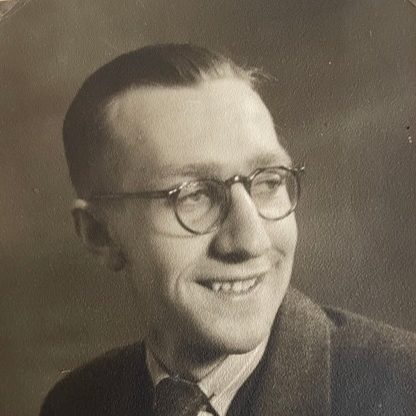
Wim Boxhoorn