
Who was Nita really?
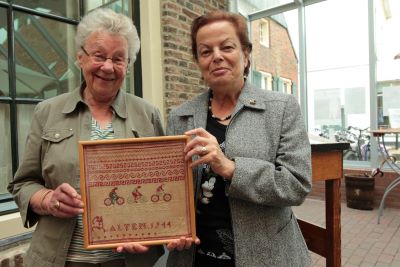
Presentation of the sampler of ‘Nita Visser’ (Anita Waisvisz) to the National Museum of Hiding and Resistance in 2010.
Niece from Suriname
In September 1942, eight-year-old Anita Waisvisz joined the family of widow Hendrika (Riek) Heinen-Rots in Aalten. Although Riek had been raising her three young children alone on a meager pension since her husband’s death in 1934, she did not hesitate for a moment to take in the Jewish girl.
To deceive the outside world, Anita was presented as a Surinamese niece who could not return home due to the war. She was fully embraced by the family and became inseparable from her ‘brother’ Henk and ‘sisters’ Dien and Annie. Her own sister, Elizabeth, was in hiding elsewhere.
Living under the same roof as the enemy
The circumstances in the Heinen household were far from simple. In the final phase of the war, the situation became life-threatening when two German soldiers were billeted in the house. Despite the enemy’s presence and the fact that Anita had a clearly Jewish appearance, Riek kept her safely hidden. In addition to Anita, Riek also provided shelter to two Dutch men evading forced labour (Arbeitseinsatz) in Germany.
The sampler of ‘Nita Visser’
During her time in hiding, Anita attended the Wilhelminaschool. During needlework lessons, she embroidered a sampler to demonstrate her skills. However, it was not her own name that featured on the cloth, but her codename: Nita Visser.
A tragic message
One day, Anita was visited by her sister Elizabeth with heartbreaking news: their parents had been murdered by the Nazis on 28 May 1943. Her father perished in Sobibor and her mother in Auschwitz. As she was now an orphan, Anita remained with the Heinen family until 1947. Two years after the liberation, she was placed in the care of a Jewish organisation, eventually immigrating to Israel in 1950.
Recognition and lasting friendship
The bond between the foster family and Anita lasted for the rest of their lives; until the passing of ‘sister’ Dien in 2019, they maintained weekly telephone contact. For her extraordinary courage, Hendrika Heinen-Rots was recognised by Yad Vashem as ‘Righteous Among the Nations’ in 1982. In May 2010, Anita donated her unique sampler to the Nationaal Onderduikmuseum.