
Karel Deur
(Brielle, 1918)
Member of the 1st Company DNB
Meeting in Aalten during the Hunger Winter, married in military uniform in 1945
Otto Karel Theodoor (Karel) Deur was born in Brielle on 11 August 1918, the son of Willem and Maria Deur-van der Heul. After technical school (woodworking), he received a summons for compulsory military service. At the start of the war, he was a sergeant major in the service of the Dutch armed forces. After the capitulation, all Dutch servicemen were sent home. Karel then went to work in his father’s tailor shop.
When all non-commissioned officers were called up by the occupier to report themselves on April 29, 1943, Karel went into hiding in the Achterhoek and joined the resistance. First, he stayed with the family of Bernard and Drika Colenbrander at ‘de Kuene’ in Heelweg-West, Varsseveld. This family had eleven children, and there were also seven Jewish people in hiding and resistance fighters in the house. His second hiding place was with the Korten-Koskamp family at the De Woerd farm in the hamlet of IJzerlo near Aalten. Hidden here were a police officer from Aalten plus young men who did not want to work in Germany.
At the end of 1944, Karel Deur became a member of the resistance group De Bark, named after the old farm on the border of IJzerlo and Dinxperlo. In the severe winter of 1944-1945, the group of ‘Barkianen’ practiced with weapons here. De Bark was located 200 meters from his hiding place.
During the Hunger Winter, Karel met Rie Vermaas. She was born on June 19, 1922, in The Hague. She had walked to the Achterhoek with her sister Annie. They, too, were taken in by the Korten family. It was not long before Rie began doing courier work for the resistance group. In this way, contact was maintained with other resistance groups in the area. At the end of February 1945, the group left De Bark and prepared for the approaching liberation at three different locations.
During the Easter period of 1945, Karel sat at the sewing machine at the Korten farm, stitching together one blue overall after another for the Home Forces, combat section.
Shortly after the liberation of Aalten in mid-April 1945, Karel and Rie were incorporated into the army corps of the Canadian liberators. Rie was a member of the staff of Commander Bob Krul. Karel was a member of the first company, under the leadership of Company Commander Jan Ket (who had previously commanded the resistance group De Bark). There were dangerous moments when the men did not know whether they would be fired upon when approaching a farm in the Betuwe. Should things become difficult, they had to fire red flares so that the Canadian army could determine their position. At night, Karel often went on patrol.
Between Bunschoten and Spakenburg, the company experienced the capitulation. On 5 May, many photos were taken! Subsequently, they had to guard the check-line between Amersfoort and Woudenberg.
Karel Deur was designated to follow a training course at the Cadre School in Hengelo, Overijssel. The lessons were given by British and American instructors. After this tough training, his rank was sergeant major instructor. Following this, he was transferred together with Jan Ket to Blerick in Limburg and subsequently to Roermond. The DNB staff was also moved to Roermond. They worked for the Mine Disposal Service, which had been founded in 1944.
Karel and Rie married on 22 August 1945 in The Hague. They also went to live there. Two daughters and three sons were born in The Hague. Karel worked for the Dutch armed forces until approximately May 1947. After that, he worked at the Tax and Customs Administration. In 1959, the move to Ede followed. After the war, Karel and Rie always maintained contact with the Korten family. Contacts also remained with a few members of the resistance group (Jan Ket, Geert Vos).
Within his family, Karel preferred not to talk about the war years anymore. His opinion was: “We did what had to be done.” Then he would fall silent.
Karel Deur passed away on 8 December 1988 in Ede. Rie passed away on 10 July 2013 in Ede.
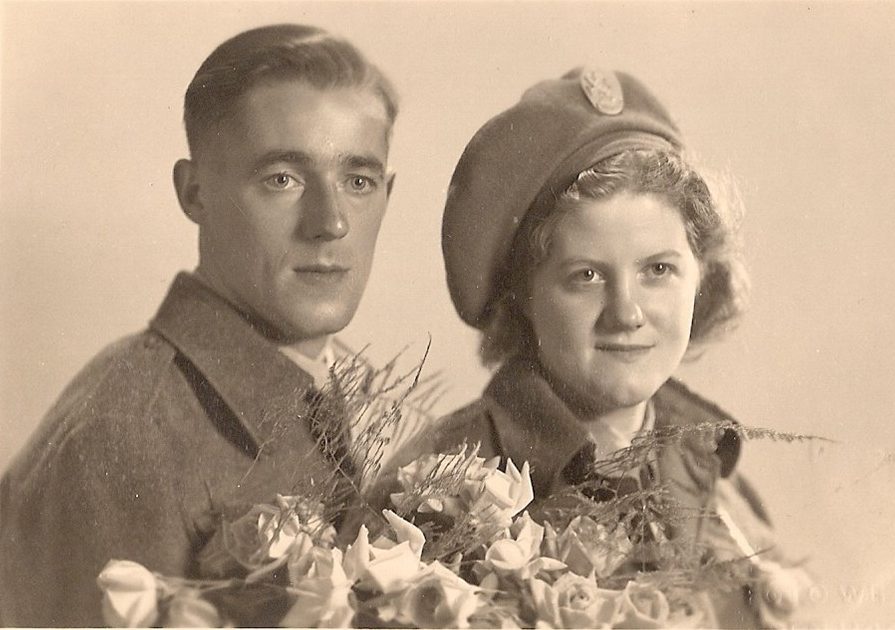
Karel Deur and Rie Vermaas