
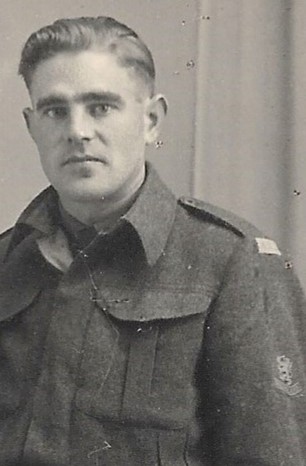
Jan Vaags
(Aalten, 1920)
Member of the 1st Company DNB
When Aalten was liberated on Good Friday, March 30, 1945, Jan immediately reported to the Dutch National Battalion
aren’t Jan (Jan) Vaags was born on August 24, 1920 in Aalten at the address Lintelo 24, farm “Voorst” (later Tammeldijk 1). He married Elisabeth Johanna Geertruida (Lisa) Lensink of the Groot Doornink farm, Lintelo 46 (later Sondernweg 8) in Aalten (1924-2010). From farm “Voorst” you can almost see the Groot Doornink farm. Lisa was a sister of Jo Lensink, who kept a diary together with Bernard Fukkink when the DNB joined forces with the Canadian fighters.
The outbreak of war
At the beginning of 1940, the Vaags family had seven children, two of whom no longer lived at home. The eldest daughter, Hendrika Johanna, was married in the meantime and son Hendrikus Johannes was stationed in Indonesia as a soldier. For the family, the war began with a lingering drama: Hendrikus died in Indonesia in August 1941 from the effects of asthma. Due to the lack of communication during wartime, the exact dates could not be traced at the time; It was not until 1949 that the authorities officially confirmed his death.
When the Second World War broke out in the Netherlands, 19-year-old Jan was stationed in the Frisian Kornwerderzand as a conscript. This was the only place in Europe where the German Blitzkrieg was brought to a halt. The position bravely held out, but due to the general capitulation of the Netherlands, Kornwerderzand was eventually forced to surrender. After the surrender, Jan is said to have helped to dump trucks in the harbor, to prevent the Germans from confiscating them.
According to the information about Kornwerderzand, the Dutch soldiers were briefly taken prisoner of war. Around May 30, 1940, Jan returned home, where he initially helped on the farm. After some time he started working as a driver at the timber merchant Te Paske in Aalten. That was convenient because he then received an Ausweis and did not have to report for the Arbeitseinsatz.
But on September 5, 1944, the tide turned, the day that would go down in history as Mad Tuesday. When the message was spread on the radio that the Allies were continuing the advance, celebrations were held in many places and flags were raised. NSB members fled because they were afraid that they would be taken by the Dutch. But it soon became clear that the advance had failed miserably. The obligation to report for the Arbeitseinsatz was also intensified.
Hiding and resistance
Jan could no longer fall back on his Ausweis. Everyone had to report for the Arbeitseinsatz. Together with his brother Albert, he went into hiding in the hiding place of the Vaags family in the adjacent forest as soon as danger threatened.
Jan joined the resistance and helped with the weapon drops in the Goor and with their transport. According to his son Jan jr., his father was familiar with resistance fighters such as Lembert Wiggers, who was involved with De Bark , and he also knew Jan Ket and Kees Ruizendaal.
The Dutch National Battalion (DNB)
When Aalten was liberated on Good Friday, March 30, 1945, Jan immediately reported to the Dutch National Battalion. He was assigned as a driver to the 1st company, a unit that consisted largely of local people from Aalten and former people in hiding.
On May 6, 1945, Bunschoten was liberated. A number of DNB members went to church there and drank coffee. Jan and a number of comrades are photographed with three Bunschoter ladies in traditional costume.
On Monday, June 11, 1945, Jan was involved in an accident with the truck he was driving. The truck transported a number of people to the cadre school in Hengelo (O) and a number of people on leave from Aalten. In a bend in the road near Bathmen, the left front tire burst, causing the vehicle to collide with an English truck. In this accident the cook of the 1st company, H. Wiggers from Aalten, was killed. A few people were also injured, namely J.M. Peppelman, L. ter Vrugt and P.S. Wildschut.
J.M. Peppelman later became brother-in-law of Lisa Vaags, when he married a stepsister (in Bokkel) of Lisa. Jo Lensink wrote about it in his diary: “At about eleven o’clock we were inside, where we heard that another car accident had happened. Several boys were in the hospital: concussion, broken legs, etc. I tried to get to J. Vaags who had ridden, but I was advised against it. So I just wanted to wait until the other morning.”
It is not known whether Jan Vaags has signed. Jo Lensink did sign up and went to Knokke on 30 July 1945 where he joined the mine clearance service. The DNB was dissolved on 12 July 1945 and those who signed up then fell under II-8 R.I. (second battalion of the 8th Infantry Regiment).
After the Liberation
Jan married his Lisa on August 20, 1948 and together they started a family with four children. Experiencing the war had no demonstrable influence on the functioning of the family. Jan Vaags visited the reunions of the DNB, most recently on 24 April 2009 in De Harskamp. Jan Vaags died on November 6, 2012, more than two years after the death of his wife Lisa.
Jan Vaags