
Jan Somsen
(Aalten, 1920)
Member of the 1st Company DNB
Military and Resistance Fighter in the Second World War
Arent Jan (Jan) Somsen was born on 18 May 1920 and grew up on farm ‘De Snieder’ in Lintelo as the son of Frederik Jan (Freek) Somsen and Hendrika Wilhelmina (Drika) Tammel. He had a sister, Riek. The family lived together with an aunt on the farm. Jan was friends with his cousin Henk Somsen, who lived on a neighbouring farm.
In 1940, shortly before the outbreak of the war, Jan was called up for military service. As a farmer’s son with experience with horses, he was assigned to the Hussars of the 4th Depot Cavalry and trained as a motorcycle orderly. He was stationed at the Alexander Barracks, near the Waalsdorp camp in the dunes between Scheveningen and The Hague.
The German Invasion and the Battle of The Hague (10 May 1940)
On 10 May 1940, the Netherlands was unexpectedly attacked by German troops. Jan experienced this firsthand: In the early morning, he saw German aircraft fly overhead, and his barracks were bombed. In a letter to his family, he wrote about the chaos and panic that ensued. There were many casualties in his unit: three corporals and 63 Hussars lost their lives, while 150 others were wounded. The bombings destroyed the stable complex, and more than 100 cavalry horses had to be put down. Jan himself survived and remained in the barracks for another three weeks before he was allowed to go home.
Going into Hiding and Resistance
In the course of the war, the Somsen family became increasingly involved in the resistance. From 1943 onwards, they provided shelter to six fugitives on farm ‘De Snieder’, including a Jewish man and several young men who wanted to evade the Arbeitseinsatz. The farm became a meeting point for resistance cells, and church services were even held there.
Jan actively joined the underground resistance in Aalten in the final phase of the war. He helped collect and transport weapons that were dropped by the Allies in the Achterhoek. Operating from farm ‘Spölman’ in Lintelo together with a small resistance group. One of the leaders of this group, ‘Zwarte Jan’, organised the distribution of the weapons, which were hidden under straw and spread across the region to arm the local resistance groups.
Fighting and Risks
Work in the resistance was dangerous. In a confrontation with German military personnel at farm ‘Meihuis’, a resistance fighter, Herman Huinink, was fatally shot. Jan and his comrades had to fight their way to safety while the Germans laid smoke screens to escape. Eventually, the Germans were captured by the resistance group. Jan was one of the bearers of Huinink’s coffin at his funeral on 4 April 1945 in Aalten.
Liberation and DNB
Jan Somsen was appointed as succeeding group commander of the combat section of the Binnenlandse Strijdkrachten (BS) after the liberation. He received a blue overall with an orange armband as a uniform and joined the Dutch National Battalion on 15 April 1945.
Recognition and Legacy
After the war, Jan Somsen received a medal and certificate on 6 May 1946 as recognition for his efforts in the liberation of the Netherlands, presented by the Dutch National Battalion and the First Canadian Corps. These commemorative pieces hung for years in the front room of farm ‘De Snieder’.
Jan rarely spoke about his experiences after the war. He visibly struggled to talk about the atrocities and dangers. Only later did documents, letters, and photos surface that shed light on his contribution to the war. His son Erik Somsen later put these memories on paper.
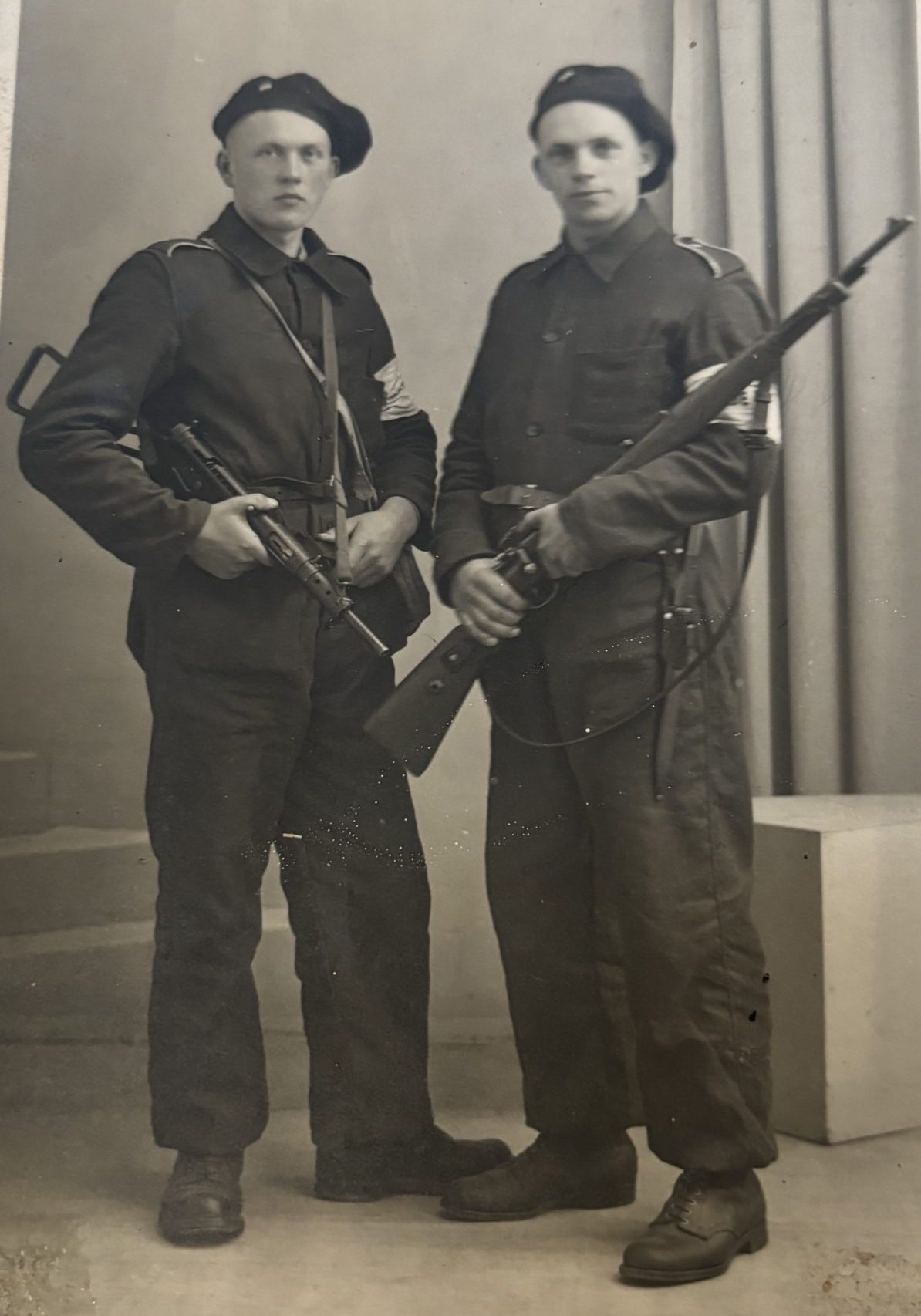
Jan Somsen and Henk Westerveld