
Jan Snijders
(Barendrecht, 1908)
Member of the 1st Company DNB
He marched with the Canadian Army over the Veluwe
Jan Snijders was born on 18 August 1908 in Barendrecht as the son of Jan and Elizabeth Snijders-Koedood. He has an older brother and two younger brothers. On 2 March 1938, he married Catharina van Zwoll in Rotterdam.
Summer 1945, he lives at the address hamlet Dale No. 54 municipality Aalten. That is the farm of the Ebbers family on “de Steeg” at the Romienendiek. He is also often found at the Bongen family on farm ‘de Riete’ and at the Veerbeek van Timpert family in Dale. On the Riete, Cent Liefhebber from Ridderkerk and Chris Hoek from Rotterdam are in hiding; they come from the same area.
After the occupation by the German army, he assisted the Rotterdam police from May 1940 to October 1940, operating from the Citizen Guard. He was a police auxiliary officer from May 1942 to 12 March 1944. He refused to follow the police training in Schalkhaar. In the Westenberg Barracks, Dutch police officers were trained under German supervision over six months in the ideology of the SS, after which the officers were added to regular corps. Thus, the occupier tried to gain more control over the Dutch police apparatus. Snijders did not want to cooperate with that.
On 14 March 1944, Jan Snijders went into hiding in Aalten, after receiving the order to guard a German military post. He joins the group of illegal workers, performs courier duties, and arranges transport for Dutch people who fled from Germany.
Binnenlandse Strijdkrachten and DNB
From September 1944, he is a member of the Binnenlandse Strijdkrachten. After the liberation, mid-April 1945, he becomes a member of the 1st Company of the DNB and marches with the Canadian Army over the Veluwe.
The local commander of the Dutch Binnenlandse Strijdkrachten notes in July 1945 that Jan Snijders is ill. He has shortly before marched with the Canadian Army over the Veluwe. Snijders has told him that before the war he worked as a police auxiliary officer in Rotterdam. Afterwards, he worked as manager of the work camp “de Schaapskooi” in the dunes of Rockanje in the years 1937, 1938, and 1939. There was space there for a hundred young men, who among other things had to dig the Breede Water and the Quackjeswater.
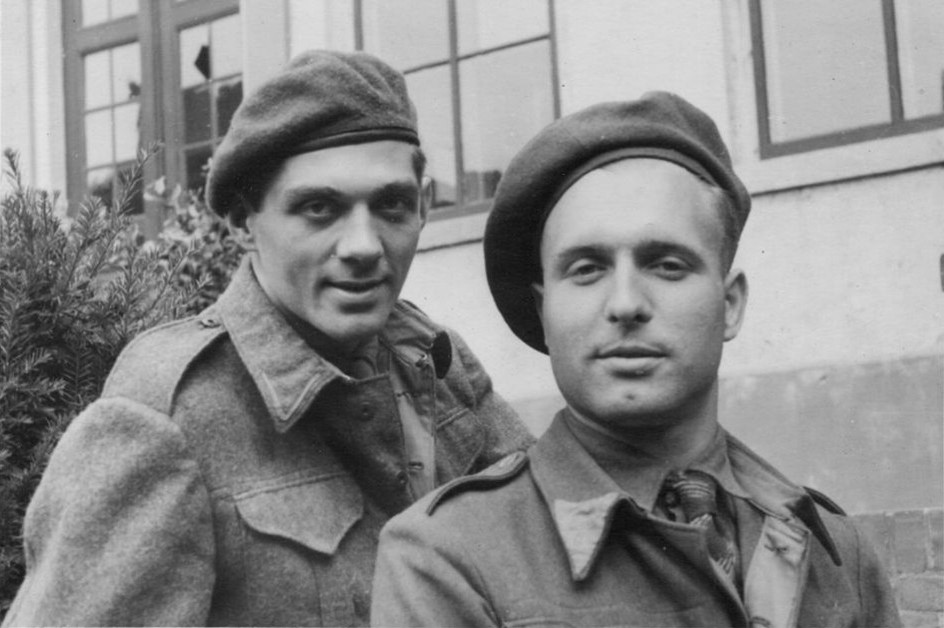
Hans Renshof (left) en Jan Snijders, June 1945