
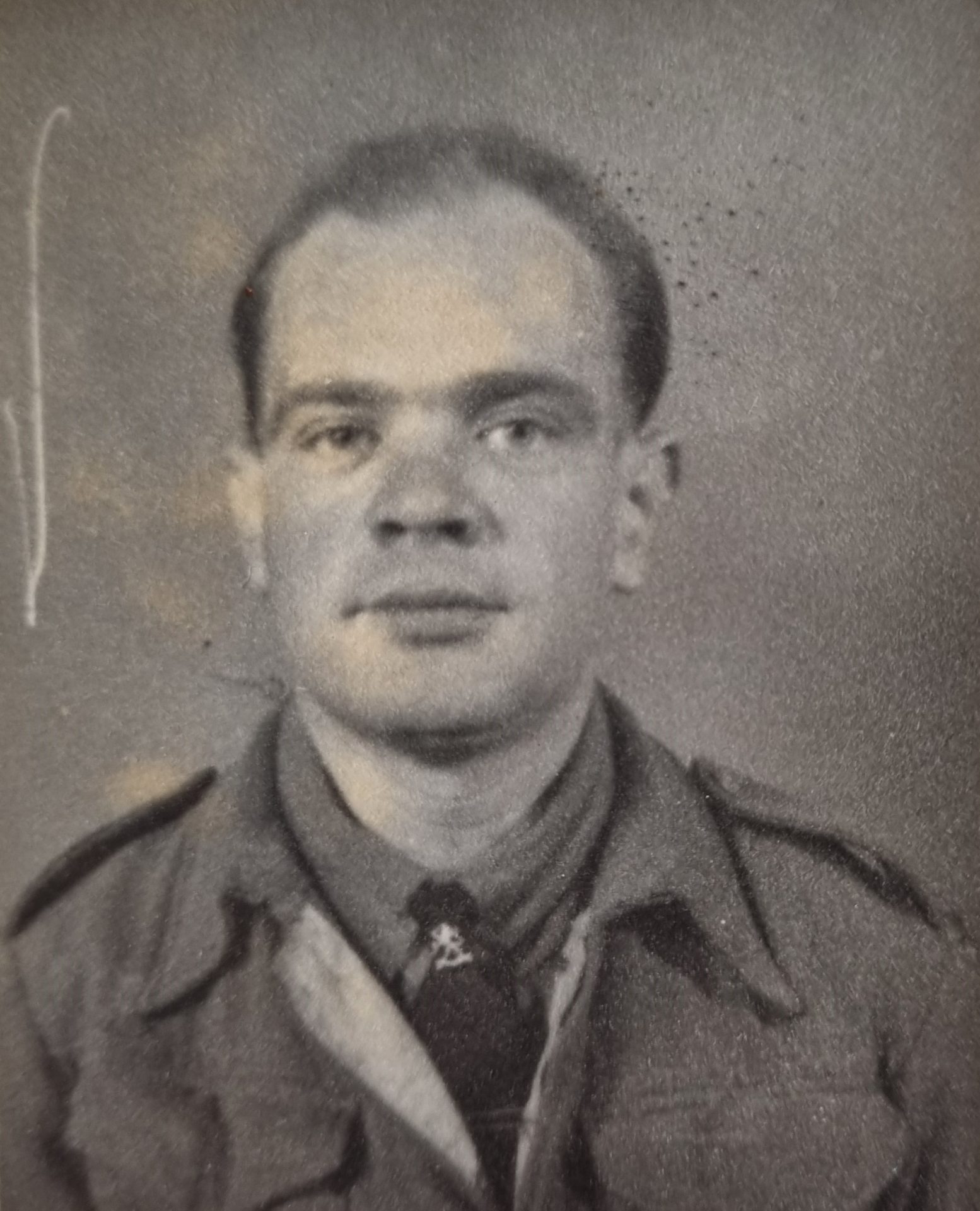
Jan Arink
(Beltrum, 1919)
Member of the 3rd Company DNB
He never forgot how prisoners of war, in particular, led the way during mine clearance
Johannes Gerhardus (Jan) Arink was born in Beltrum, in the municipality of Eibergen, on 7 March 1919, as the eldest son of Jans Arink and Trui Meddeholt. It was the second marriage for his father, who was a farmer at the ‘Mentink’ estate in Beltrum and a clog maker. Jan’s eldest brother, Johannes H. (Hendrik) Arink, born in 1910 from his father’s first marriage, was called up for mobilisation in 1939. When the Dutch army lost the struggle against the occupier in May 1940, Hendrik was taken prisoner of war and transported to Kamp Neubrandenburg. He returned home in June. This event left a profound impression on the family. Another brother, Bernardus J. (Bernard) Arink (born in 1914, also from the first marriage), went into hiding during the war on a farm in Zwillbrock, a hamlet in the German town of Vreden.
When Jan, like other soldiers, was ordered to report himself again in 1943, he went into hiding. He wandered from farm to farm, as hiding at home was not an option. He was constantly on the run from the occupier. While his brother Bernard was already in hiding elsewhere, Jan’s parental home did shelter other people in hiding.
In 1944, Jan Arink became a member of the Interior Forces (Binnenlandse Strijdkrachten), the combat section of Eibergen. After the liberation of Eibergen and the surrounding area, he joined the third company of the second battalion of the Dutch National Battalion in mid-April 1945, holding the rank of Private First Class. When the DNB ceased to exist in July 1945 and the men of the 3rd company were offered a one-year contract to join the Dutch Army, Jan Arink signed on. He entered service with the 3-II-8-R.I. unit.
The Netherlands was littered with mines and unexploded bombs, estimated at 120,000 tonnes. In the meantime, the Disposal and Mine Service had been established. The work was chaotic and merely a drop in the ocean. Arink underwent training for mine clearance in Belgium. Afterwards, in Roermond, he supervised the work and primarily guarded the captured German soldiers, who were deployed and forced to lead the way. Jan realised that the mines had been placed by the occupier during the war, but he struggled deeply with the fact that it was primarily the German prisoners of war who ran the risk of losing their lives.
Jan worked for a contracting firm named “Foeke,” and later at the Wire Factory in Beltrum. In 1951, he began working at NEDAP in Groenlo, remaining there until his retirement. Additionally, he ran a farm at Beerninkweg 24 in Meddo. His brother Hendrik took over the parental farm. Jan married Anna Margaretha Luttikholt (1925–1976) in a civil ceremony on 18 January 1951 in Eibergen, followed by a church wedding on 26 April 1951 in Beltrum. They had five children: two sons and three daughters.
Jan Arink passed away on 29 March 1996 in Meddo, municipality of Winterswijk.
Jan Arink