
Jaap and Fien’s War Diary
In 1942, Jacob (Jaap) Weijel (1916–2004) and Fientje Aleng (1918–2011) were married in Amsterdam. It was one of the last Jewish marriages that could be performed at the registry office in the capital. Shortly thereafter, the German occupation forced the young couple to make a radical choice to escape deportation.
Going into hiding in Haart
Jacob’s father, the Aalten cattle trader Joseph Weijel, approached Jan Berend Drenthel to ask if his son and daughter-in-law could go into hiding. Drenthel, a widower living with his children on the ‘Nieuw Drenthel’ farm in the hamlet of Haart, agreed after consulting with his family. It was a risky decision; hiding Jews carried the death penalty. On 10 September 1942, Jaap and Fien arrived in Aalten by train.
Life on a few square metres
What began as a request for a few weeks turned into a stay of nearly three years. The couple were given a room measuring two by three metres. Jan Berend Drenthel gave up his own bed for this and slept in a bed niche from then on. In late 1943, Fien’s brother, Miel Aleng (1923–2008), joined them. Three adults shared the small space and the 1.20-metre-wide bed.
The transition from social and cultural life in Amsterdam to isolation on the farm was immense. The people-in-hiding had to remain invisible at all times and eat whatever was served. Conditions were harsh: it was extremely cold in winter, and the threat was constant, especially when SS men and later fleeing NSB members (Dutch Nazis) were billeted at the farm.
A chronicle of monotony and fear
To withstand the psychological pressure and monotony, Jaap and Fien kept a joint diary. They took turns every two weeks as writers to keep the recording varied. In total, they filled about 870 pages; a chronicle of 933 days in isolation. The diary provides an insight into the dilemmas and difficult situations faced by people who become dependent on each other and try to “make the best of it” together.
The fragments alternate between the daily routine and moments of raw fear, such as fleeing headlong through a window to spend the night in an icy ditch in the fields during raids. Besides the fear, the notebooks show a moral development: the initial detachment gradually gave way to deep admiration for the Drenthel family, who risked their lives daily for their guests.
Recognition and handover
Following the liberation on 30 March 1945, Jaap, Fien, and Miel returned to Amsterdam. Jan Berend Drenthel, who died in 1958, rarely spoke of his role after the war. In 2022, he was posthumously honoured by Yad Vashem as ‘Righteous Among the Nations’.
The original diaries are held at the NIOD Institute for War, Holocaust and Genocide Studies. To keep the story alive locally and for the family, Carry Kuling-Aleng (Miel’s daughter) and her husband Aad digitised the texts and compiled them into the 350-page book ‘Ondergedoken’ (In Hiding).
In 2021, this tribute to the will to survive and the assistance provided by the Drenthel family was officially handed over to the Nationaal Onderduikmuseum in Aalten. During an emotional gathering, the descendants of both the people in hiding and the Drenthel family who were present emphasised the significance of this donation. A family member put it poignantly:
“The Nazis wanted to destroy us Jewish people, but as you can see, in our case, thanks to the Drenthel family, they did not succeed!”
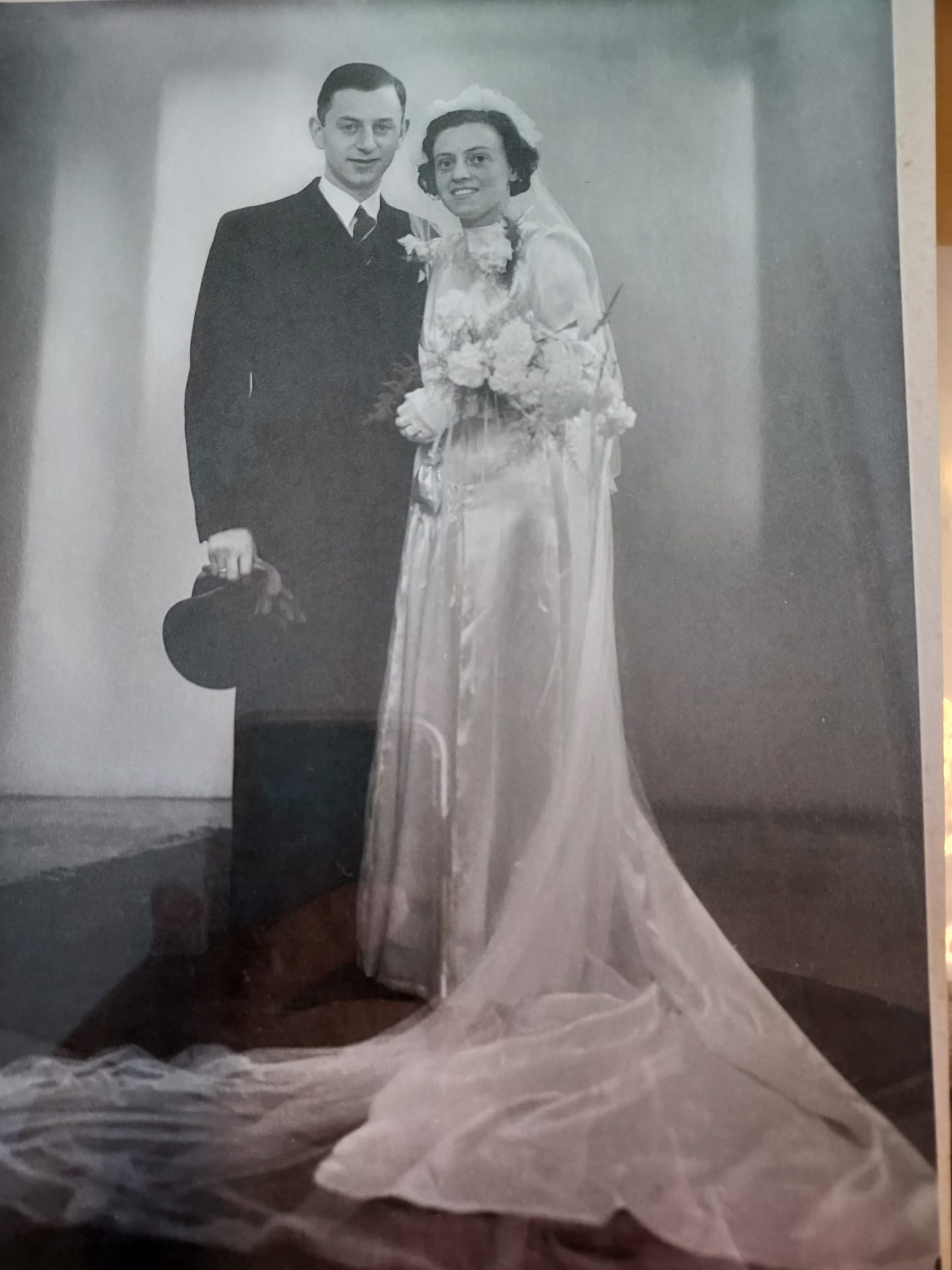
Wedding photo Jaap Weijel and Fien Aleng