
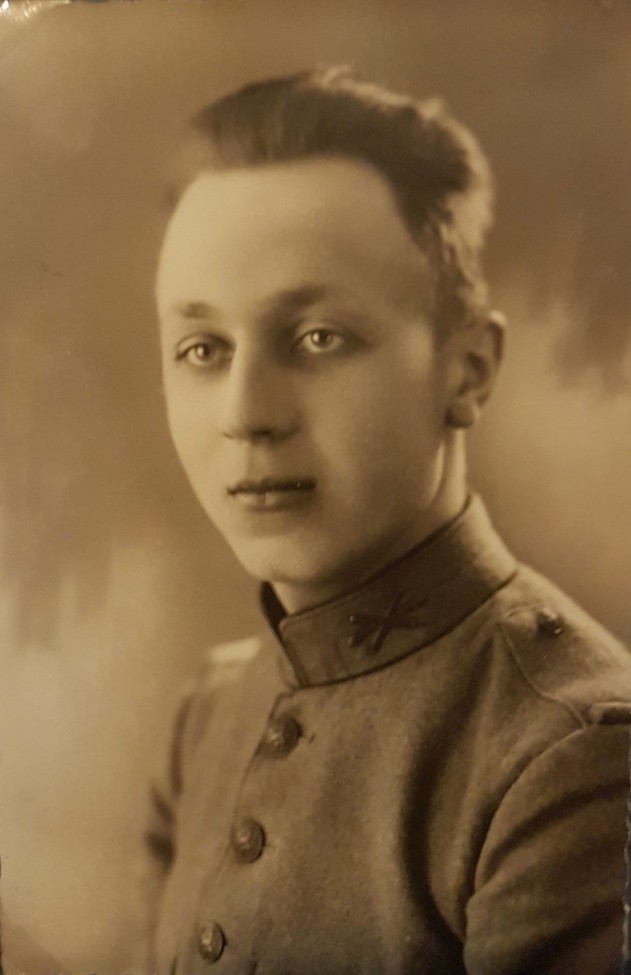
Herman Wisselink
(Eibergen, 1918)
Member of the 3rd Company DNB
A fugitive on both sides of the border
Herman Wisselink was born on 28 December 1918 in Eibergen. There is little written record of his time in hiding. He stayed in a neighbouring municipality, and his family did not speak about him with others, for everywhere betrayal lurked. Herman was sought by the Germans. There were frequent raids at his family’s home with the question: “Where is Hermann?” His (second) father Berend would invariably reply: “The boy has been gone for so long already. If you can tell me that, please do, because I don’t know either and could go looking for him!” After the war, it became clear at least that Herman had made things difficult for the occupier, was part of the resistance group around Donselaar, Olthof and Bosklopper. But he never told much about it.
Herman was a clever boy
Herman was born one year after his parents Gerrit and Hendrika Wisselink-Hamersteen married. His father died already in May 1920 of pneumonia. Herman was then only a year and a half old, and his brother Gerrit still had to be born. Herman’s mother remarried a year later to Berend Hendrik Boomkamp, a half-brother of her husband Gerrit. Boomkamp moved in with her on the farm, which later received the name Erve Wisselink.
At primary school it soon became apparent that Herman had a gentle character, was very quick to understand, and could learn very well. He was indeed interested in agriculture and everything that came with it, but would rather become a teacher. After the middle school (ULO) and teacher training college, he stood – nineteen years old – already before the class of his former primary school, the Willem Sluijterschool in Eibergen. His much younger sister Dina attended his lessons there at the time. She keeps very fond memories of her dear brother.
Herman must go underground
Herman was called up for mobilisation in 1938 and served as a sergeant in The Hague. He survived the fighting with the Germans in May 1940 and was a prisoner of war for a period. He was released but had to go underground some time later due to the Germans’ order for all Dutch soldiers to report themselves. He went to his family Boomkamp on farm Broekmans in Winterswijk, close to the 300-metre road along the border. The family consisted of uncle Albert and Dina Boomkamp-Mateman with their son Johan (four years younger than him) and daughter Leis.
The farmstead lay completely secluded in the hamlet of Woold near the border. Danger also lurked there and there were raids. At signs of trouble, Herman ran across the border in good time to the neighbours Braokman, real neighbours in Germany with whom there was a good relationship. Their fields and meadows lay adjacent, with the border as the line between them. From the summer of 1943 onwards, Herman stayed permanently with the German family Braokman, also called Hof van Brake in Barlo (Germany). With this, this family took a great risk. Braokman had two sons Beernd and Gerhard, who had to serve in the Wehrmacht. They fell, for nothing was ever heard of them again.
Political career
At the end of the war, Herman became a member of the Binnenlandse Strijdkrachten (Internal Forces), Eibergen section, a group of about 35 men. On Liberation Day, he entered Eibergen as one of the first, riding as a guide on a tank. He was part of the 3rd Company of the Dutch National Battalion that moved with the Canadian Army to liberate the Veluwe and the Betuwe between mid-April and mid-July 1945.
Herman Wisselink died on 11 March 1995 in Bathmen.
Herman Wisselink