
Hans Renshof
(Bredevoort, 1919)
Member of the 1st Company DNB
From resistance fighter and member of the DNB to police investigator.
Hans Renshof was born on 27 November 1919 in Bredevoort as the only son of municipal constable Antonius Renshof and Gerdina Voordes. In the autumn of 1920, the family moved to Winterswijk. At sixteen, Hans began working as a clerk at the Willink textile factory and entered military service a few years later.
During the German invasion in May 1940, he fought at Valkenburg airfield. While dozens of his comrades-in-arms were killed, Renshof survived the battle. Upon his return, however, he was no longer welcome at his former employer due to the regulations in force at the time.
Constable in the resistance
In September 1940, Renshof joined the police force in The Hague. Following the appointment of an NSB commissioner there, he applied for the position of municipal constable in Aalten. On 1 August 1942, he was appointed there simultaneously with Kees Ruizendaal. At the border, he worked as a municipal constable alongside customs officers Jan Ket and Jaap Allersma.
There were regular consultations with Mayor Monnik and LO leader Jan Wikkerink regarding the stance the police should take in serious situations. The commander of the Marechaussee in Gelderland was by then an NSB member again, namely Colonel Feenstra. From the summer of 1943, Renshof participated in the so-called ‘warning snowball system’ when a raid was announced.
In hiding and ‘De Bark’
In early December 1944, he went into hiding with the Fries family on the Dijkstraat. He was treated as one of the family and participated in the resistance together with the sons, Jacob and Dick Fries. His alias was ‘Zwarte Hans’ (Black Hans). At the request of Jan Ket, he joined the ‘Barkianen’ resistance group in early December 1944. During the first months of 1945, he spent much of his time at the headquarters ‘De Bark’.
At the end of February 1945, De Bark was evacuated, and the three sections dispersed to various locations in the area. Hans Renshof returned to the Fries family. On 24 March 1945, the Fries family’s house and barn were destroyed during a bombardment. After Dick Fries and Hans Renshof were dug out by Jacob Fries, Renshof found a new hiding place in the cellar of the local dairy factory.
Liberation and the Dutch National Battalion
When soldiers of the British Army, part of the First Canadian Army, arrived to liberate Aalten early in the morning on 30 March 1945, he was involved in the fighting as a member of the Barkianen. A day later, he resumed his police duties and, together with his colleagues, arrested several German soldiers. His commitment did not end there; as a member of the 1st Company of the Dutch National Battalion (DNB), under the command of Jan Ket, he actively contributed to the further liberation of the Netherlands.
After the war
In the summer of 1945, Renshof joined the Special Court of Justice (Bijzonder Gerechtshof) in Arnhem as a detective. There, he encountered many Nazi top officials behind bars, including Rauter and Christiansen. Among others, he interrogated Velle, the former NSB commissioner of Winterswijk and his own father’s superior in the Winterswijk police force.
In 1948, he returned to the Aalten Police Service at his own request. In 1959, he became deputy group commander of the National Police (Rijkspolitie) in Buren (Gld) and in 1962 a detective with the National Police in Nijmegen. At the end of 1979, he retired from the police force as group commander of the National Detective Agency (Rijksrecherche) in Nijmegen due to reaching the mandatory retirement age.
In the local newspaper, he stated:
“The population of Aalten as a whole deserves a mountain of decorations for what it did during the war. You won’t find a village like it anywhere else.”
Hans Renshof married Riek Gijsbers in 1946; the couple had three children. He passed away on 3 March 1991.
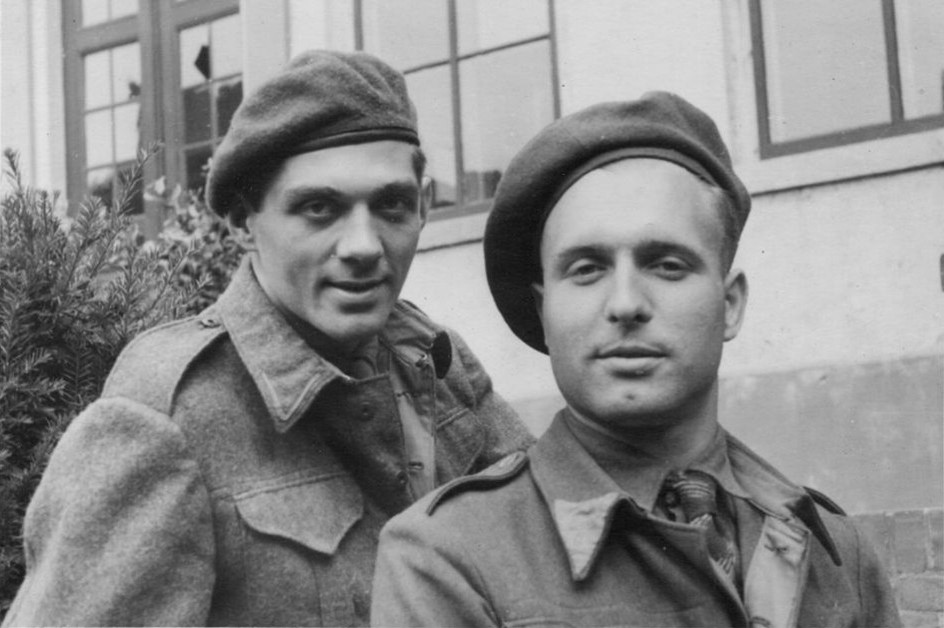
Hans Renshof (left) en Jan Snijders, June 1945