
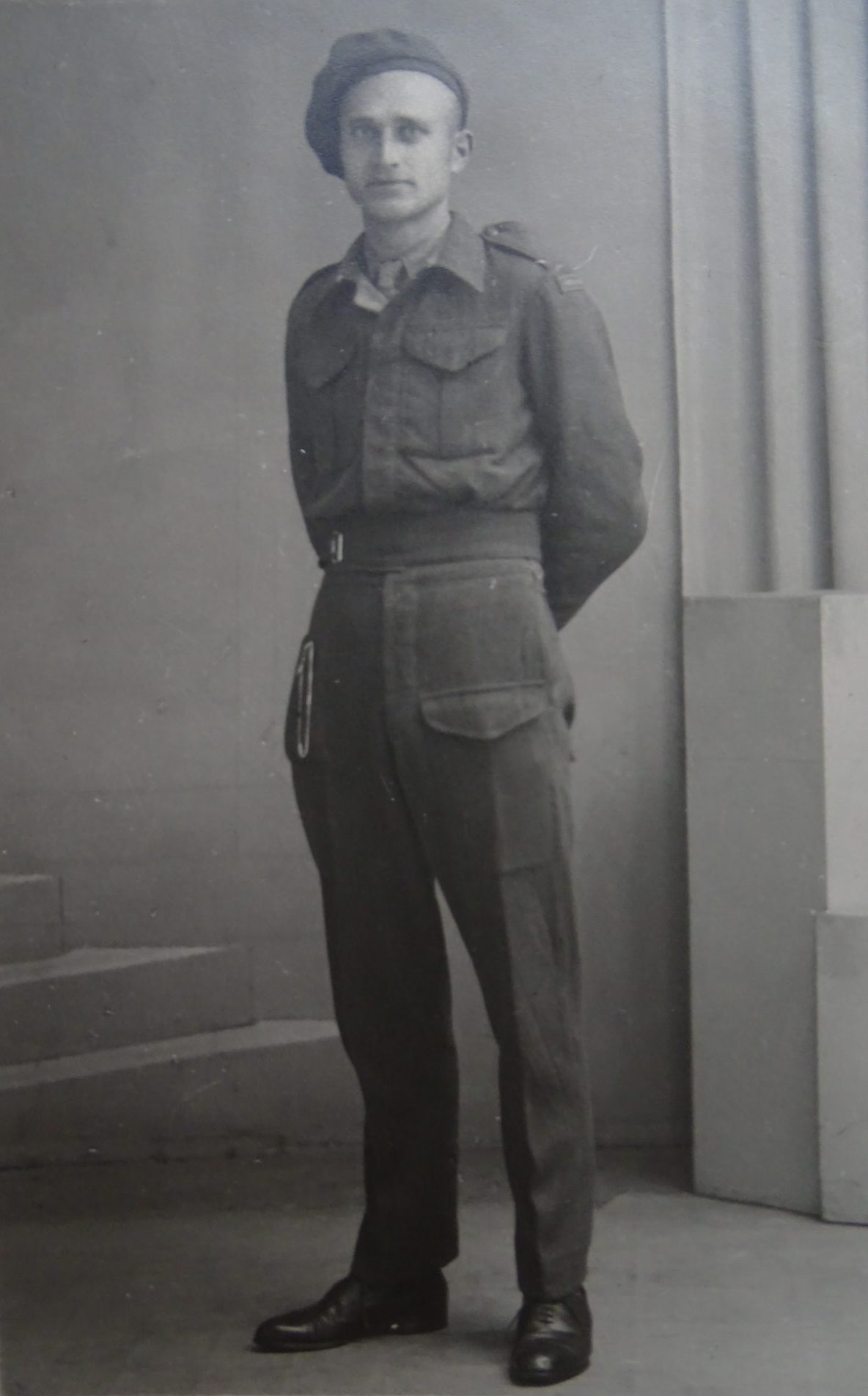
Bertus te Winkel
(Aalten, 1917)
Member of the 1st Company DNB
From resistance in Barlo to the liberation of the Netherlands
Bertus te Winkel was born on 7 February 1917 in the hamlet of Barlo near Aalten, as the son of Aalbert and Anna te Winkel-Bosman. His father, originally from Winterswijk, had bought a piece of wasteland in Barlo ten years earlier, on which he established his cement industry. A few years later, he had a farm/residence built nearby. He married Mina Wevers van de Haart in 1910 and after her death, Anna Bosman. Bertus was the eldest son in this second family and had four sisters and six brothers.
Joining the Resistance
During the war, Bertus joined the underground movement in the hamlet, which was formed by former military man Johan Onnink. Hendrik te Lindert from the Boschman farm had the leadership; about twenty men with their families were involved. Bertus, together with some friends of the same denomination, was invited to a meeting at baker Haverkamp on the Prinsenstraat in Aalten.
Thus, Bertus became increasingly involved in the resistance. The activities included housing (Jewish) people in hiding, refusers of the Arbeitseinsatz, and Allied pilots, as well as preparation for armed struggle during the liberation. This also included the transport of weapons that came from the weapon drop in the Aaltense Goor.
Service with the Dutch National Battalion
Two weeks after the liberation of Aalten, Bertus te Winkel joined the Dutch National Battalion (DNB). He mainly operated with his resistance friends from Barlo, the Te Lindert brothers and Johan Tolkamp from Klein Deunk. They had together performed significant resistance work during the war and now, having only recently experienced freedom, wanted to contribute to the liberation of the rest of the Netherlands. For Bertus, participation in the DNB was self-evident, also fueled by his earlier resistance activities. He reported to the BLO-school in Aalten and was assigned to the 1st Company.
After the war
In the first years after the war, everyone was busy with reconstruction, marrying, and having children. People wanted to forget the war as quickly as possible and did not speak about it anymore. After ten years of engagement, Bertus te Winkel married Mien Tolkamp in 1947, whom he had known all his life. The couple had a daughter and two sons. Bertus continued his father’s work in the cement business, while his brother Arnold took over the agricultural business. In 1991, Bertus ceased his business.
According to Bert Jr., the war had no noticeable influence within the family. The father was upright and integral, harboured no hate or resentment against the Germans, and also refused to use the word ‘mof’ (a derogatory term for Germans). Bertus took over the work of the concrete business.
In 1997, Bertus finally received the Wounded Badge (DIG). He died on 22 July 2004.
Bertus te Winkel