

Anne Reiring
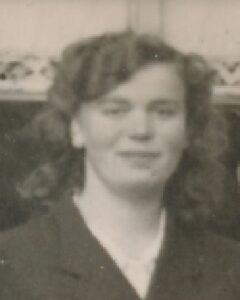
Anne Reiring in 1947
In 1940, Anne was fifteen years old and the second child of Johannes Reiring and his wife Gesina. The family of eleven lived on the Beusink farm in Dale. The farm became a sanctuary for those refusing forced labour, a Russian man named Iwan, and approximately 25 French refugees and airmen. Anne assisted the Lichtenvoorde ‘pilot line’, escorting French airmen to the railway station in Aalten. Everything always went well.
“At home, we already had two Dutch men in hiding, one of whom was from Gendringen. They would hide in the hay whenever danger threatened. Two days a week, I worked at the Esselink villa here in Dale. One day, I saw two boys in a small wood between the villa and our house; they had hung their clothes out to dry. ‘What is this?’ I thought. I told my father and he went to fetch them; they were given food and were allowed to sleep in our barn. They were French prisoners of war from the camp in Bocholt (Stalag VI F). They had got soaked during their escape.
Our man in hiding from Gendringen spoke foreign languages. He contacted the police and the underground. A few days later, the boys were collected from our home by the resistance. Later, the military policeman Kees Ruizendaal and members of the underground (Joep ter Haar and Wim Pampiermole from the Lichtenvoorde pilot line) came to us asking if we could take in a few more. We agreed, and so we took several more into our home.
I was asked to take them to the station in Aalten, which I did via all sorts of narrow back paths. Sometimes there were five, sometimes two, sometimes three. We walked as far as the Roman Catholic cemetery and then a short distance along the main road. It always went well. On that train from Winterswijk, there were people from the resistance; they would meet the foreigners and take them further. By the time I had already taken 15 to the station, another five arrived at the house. We must have had at least 23 Frenchmen in our home.
At the end of the war, we also had a family from Amsterdam and a family from Rotterdam staying here. The ‘Tommies’ were getting closer. We had 30 German soldiers billeted with us for several days. That happened to all the farmers in the area.
We had already had the Russian, Iwan – a prisoner of war who had fled from Germany – staying with us for some time, and he didn’t like it. He was used to hiding quickly at the first sign of trouble. But what now? Father said to Iwan: ‘You are our Uncle Herman and you are deaf and dumb’. Iwan said he was afraid, ‘viel Angst’. Father said: ‘There’s no need for that, it will all be fine’. He wasn’t allowed to open his mouth. He stayed with us for a while after the liberation. We slept in the air-raid shelter, but Father stayed in the house.
After the war, the newspaper came to interview Father. He said: ‘It is nothing more than our duty to help. If we were in such a situation, we would also want to be helped in this way’.”
A few years after the war, Johannes Reiring and his wife received a high French decoration, a commemorative medal. Father and Anne’s older sister went to Apeldoorn to collect the Médaille de la Reconnaissance Française: a pin and a certificate. Other people were decorated that day, including resistance members from Lichtenvoorde.
In 1985, airman Pierre Paput from the Loire region in France sent a photo of himself, his wife, and their two sons to the Reiring family. The son and daughters of the French soldier Jean Castro from the Pyrenees came to visit Anne as a surprise in June 2010.
Anne Klein Nijenhuis-Reiring passed away on 10 November 2020.