

A liberation with tears –
Bernard and Henk de Vries
Bernardus Marinus de Vries
2 April 1925 – 24 April 1945
Hendrik Willem de Vries
18 December 1931 – 5 April 1945
R.C. cemetery Bolwerkweg Bredevoort, 2nd row right grave 5
The de Vries family consists of father, mother and nine children. They live in a small house on the Hozenstraat in Bredevoort and have a meager existence. One of the sons, Bernard (born April 2, 1925), is forced to work in Germany. When the war reached a turning point in the course of 1944, Bernard decided to go into hiding. Although it is dangerous, he comes home every now and then. This was also the case on 1 September 1944. Mother asks him to dig up a bucket of early potatoes from the vegetable garden just outside the town. That’s where fate strikes. Master Wellink (father of Nout Wellink, former president of the Dutch Bank) sees how a landwachter arrests Bernard and takes him away. Nobody knows where to go. After the liberation on 30 March, the de Vries family was haunted by uncertainty about Bernard’s fate.
Five days after the liberation, April 5, the family suffers another fate. The 13-year-old Henkie is sent out to get milk in the hamlet of Corle, below Winterswijk. The road to Corle is crossed by the Slingebeek. Near the bridge (where the Twee Bruggen holiday park is now) there is still a lot of war equipment that was left behind by the fleeing Germans.
This has a great attraction for the boy and Henkie no longer thinks about getting milk.
A farmer on the other side of the stream sees Henkie working with a panzerfaust. He still shouts at him: “Please get rid of it, leave the rubbish lying around!” But it is too late. The grenade explodes and Henkie is killed.
The sadness is indescribable. Bernard disappeared without a trace and Henkie, badly mutilated, died. When the general liberation took place a month later, there was also a massive celebration in Bredevoort. Party arches appear. A party arch is also placed in front of the house of the de Vries family (how wry). For the family, it is a liberation with a tear.
At the end of May 1950, a document from the Red Cross arrives via the Municipality of Aalten. Only then did it become known that Bernard had died on 24 April 1945 due to hardships in the German Konzentrationslager Wöbbelin.
Wöbbelin
As early as April 1944, the Wöbbelin camp served as a reception camp for evacuation transports from Neuengamme subcamps. Due to inadequate and irregular food supplies, indescribably poor hygienic conditions and almost no adequate medical care, the prisoners died by the hundreds.
The camp was not finished. There were no doors in the barracks, no glass in the windows. There was only sand on the floor. There were no beds, but a kind of cages. There were no sanitary facilities, only a hand water pump. Some holes had been dug in the ground that served as a toilet. The camp was heavily polluted. The prisoners were covered in lice. There was hardly any food. Camp Wöbbelin would serve no more than 10 weeks. More than 5000 prisoners were housed in Wöbbelin. More than 1000 prisoners died during the short existence of the camp.
Sources:
This story was written after conversations with Bertus de Vries. (brother of the victims)
Research: Hans de Graaf and Louis Veldhuis
Website; War Stories Foundation – Concentration Camp Wöbbelin-Struthof
© Collection National Hiding Museum Aalten
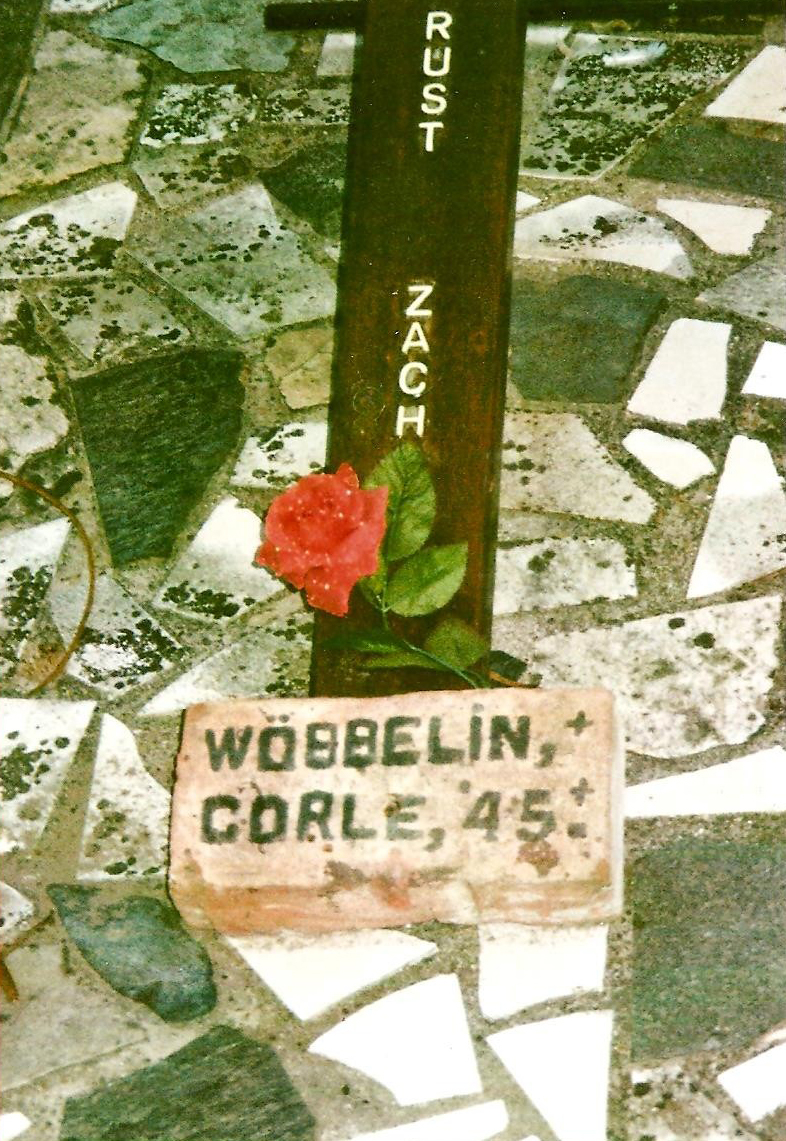
Memorial stone on the grave of Henk de Vries
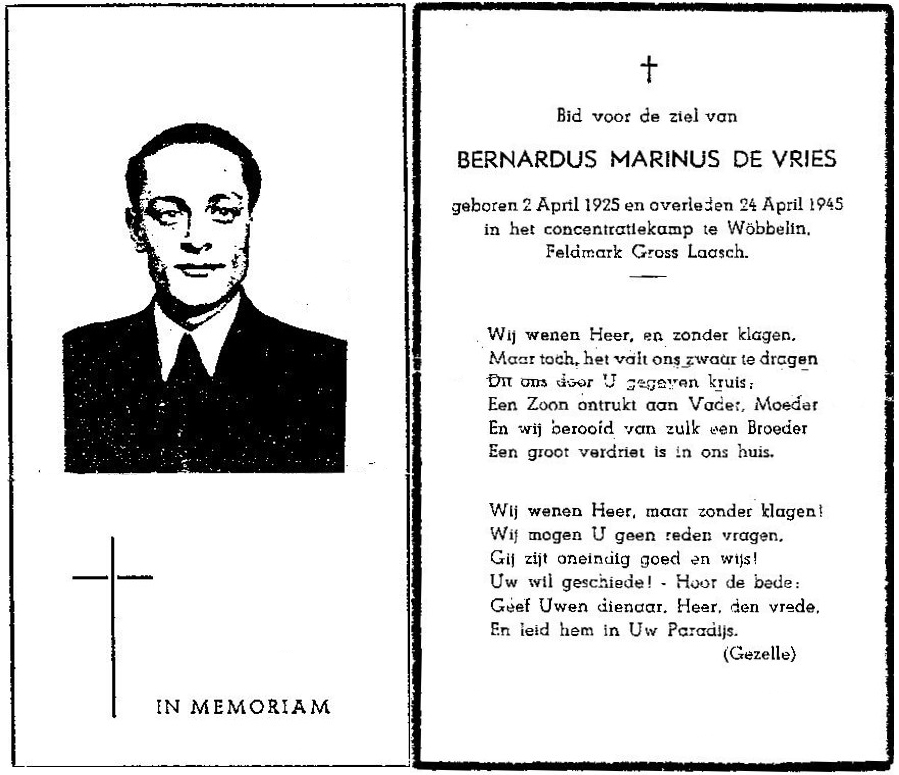
Funeral card Bernard de Vries
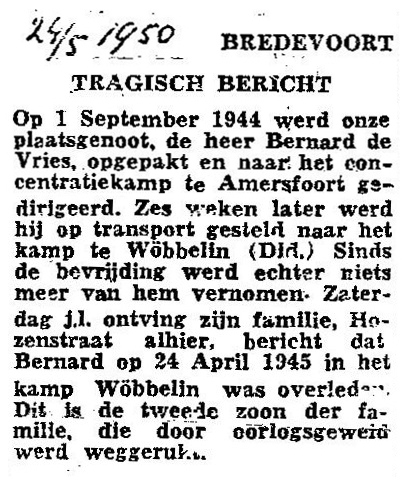
Newspaper report on the death of Bernard de Vries