

Bombing of Dijkstraat | 24 March 1945
On Saturday afternoon, 24 March 1945, shortly before the liberation, Aalten was hit by a heavy aerial bombardment. English bombers carried out an attack at approximately 13:30, with the factories on the Dijkstraat as the primary target. The destruction in the village was immense and the human suffering was profound.
On Saturday 24 March, planes suddenly dived shrieking over Aalten. Almost immediately, the whistling sound of falling bombs was heard. The factories on the Dijkstraat were the target. Part of the Driessen textile factory and its office were bombed. The Aaltense Tricotagefabriek (ATF) factory was also turned into a heap of rubble. From the bridge on the Dijkstraat to the railway line, houses were totally destroyed, while others sustained very severe damage. The consequences were horrific. There were at least eighteen or nineteen fatalities. The exact number remains unknown to this day.
At the house of blacksmith Umbach, the cellar where father Umbach (43) and three of his children (13, 10, and 5) were sheltering was hit by a direct strike. All perished. The mother of the family and another son narrowly survived by crawling under a table in the kitchen. A little further away, the couple Te Linde-Wechelaar (both aged 68) and their 40-year-old son lost their lives. At the Koelman residence, the father (55) and daughter (20) died. J.H.A. Tepe (50), M.C.J. Leemhorst (34), A. Lamers (73), S.J. Kamphuis (15), and J.H. van Mechelen (15) were also among the victims. Furthermore, three evacuees: C. van Ingen (79) and C.H. Stokking (25). In the Aaltensche Courant of 4 May 1945 and in the book Er op of er onder, three more victims are mentioned: M.J. Praster-Polman (28), Klazina Ros (38), and a certain G.A. van der Meulen (44).
There were also many injured. The emergency services of the Red Cross and Air Raid Protection had their hands full recovering the dead and pulling survivors from the rubble. Bombs also fell in the Boomkampstraat, Stationsstraat, De Wheme, Kerkstraat, Hofstraat, Hogestraat, Molenstraat, and Varsseveldsestraatweg. South of the railway line, buildings on the Parallelweg and Koopmanstraat were damaged.
Eyewitness account: Jan Klompenhouwer
An event that made a big impression was in the last week of the war: the bombing on Saturday afternoon, March 24, 1945 at half past one by English bombers. During the bombing we were in the shelter dug by my father and uncle Bernard. The neighbors, the Visser family, were also in our basement because there was groundwater in their basement. In retrospect, this was a good thing, because a bomb fell in their basement and nothing remained standing. At our basement, the first bomb fell exactly behind the basement and the next one exactly in front of the basement. Both entrances had collapsed. We had to be dug out.
There was panic and total desperation at that moment and also moments later, upon seeing the ruins of our house. As a child, you notice the emotions of adults. If they are in total despair, you as a child absorb some of that. My eldest brother Bertus was not in the cellar with us but had sought refuge under a lean-to. That roof had collapsed, but fortunately, he was unhurt. It was a great relief to see him alive.
Many people in our neighborhood were killed in this bombing, both local residents and evacuees and people in hiding. Later it was said that the Driessen textile factory on the Dijkstraat was the target, because it was suspected that ammunition stocks were stored there. The goal was missed, but in the Dijkstraat the havoc was very great.
Many neighbors were killed that day, including a number of children my age. The son Freek of the Umbach family had died in this bombing. That was terrible and made a big impression. He was about the same age as me. And I was still there. Our house was so badly damaged that we could no longer live there.
Bombs in Barlo
Bombs also fell on the Meinenweg in Barlo that afternoon. An unknown number of Germans died there. B.H. Ebbers (77) was hit by shrapnel and died two days later from his injuries. In the evening, many in the village were still startled by unexploded ordnance and fierce fires. After this ‘Black Saturday’, many left the village and sought shelter at farms in the surrounding hamlets.
All victims were buried (some temporarily) in various cemeteries in Aalten.
Victims Dijkstraat Aalten:
Heinrich Friedrich Umbach (43) – Berkenhove Cemetery, grave A/0002
Frieda Elisabeth Umbach (13) – Berkenhove Cemetery, grave A/0002
Bernardus Wilhelmus Umbach (10) – Berkenhove Cemetery, grave A/0002
Friedricus Hubertus Umbach (6) – Berkenhove Cemetery, grave A/0002
Stevina Johanna Kamphuis (15) – Berkenhove Cemetery, grave 607
Jan Hendrik A. van Mechelen (15) – Cemetery Varsseveldsestraatweg, grave 144
Johan Friedrich te Linde (68) – Cemetery Varsseveldsestraatweg, grave 211
Carolina Gerharda te Linde (68) – Cemetery Varsseveldsestraatweg, grave 211
Johannes Lambertus te Linde (40) – Cemetery Varsseveldsestraatweg, grave 211
Catharina van Ingen (79) – Cemetery Varsseveldsestraatweg, grave 211
Catharina Hendrika Stokking (25) – Cemetery Varsseveldsestraatweg, grave 211
Klazina Ros (38) – Cemetery Varsseveldsestraatweg, grave 1127
Anton Lamers (73) – Cemetery Piet Heinstraat, grave v B r 13-13
Maria Johanna C. Leemhorst (35) – Cemetery Piet Heinstraat, grave v B r 14-2
Hermina Maria G. Koelman (20) – Cemetery Piet Heinstraat, grave v B r 14-4
Henricus Wilhelmus Koelman (55) – Cemetery Piet Heinstraat, grave v B r 14-4
Johannes Hendrikus A. Tepe (50) – Cemetery Piet Heinstraat, grave v D r. 6-1
Gerrit A. van der Meulen (44) – Grave unknown
Maria Johanna Praster-Polman (28) – Grave unknown
Victim Barlo:
Berend Hendrik Ebbers (77) – Berkenhove Cemetery, grave 386
Sources:
- Aaltensche Courant, 4 May 1945
- Aalten in Bezettingstijd. Author B. de Joode
- Er op of er onder: Aalten, het land der onderduikers en illegaliteit. Author G.W. Vaags
- Aalten in Oorlogstijd. Author J.G. ter Horst
- Research: Louis Veldhuis © Collection Nationaal Onderduikmuseum
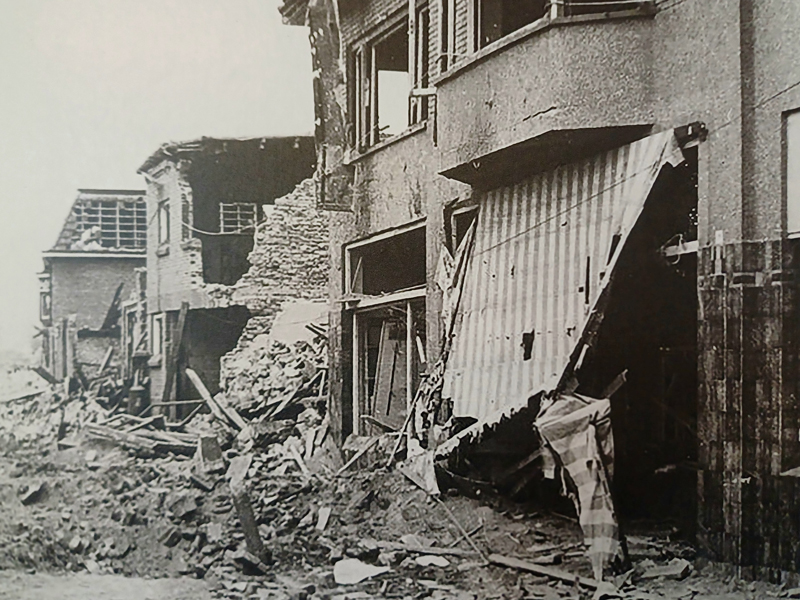
Devastation in the Dijkstraat.
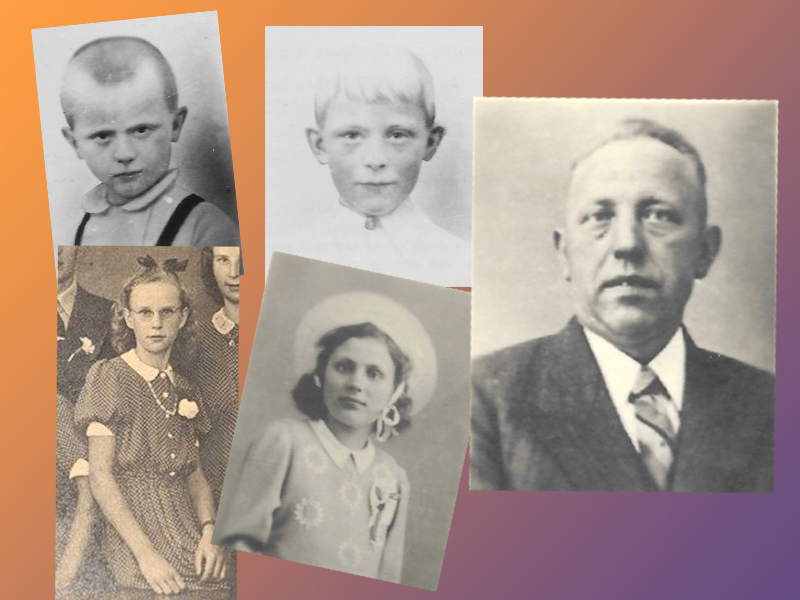
Many victims including: three children of the Umbach family together with their father. And Annie Kamphuis, the younger sister of resistance courier Jo Kamphuis.