
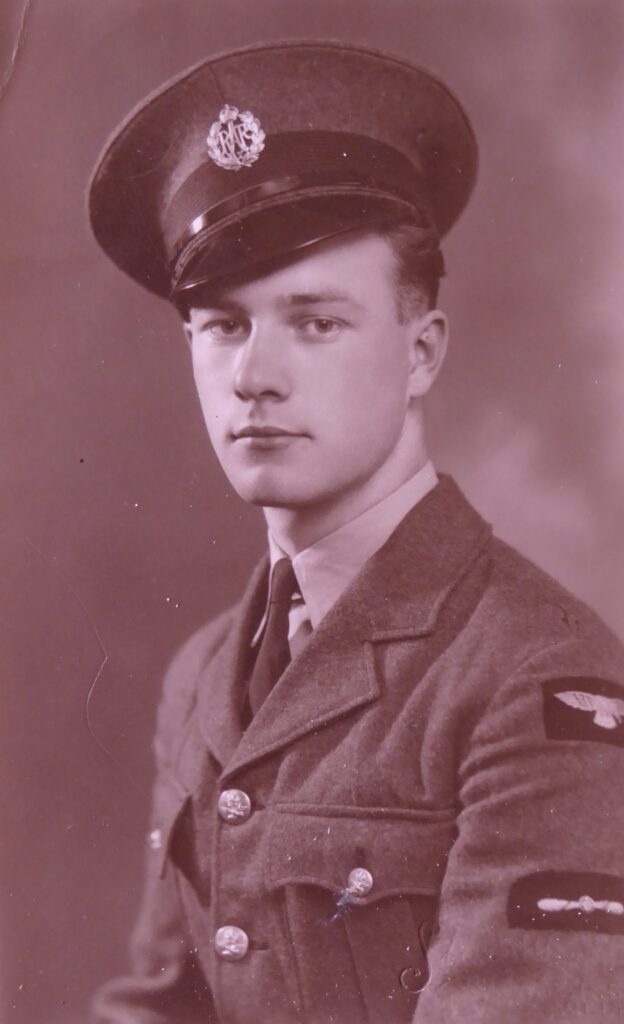
Roy Kay
 On the night of 16 to 17 June 1944, a British bomber was shot down over the hamlet of Barlo near Aalten. The aircraft, a Lancaster MF 840BQ/V bomber of the 550th Squadron, was on the return flight from an attack on the synthetic oil refineries in Sterkrade, north of Essen, when it was fired upon by a German night fighter. Above Barlo, the Lancaster lost part of its tail and crashed near ‘De Radstake’ in Varsseveld.
Six of the seven crew members lost their lives: G.S. Smit, pilot; J.J. Berg, navigator; L. Pulfrey, bomb aimer; R. Townsend, radio operator; J. Tizard, mid-upper gunner; and J. Heath, tail gunner. Leslie Pulfrey was the first to leave the burning aircraft over Barlo, but he did not survive the jump.
Flight Engineer Roy Kay was the only one to survive the crash. He came down by parachute and was only slightly injured. The resistance—Ome Jan, his daughter Jo Wikkerink, and pilot helper Wissink—brought him to safety so that he could safely return to England. During his journey back, he gathered a great deal of information, which he passed on to the Americans.
The six fallen airmen are buried side by side at Rentinkkamp Cemetery in Varsseveld. Roy Kay passed away in England on 23 March 2009.
In 2014, Mrs Jo Bulsink-Wikkerink donated all the materials containing the story to the National Resistance Museum (Nationaal Onderduikmuseum) in Aalten.
On Saturday 13 August 2016, Roy Kay’s widow, over 90 years old, visited the memorial site in Barlo together with her daughter Alison, eldest son Paul, and his son George. They were accompanied by Mr and Mrs Ploeger (granddaughter of the Aalten resistance fighter Ome Jan Wikkerink). Also present were Mr and Mrs Wissink from The Hague. Uncle Alex Wissink provided Roy Kay with shelter in The Hague for 40 days, as did his sister from Krefeld (Germany) and a second cousin; the granddaughter of Alex Wissink from America with her son was also present. Also attending from England was a nephew of the fallen navigator J.J. Berg: Gary Berg.
At the memorial site on the Gandvoortweg, floral tributes were laid, and Gerrit Hendrik van Eerden told the story of the events during the night of 16 to 17 June 1944.