
Willy Michel
(Velsen, 1920)
Member of the 2nd Company DNB
Willy alias Frans: A German national fights in the Canadian army
Willy Michel, known within the resistance by the codename ‘Frans’, led a remarkable life during the Second World War. As a German national (Rijksduitser) who had grown up in the Netherlands, he deserted from the Wehrmacht to join the Binnenlandse Strijdkrachten (Dutch Interior Forces).
Youth and military service
Willy Michel was born in Velsen on 20 March 1920 as the son of August Michel and Angela Bieuwer, a couple with German passports who were still living in France in 1910. August Michel worked at the Gonnerman plate mill in Velsen-Noord. Willy became an electric welder at the same company.
At the outbreak of the war, the family moved to Friedberg in Hesse, but Willy remained in Velsen, as did his married sister Ellie. Following the German occupation, Willy was soon called up for military service in Germany and sent with his unit to the Eastern Front. After being wounded there, he was granted leave to return to the Netherlands to recover. The chaplain of the Roman Catholic church in Velsen-Noord informed him that he could go to Gelderland and provided an address where he could report. He therefore deserted — a decision that carried the death penalty. He had to remain constantly vigilant to avoid being caught.
In hiding and the resistance in the Achterhoek
From October 1942 to May 1943, he went into hiding in Putten. Subsequently, using the alias ‘Frans’, he was able to hide in Varsseveld at the homes of Gussinklo (de Jaeger), Wisselink (Oberink), and Derk and Leis Migchelbrink on the Terborgseweg. He was also to be found at Heusinkveld’s (Klein Entink). During the final year of the war, he stayed with the Wisselink family at the Oberink farm.
Willy managed to keep his true identity hidden until the liberation and became deeply involved in the resistance. As a member of the ‘Raad van Verzet’ and from October the Interior Forces (BS), he made use of his military knowledge. Willy was familiar with many German weapons and their use. A shooting range had been set up in the meadow near the Oberink woods. There, Willy gave shooting lessons to men of the BS while resistance comrades stood guard.
Service in the Dutch National Battalion
In mid-April 1945, many BS men from Varsseveld joined the Dutch National Battalion (DNB). Willy Michel did so as well, alongside his comrade Derk Migchelbrink and Derk’s brother-in-law Hein Helmink (both married). Although officially a German national, he fought in a Canadian uniform on the side of the Allies.
At the beginning of May 1945, Willy was granted leave to visit his parents and his fiancée, Rie Zonneveld, in Beverwijk. He had not seen them for four years! Shortly before, between Woudenberg and Scherpenzeel, he had met someone with a brand-new DKW 350 cc motorcycle (the bike had been well hidden for five years). He was allowed to borrow this motorcycle, together with his comrade Henk, in exchange for a carton of cigarettes. They obtained petrol from the Canadian army command upon request. Henk held a motorcycle license, and so they set off on Sunday at six o’clock. The journey went smoothly, partly because they were wearing Canadian uniforms. It was a fantastic reunion. By nine o’clock in the evening, they were back with the army.
In June, he went again. On 13 June 1945, the acting commander of the second company reported that Willy had not yet returned from leave. It was feared he had been arrested due to his nationality. A short while later, Willy returned. Politically, he was beyond reliable. It was established that he had more than earned his stripes in the resistance.
After the war
On 25 June 1945, Willy left the DNB and returned to Velsen. He married Rie Zonneveld in Beverwijk on 28 February 1946 and resumed his work at the plate mill, where he remained until his retirement. Together they had a son, Peter Michel. Willy Michel passed away in Velsen in January 2002.
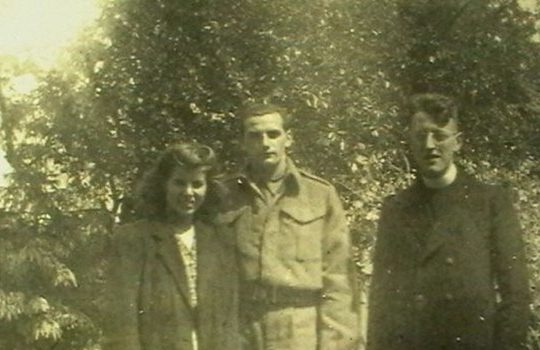
Velsen, May 1945. Willy Michel (centre) with his fiancée Rie and Chaplain Paassen.