

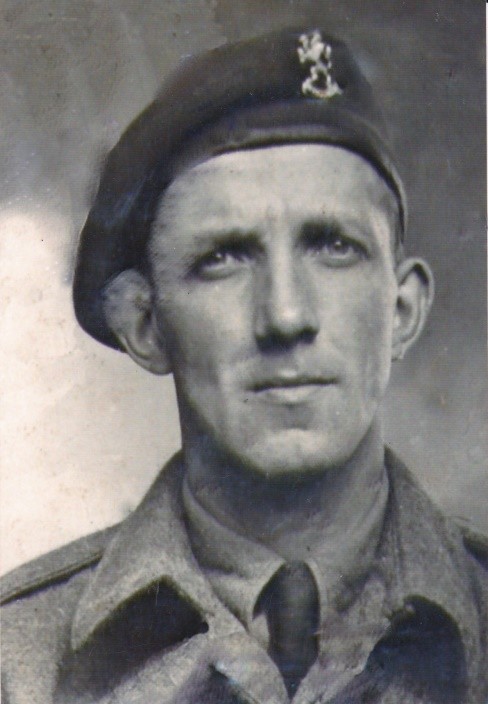
Willem Ruesink
(Gendringen, 1920)
Member of the 2nd Company DNB
When the DNB was disbanded, Wim re-enlisted and joined the Mine Clearance Service
Willem Johan Ruesink was born on 21 March 1920 in Klein Breedenbroek near Gendringen, the son of baker Rudolf Arend Jan Ruesink and Willemina Johanna Westerveld, alongside one sister and three brothers.
Period of service and a cunning encounter
From the autumn of 1944, Willem was a member of the Netherlands Forces of the Interior (NBS) in Gendringen. In 1945, he answered the call to join the Dutch National Battalion (DNB), serving in the 2nd Company. During his stationing in Amersfoort, he spent a period in Camp Amersfoort, which had been liberated by the Allied army shortly before.
Willem’s duties included guard duty near the village of Eemnes, where attractive young ladies occasionally passed by. This was how he came into contact with Martje Roodhart, a farmer’s daughter. When Willem discovered that Martje was very skilled at making and repairing clothes, he secretly tore a button off his uniform, knocked on the farmhouse door in the evening, and asked if she would sew the loose button back onto his jacket. In the weeks that followed, they saw each other more often.
Mine clearance and family life
In July 1945, when the DNB was disbanded, Willem re-enlisted to work for the Mine Clearance Service. In 1951, Willem and Martje married and settled in Winterswijk, where Willem worked as a metalworker. The couple had four sons: Dolf, Jan, Wim, and Martin Ruesink, all of whom would later work in journalism.
Willem worked for many years at the Hoekstra coachwork factory in Winterswijk. He passed away in 2001 at the age of 81; Martje died six years later.
The legacy of the liberation
“We are not children of war,” one of the sons later said, “but we do owe our existence to that time. In fact, we are children of the liberation.” In his book ‘Bewaar de herinnering’ (Keep the Memory), which covers the period of reconstruction and the 1960s, son Dolf Ruesink describes how his parents met in the May days of 1945. He highlighted the contrasting ways they experienced the Second World War and the influence those fearful years of 1940–1945 would later have on the family’s life.
Willem Ruesink