

Ries Kuiling
(Eibergen, 1919)
Member of the 3rd Company DNB
Scarred by the Grebbeberg and the tragic death of his brother
Marinus Gradus (Ries) Kuiling was born in Eibergen on 25 October 1919, the son of Gerrit W.G. Kuiling and Gerharda W. van Dijk. He grew up with four brothers and four sisters; seven of the sixteen children in the family died at a very young age. His father ran a flour mill on the Grotestraat, and the family lived in Mallum, just outside the village of Eibergen. Ries worked as a woodworker and gardener. Shortly before the war, he was called up for military service, and in early May 1940, he fought against the German army on the Grebbeberg. This was a true hell, which likely determined his attitude, as he subsequently joined the resistance.
Youth photos showed a combative young man. He took in many people in hiding and escaped prisoners of war, whom he placed in safe houses. He ignored the occupier’s call for the mandatory Arbeitseinsatz (forced labor), which meant he had to go into hiding himself. He chose various addresses and was always on the move.
The Tragedy of ‘Boetie’
The date April 20, 1944, was the day of the major raid in Eibergen and the surrounding area. Ries was also wanted, but he managed to flee in time. The great tragedy was that his younger brother Gerrit (‘Boetie’) was murdered that day. On his 20th birthday, Boetie was in the wrong place at the wrong time. As an assistant to baker Van der Ziel, he had to deliver a loaf of bread to the Heinen family at the printing works on Grotestraat. Just as he arrived, the Sicherheitsdienst (SD) entered the building from the front and back. Boetie stood watching for a moment, partly because his brother Ries was in the underground resistance. The “Black” guard with a rifle, who was guarding the premises outside, approached him and drove him into a corridor next to the house. When Boetie tried to take his identity card from his back pocket, this NSB (National Socialist Movement) member shot him in the chest at close range. Boetie was carried inside. A police officer and a doctor were called, but he passed away. All of Eibergen was deeply shocked. The line of people who came to offer their condolences was unprecedentedly long.
When the SD and NSB (National Socialist Movement) appeared at the family’s door a short time later searching for weapons, Ries became furious. He grabbed an NSB (National Socialist Movement) member by the collar and told him exactly what he thought, after which the unwanted visitors left. In hindsight, Ries was lucky not to have been taken away. The perpetrator was later detained in 1945, but he escaped and evaded his punishment. Boetie’s death remained a painful loss for family and friends.
Resistance and Dangerous Missions
In the autumn of 1944, Ries Kuiling became a member of the Home Forces, Eibergen group. They primarily attempted to steal equipment from the Germans, such as good bicycles, weapons, and ammunition, because the promised weapons from the Allied air drop in Aalten were not delivered. One evening, Kuiling went out with four others to a farm in Haarlo to ambush a wagon carrying German hand grenades. However, they were discovered and bullets flew around them, but here too, Ries managed to get away in time. He experienced many such tense situations, but things always turned out well.
The Liberation and the DNB
As the Allies approached Eibergen, the Home Forces commander designated his bravest men: Kuiling and Wisselink. They were sent ahead to the English tanks to report tank traps and obstacles and to provide extensive support. Following this, Ries and his Home Forces group from Eibergen captured 500 German prisoners of war. The English liberators were very pleased with this, as it saved them a great deal of work. When the request came to join the Canadian army to help liberate the Netherlands, the entire group (except for three people) responded enthusiastically. Ries Kuiling became a member of the 3rd company of the Dutch National Battalion, just like his comrades in the resistance to whom he felt a strong bond.
Life After the War
After the war, Ries worked for the Inland Revenue (Rijksbelastingen) for more than 40 years and was very active in trade union work. On 26 June 1952, he married Lies van Boggelen in the municipality of Herwen en Aerdt. The family settled there, and two daughters and a son were born. Ries always remained interested in the history of 1940–1945 but did not talk much about his own experiences. He did, however, occasionally visit a war cemetery with his children and would remark in passing: “Someone I knew is buried here.”
Ries Kuiling passed away in Zevenaar on 10 October 1993.
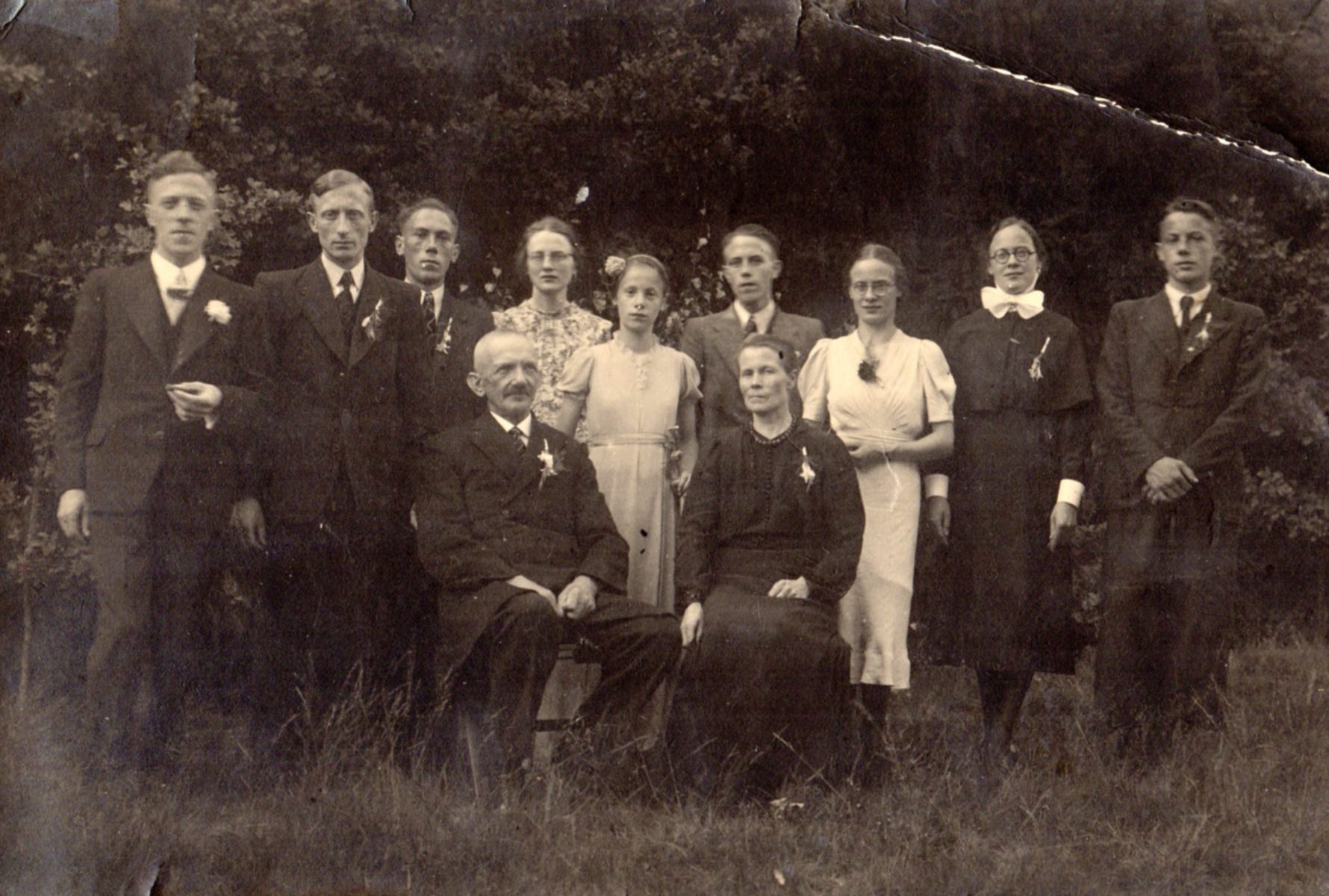
Ries Kuiling, third from the left. His brother Boetie is on the right.