

Jan Hendrik Groenewegen
(Dokkum, 1889)
Army Chaplain, Staff of the DNB
From chaplain of the resistance to army chaplain
Jan Hendrik Groenewegen was born in Dokkum on 25 December 1889, the eldest son of Reverend Hermanus IJ. Groenewegen and Henriëtte A. Kollewijn. His father was a Remonstrant philosopher of religion and ethicist who, in that very year of 1889, was promoted to Doctor of Theology. Due to his father’s professorship, the family moved to Utrecht in 1891 and to Rotterdam in 1893. Jan Hendrik grew up with one sister and two brothers. After secondary school, he studied theology in Leiden. He was exempted from regular military service but was required to serve in the army as a chaplain.
On 30 July 1918, he married Elise Mathilde Spenneman in Zeist, who was born in Trier, Germany. For twelve years, he served as the minister of the Remonstrant congregation in Oude Wetering before becoming an army chaplain. Groenewegen, holding the rank of lieutenant colonel, was a highly experienced chaplain in ethical matters, such as officer discipline and the conduct of field preachers. He possessed great tact when dealing with difficult situations and decisions regarding those entrusted to his care.
From 1940, Groenewegen was involved with the underground movement. Through chaplaincy meetings, he knew ministers and military personnel in the resistance. During the war, he encouraged and advised the resistance whenever possible. He collaborated with his friend and colleague, Reverend J.G. Knottnerus, whom he had met in The Hague as a field preacher and head of spiritual care. At Knottnerus’s parsonage in Varsseveld, where Groenewegen visited regularly, there was a constant flow of military personnel and people in hiding. Spiritual care became a prominent issue in late April 1943, when the occupier announced that Dutch military personnel were to be returned to prisoner-of-war status and sent to camps in Germany.
Together with spiritual caregiver H.J.J.M. van Straelen, Groenewegen managed to convince the occupier of the necessity of spiritual care for the prisoners of war. They received permission to send chaplains to the POW camps. This mission was on a voluntary basis, and candidates were approached in consultation with their respective church congregations. In total, twelve army chaplains took on this responsibility. From 1940, Groenewegen also engaged in illegal work alongside the soldier Bob Krul, a member of the Ordedienst and Raad van Verzet. From the autumn of 1944, Krul served as the Achterhoek district commander of the Dutch Interior Forces (Region 5).
In mid-April 1945, the Dutch National Battalion (DNB) was formed—a citizens’ army that advanced with the Canadian Army to liberate the Veluwe, the area around Scherpenzeel and Amersfoort, and the Betuwe regions. Bob Krul became the commander of this army, and Reverend Groenewegen joined the staff of the DNB.
When two DNB members died during their service (Wim Obbink and Hans Wiggers), Reverend Groenewegen performed the military honours at their graveside in Aalten.
In 1946, Reverend Groenewegen held the rank of major and was attached to the barracks in Amersfoort.
In 1952, he was awarded the Cross of Merit (Kruis van Verdienste), a bravery decoration for his illegal work in the Achterhoek. The ceremony took place on 29 April 1953 at the Royal Palace in Amsterdam. He passed away six months later, on 1 November 1953, in Amersfoort. He was buried at the Lusthof cemetery in Leusden.
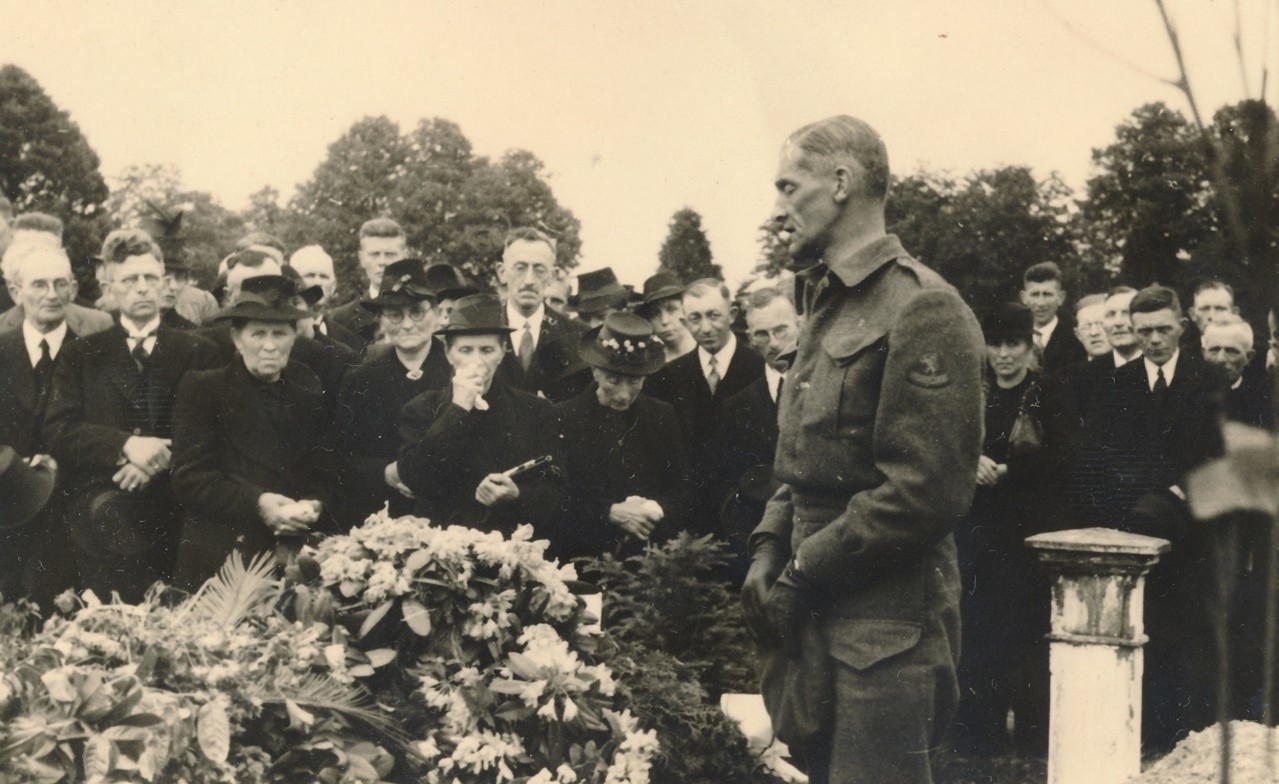
Jan Hendrik Groenewegen