
Franz Josef Freyer
(Wenen, 1912)
Member of the 3rd Company DNB
Austrian-born citizen plays courageous role in the Dutch resistance
Franz Josef was born in Vienna, Austria, on 27 August 1912. His father was a decorative blacksmith. As a boy, Franz came to the Netherlands in 1920, where he was taken in by the young family of Jan and Marie Brinke and their six-year-old son Dorus at Gunninkweg 1 in Voor-Beltrum. When Franz was fifteen, he accompanied his foster parents and Dorus to a wedding on Heelweg in Varsseveld. It was Wednesday, 1 June 1927, the day a cyclone swept through the Achterhoek and Twente regions, causing millions of guilders in damage. The area where he lived was completely devastated that day. The ‘naobers’ (neighbours) helped each other, ensuring that horses, pigs, and cows were rescued from the heavily damaged farms. This must have made an enormous impression on Franz. He helped with the reconstruction of the farm and worked the land. On 20 May 1938, Franz was granted Dutch nationality. This was during the period when NSB (Dutch Nazi Party) members of Parliament strongly objected to the naturalisation of nearly 2,000 foreigners that year.
At the beginning of the Second World War, Franz quickly became a member of the underground movement. In the autumn of 1944, he joined the combat section of the Interior Forces (Binnenlandse Strijdkrachten), Eibergen branch. In 1945, his commander, A.J. Derks, stated that Franz had shown great initiative in the resistance during the war. He possessed courage, tact, and character. Whenever reports came in, he tracked down Allied pilots and escapees. He took them in, providing them with shelter and food. He also assisted French and Polish prisoners of war who had escaped from Germany, participated in weapon transports, and was a member of a sabotage group that significantly disrupted German military traffic.
Immediately after the liberation, Franz joined the 3rd Company of the Dutch National Battalion under the leadership of Commander Jan Tinge. During and after the liberation, he showed great composure while clearing the area of enemy remnants. The commander concluded his testimonial by noting that Franz enjoyed the highest respect from his community and resistance comrades, as he was modest and did not boast of his deeds.
On 11 September 1947, Franz Freyer married Marie Borgijink in Groenlo. They had a daughter and a son. Franz and Marie already ran a taxi business in Lievelde, which moved with them to Groenlo. In addition to the taxi firm, Marie later opened a needlework shop on Nieuwstad in Groenlo. The local hospital’s ambulance was stationed with the Freyer family, and Franz became an ambulance driver, providing aid whenever necessary. During taxi journeys, Franz offered a listening ear to both young and old.
Franz Josef Freyer passed away on 5 November 1989 in Winterswijk.
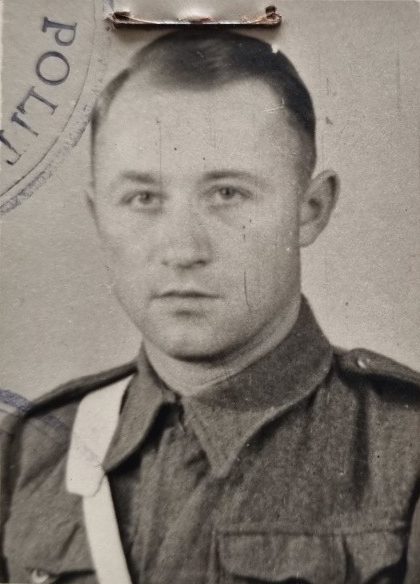
Franz Josef Freyer