
Albert Wisselink
(Heelweg, 1920)
Member of the 1st Company DNB
The scars of the phosphorus bomb remain always visible
Albert Wisselink was born on 6 April 1920 on farm ‘Spieker’ on the Heelweg near Varsseveld, as the son of Linus and Mina Wisselink-Heusinkveld. He grew up with sister Dina and brother Hendrik. During the invasion of the German army in 1940, Albert fought as a soldier at the Grebbeberg. He was taken prisoner, transported away in a goods wagon, and stayed for seven weeks in a large prisoner-of-war camp in Neu Brandenburg, where also thousands of Poles were held captive. They suffered from cold and malnutrition, and the food was terribly bad.
Resistance and Going into Hiding
During the war, Albert worked as a farmhand in hiding in the neighbouring municipality of Aalten, whereby he ensured to appear as little as possible on public roads. He was part of a resistance group in the hamlet of Lintelo. Also his family at home had people in hiding: the parents hid Jews, resistance fighters, and two police officers. Sister Dina with her husband Willem Geurink and young children in Lichtenvoorde hid three Jewish boys Levy from Varsseveld, a Russian, and a number of refusers of the Arbeitseinsatz.
Binnenlandse Strijdkrachten and DNB
A few days before the liberation of the Achterhoek, Albert was suddenly ‘missing without trace’. Earlier, he had already joined the Binnenlandse Strijdkrachten (BS), combat section. First, he assisted in the arrest of remaining German soldiers in the area. Early April 1945, he joined the DNB together with his resistance comrades.
In July 1945, he signed up for the Dutch army and followed a special training for clearing mines. He ended up in the hospital in Tilburg after a phosphorus bomb exploded prematurely nearby. His face and hands were severely burned. His entire face, except nose, mouth, and eyes, was bandaged. These scars of the accident remained always visible.
After the war
Albert was engaged to Engelina Luijmes and married her at the end of April 1948. Lien was the niece of ‘Ome Jan’ Wikkerink, the Achterhoek resistance leader of the Landelijke Organisatie voor Hulp aan Onderduikers. Albert’s only brother Hendrik married three days after him Aaltje Kraaijenbrink from farm ‘de Tol’ at the Rademakersbroek. On the field next to this farm, on 2 March 1945, 46 resistance fighters from all over the Netherlands were executed, as a reprisal measure for the killing of four Germans by the local resistance. This drama was experienced by the Kraaijenbrink family from very close proximity.
Albert and Lien emigrated one week after their wedding to British Columbia, Canada. They had six children, a girl and five boys. The family ties with the Netherlands remained always strong, even though an ocean lay between the two countries. When Albert came to the Netherlands, he invariably visited his resistance comrade Dick Fries, who was also an active member of the DNB and the Minesweeping Service. Dick Fries became blind from the phosphorus bomb that exploded prematurely.
Albert Wisselink died in Pitt Meadows, British Columbia, Canada on 16 March 2003.
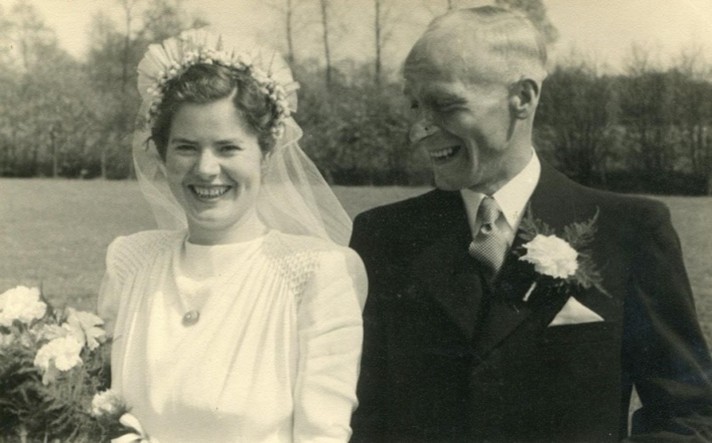
Albert Wisselink