
Across the Border
 During the Second World War, the rural outskirts of the Achterhoek border region proved to be an ideal sanctuary for those being hunted. The diverse landscape — with its woods and dense thickets, numerous secluded farms, barns, and haystacks — was largely disorienting to those unfamiliar with the area.
In this region, people showed a selfless hospitality toward refugees and those in hiding. Usually, they were taken in as part of the family circle and shared in everyday life. Those who helped considered it their Christian duty to offer shelter, providing a form of quiet resistance against the occupier’s reign of terror.
Many collected stories show that those in hiding felt safe with their host families. They saw how German soldiers at the door were convincingly outwitted. Above all, they noticed that the locals were incredibly good at keeping secrets — often even from their own relatives and neighbours. Even the youngest children were strictly taught the essential wartime lesson: ‘hear, see, and say nothing’.
Family Across the Border as a Lifeline
There are many known accounts of mutual trust and assistance on both sides of the border.
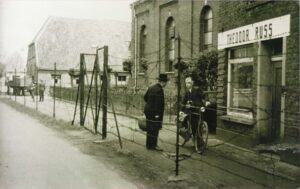
Cor Verheule from Utrecht was working in Bremen but, suffering from diphtheria, was allowed to return home in January 1943. Through a clergyman and ‘Ome Jan’ (Uncle Jan) in Aalten, he ended up with the Heusinkveld-Hartemink family in Haart. Whenever there was a raid, he would flee into the neighbours’ dugout. This shelter was unique: it had an entrance on Dutch soil and an exit on German territory. In 1952, Cor married the sister of his host family.
Wildenbeest from Breedenbroek was ordered to report for forced labour (Arbeitseinsatz) in Germany. Instead, he went to work as a farmhand for his uncle in the German village of Suderwick. He took part in German family life less than a mile from the Dutch border. In the 1930s, the Kopatz children in Suderwick had been ‘distributed’ as orphans among several local farmers. One of the sons refused military service and left for his married sister’s home in Assen. He went into hiding there and survived the war safely.
These stories show that the resistance in the border region was unique. It was a network of ordinary people who trusted one each other and made clever use of the environment and their family ties. At the National Hiding Museum, we preserve these stories to show how humanity was stronger than the border.