

Zevenaar, The Netherlands
Digging in Zevenaar
As the Allies came closer and closer, the panic among the Nazis grew. Arnhem and Nijmegen were theatres of war, and after the failed Battle of Arnhem, the Germans had to reinforce themselves. They need additional trenches and tank traps to build up their defenses. But their own men are fighting at the front, so they force workers from the occupied territories to work for them.
Dutch men are called up
As part of the compulsory Arbeitseinsatz , all Dutch men between the ages of 17 and 45 are called up to work for Germany. In Zevenaar, too, men have to do excavation work for the railway line, a life-threatening job. After all, the Allies tried to sabotage these German defences. Nevertheless, the Nazis continued to demand new workers.
Exemption slips are scarce and in demand
Most men want nothing to do with this heavy and dangerous work for the enemy. Some try to get exemption with official notes, but they are scarce. Others tried to go into hiding, but the Nazis put them under heavy pressure.
A cruel threat: shooting the elderly
If too few men came forward, the Nazis took hostages. Older men are arrested and put on a list. The threat is clear: if not enough young men come to work, the hostages will be executed. An official proclamation makes this crystal clear:
“I have repeatedly appealed to the population to report for the labor deployment in Zevenaar and Bocholt. Since this has not been followed up as necessary, I would like to inform you, by order of the S.S. Kommando in Zevenaar: 1. The following persons have been arrested as hostages: …”
The names of these men are mentioned, and their sons and fellow villagers are faced with a terrible choice. Out of fear for their fathers and other older fellow villagers, many come forward, but they often try to go into hiding again as soon as possible.
A system of slavery
The Arbeitseinsatz was a form of slavery. Young men from occupied territories were forced to replace German workers so that they could fight as soldiers. Refusal meant severe punishments or even death.
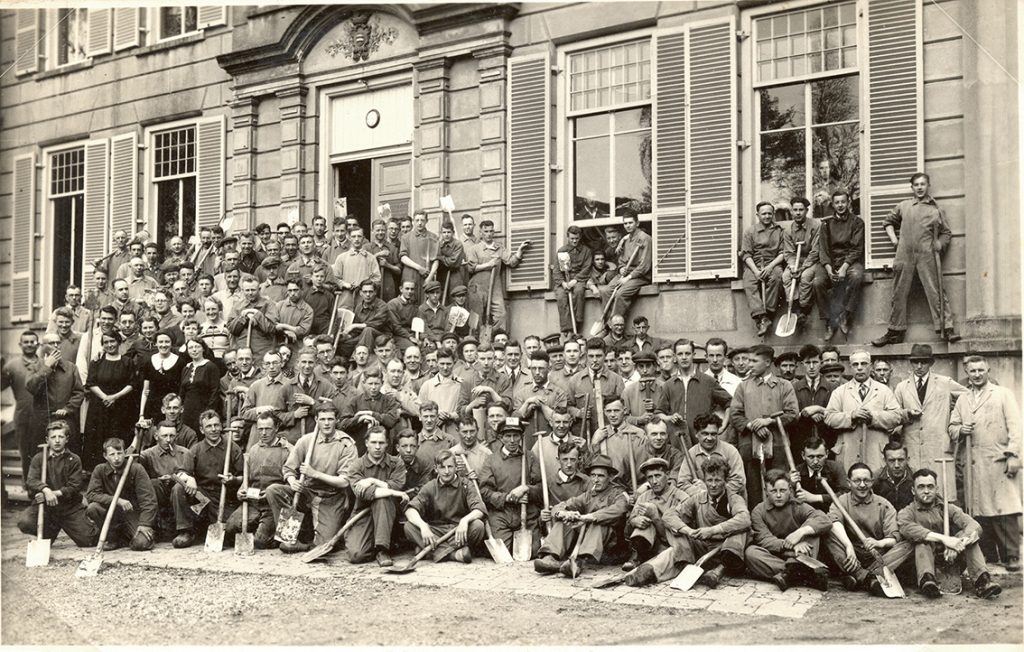
Diggers in Zevenaar Photo: Cultuurhistorische Vereniging Zevenaar
Carel Gersdorf
Carel Wilhelm Gersdorf is not only director of the Turmac Tobacco Company BV, but also leader of a resistance group. His faith does not allow him to accept the German oppression just like that. Together with other believers, he committed himself to the resistance, especially by helping people in hiding and collecting money.
Resistance within the cigarette factory
Turmac produces cigarettes, and Gersdorf uses them in a subtle way in the fight against the occupier. When the first employees have to go to work for the Germans, the management provides an impressive farewell. In addition, Gersdorf had cigarettes distributed to Allied prisoners of war at Zevenaar station, but not to the German guards. This gesture did not go unnoticed and aroused the anger of the Nazis.
A fatal call
On 9 September 1944, Gersdorf was ordered to report to the headquarters of the Sicherheitsdienst (SD) in Arnhem. He expects a warrant, as has happened before, but this time he is arrested. During brutal interrogations, the SD tries to extract information from him. In the evening he is taken out of his cell and put on a transport to Camp Amersfoort.
On the Arnhemseweg, near the Stoppelbergweg in Beekbergen, SS man Untersturmführer Enkelstroth suddenly gives the order to stop. Gersdorf is taken out of the car and shot from behind. His body is left behind, while Enkelstroth returns to Arnhem with the report that Gersdorf is “Auf der Flucht erschossen”. Gersdorf was 50 years old at the time, leaving behind a wife and two sons.
The perpetrator is punished, but briefly
After the war, Enkelstroth was tried for these and other war crimes. In 1948 he was sentenced to death, but a year later it was commuted to 15 years in prison. He was eventually released in 1951 and died four years later at the age of 48.
A lasting memory
The former Turmac factory closed in 2008 and is now a ‘culture factory’, which houses the municipality of Zevenaar, the Liemers Museum, a film house and the library, among others. A monument from around 1949 commemorates the war victims of Turmac.
A monument with meaning
The monument, originally attached to a pillar in the factory hall, contains the text:
“May their sacrifice be inspiring. H.M. Queen Wilhelmina 20-11-1945.”
On the right side is the text:
‘To those who fell
in 1940-1945 C.W. Gersdorf director 9 September 1944
B. German Tobacco Processor 29 September 1944
A.P.A. van Swaay Tobacco Processor 26 September 1944
H.L. de Reus Chauffeur 13 May 1945
A. Harfon Machinist 23 October 1942’On
the left side:
Dr. D Schnur president supervisory director 1938 – 16 March 1948
Dr. L. Blum delegate – supervisory director 1 May 1939 – 15 April 1953.
Why the names of Chairman of the Supervisory Board David Schnur and L. Blum have been placed on the monument is not (yet) known. In addition, Gersdorf’s name can also be found on a memorial stone in the Eusebius Church in Arnhem.
Read more: https://www.4en5meibeekbergen.nl/vlaggen-eerbetoon/carel-w-gersdorf/
https://oorlogsgravenstichting.nl/personen/48940/carel-wilhelm-gersdorf
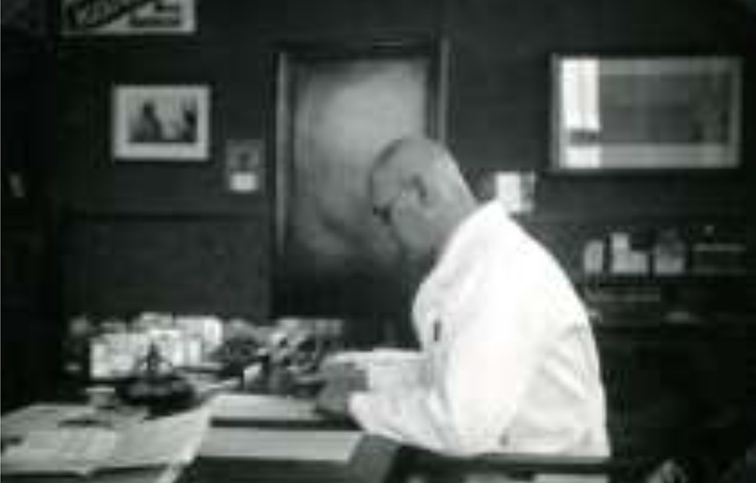
Carel Wilhelm Gersdorf (1894-1944) at work in his office of the Turmac (cigarette factory) circa 1940
War graves cemetery
In the night of 16 to 17 June 1944, an Allied bomber took off from Leonfield Air Force Base in the United Kingdom. The crew has a dangerous assignment: to bomb factories in the German Ruhr area. After completing their mission, they return, but fate strikes above Spijk, municipality of Zevenaar.
A German ‘night fighter’ intercepts the aircraft and opens fire. The bomber is shot to pieces in the air. Wreckage and bodies of the seven crew members are scattered over the village. None of them had the chance to open their parachutes.
Carpenter Caerteling is given the difficult task of making seven boxes. The bodies are laid out in the horse stable of the T&A brick factory.
The crew consisted of courageous soldiers from the Royal Air Force (RAF) and the Royal Canadian Air Force (RCAF):
Pilot: Douglas Cameron, 21 years old, RCAF
Radio telegraph operator: Leslie Basford, 23 years old
Tail gunner: Kenneth Blyth, 34 years old
Bomb aimer: John Collyer, 31 years old, RCAF
Flight engineer: David Hooper, 19 years old
Gunner rear turret: John Summers, 38 years old
Navigator: Benjamin Robinson, 30 years old
A final resting place under a large tree
The crew members are buried in the ‘Drenkelingen cemetery’ near the Byland, under a large tree. To this day, Remembrance Day takes place here every year on May 4 – a place where freedom is honored and their sacrifice is not forgotten.
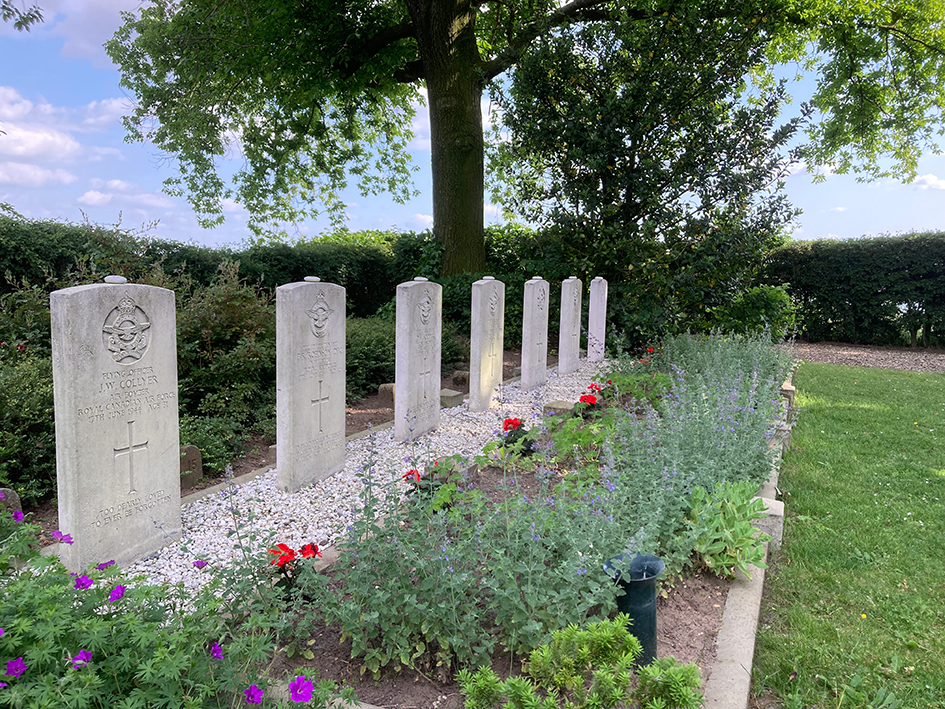
The 7 graves of the killed crew members at the cemetery at the Byland in Tolkamer
A special photo
In October 1944, a large part of the southern Netherlands, including parts of Gelderland, had already been liberated. But the Gelderland Island, like the Achterhoek, remained in German hands at the beginning of 1945. This area became a battlefield where the German occupiers and the Allies fought each other.
A forced departure
On 10 February 1945, the inhabitants of the Gelderland Island were ordered to evacuate to the north. They leave their homes and possessions behind, not knowing what they will find when they return.
Liberation is getting closer
It is difficult to reconstruct exactly how the Gelderland Island was liberated. The British probably entered Pannerden, while the Canadians liberated the former municipality of Herwen en Aerdt. On 3 April 1945, both troops met on the dike near the Putmanskrib, after the capture of the Elterberg on 1 April. No enemy was to be seen anymore and so they concluded that the Gelderland Island had been liberated. The area was almost empty. So there are only a few people who experienced the liberation of the Gelderland Island in April 1945.
An empty and devastated home ground
Upon returning, the inhabitants find their houses badly damaged and looted. They lack the most basic necessities of life, and help is slowly coming along. “My father came back from Onderdendam, not far from Bedum in Groningen. He rode his bicycle with wooden wheels back to Pannerden to see what was left of the house. Later the family was able to return,” says Hugo van den Boogaard.
Help from Hillegom
After the liberation, Pannerden had 1571 inhabitants, divided into more than 250 families. All of them have suffered damage. The municipality of Hillegom, where former mayor Jhr. Mr. Otto van Nispen tot Pannerden is now mayor, adopts Pannerden and regularly sends cars with relief supplies.
Finally party after months of uncertainty
In August 1945, it was time to celebrate the liberation. Residents gather opposite the civic guard building and the town hall of Pannerden. In photos from that time, the relief and joy are clearly visible – after months of uncertainty and hardship, their freedom is back.
Read more:
Website: https://www.heemkundekringrijnwaarden.nl/
Reference: Janssen, G.B. (1995). War over the Gelderland Island. Local History Society Rijnwaarden
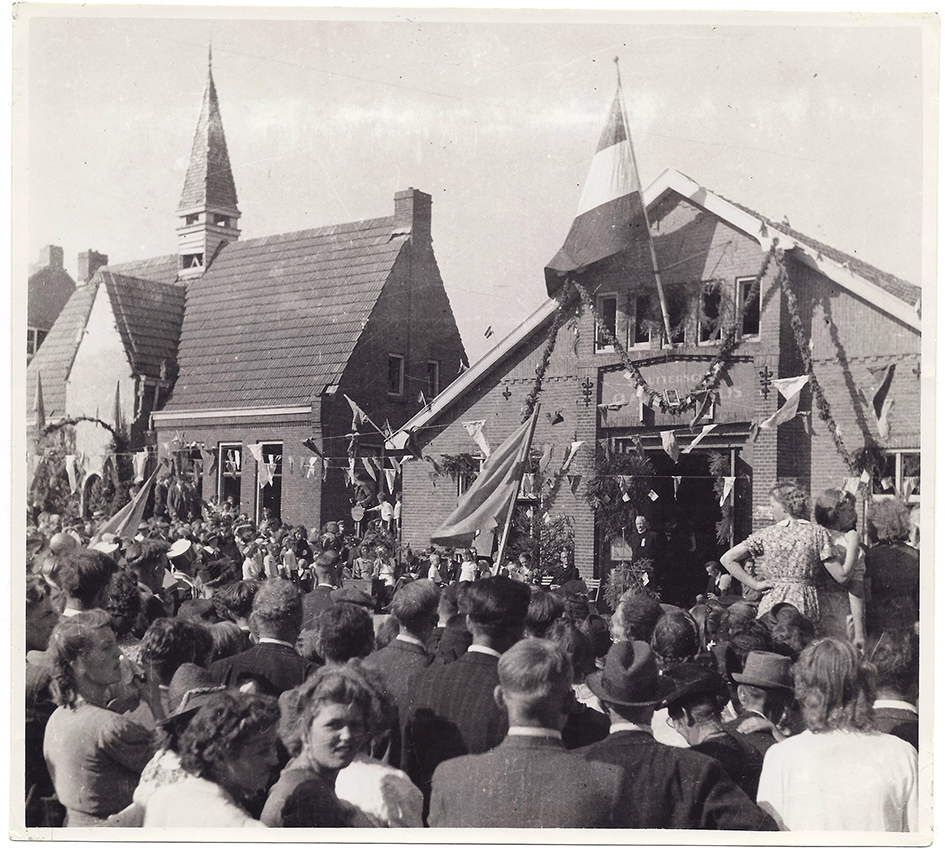
Pannerden Liberation Festivities August 1945. J. van Ingen Collection