
Where has my identity card gone? asks Huig Elias de Jong
Huib (98) returns to his hiding place for one question: where has my identity card gone?
He steps out of the car, looks around, and then points without hesitation to a piece of land. “It was roughly there.” Huib de Jong may not have been in Aalten for years, but the 98-year-old immediately recognizes the spot where he was a person in hiding as a 16-year-old boy.
De Jong is in the Achterhoek town because of a search that has occupied him for years. Somewhere here lies, or lay, his identity card.
He handed it over to the resistance during the Second World War after fleeing from the west. Since then, he has never seen the document again. “I want to know where it went.”
‘Germans went out to sea to destroy targets’
De Jong’s story begins in IJmuiden. That is where he grew up and went to school. Until the Germans requisitioned his school. De Jong’s father decided it would be good for him to start working. That is how he ended up at a shipyard as a 15-year-old boy.
He remembers exactly what it was like there at the time. In the harbor lay fast German boats, equipped with launch tubes for torpedoes. “The Germans went out to sea towards England to destroy targets there. They returned and found out that some of their own boats had been fired upon.”
De Jong had to work on the damaged vessels, but he was unable to do so.
Shortly afterwards, a warning came from a woman in the resistance: “I’m coming to get you, you have to get out of here,” De Jong says. She put him on the train to Aalten, where he was given a hiding place on the Gandvoortweg. The place where he eventually stayed until the end of the war.
‘They were often issued to Jews’
Life as a person in hiding is hard. In case of danger, De Jong had to flee. His hiding place was an underground space, with just enough room for a few people. “It was wet, damp, and cramped with straw beds,” De Jong recalls.
During that period, he handed over his identity card to Jan Prinsen of the Hunink farm. “They needed it for transporting men elsewhere,” was the explanation De Jong received at the time. He also visited the Nationaal Onderduikmuseum in Aalten in the hope of learning more about the paperwork.
History enthusiast and Aalten local Gerrit van Eerden explained to him in the museum what likely happened to his ID: “They were often issued to Jews.” By using other people’s identity cards, Jews could travel more freely. Their own identity cards were printed with a large ‘J’ on the front and back. Van Eerden estimates the chance that De Jong’s document still exists is small. “Sometimes they were also destroyed.”
No identity card, but a photo
Frouke Harmsen of the Nationaal Onderduikmuseum confirmed that the identity card was not found in Aalten. But she has something else for De Jong. “We do have a book about Barlo that features you. We will send it to you.” That book contains a photo of a young Huib de Jong, 16 or 17 years old, with his head poking out of the hiding place.
After the liberation of Aalten by the English, De Jong enlisted in the Marine Brigade in Groenlo. He was 17 years old at the time. “I had to show my identity card and ask my parents for permission. But I didn’t have that ID anymore. So I just said I was 18 and that I had used my identity card in the resistance.” It worked. The officer gave him permission to sign up. The very next day, he left with a large group of people from the Achterhoek for England and Scotland for marine training.
Love at first sight
In 1950, after also spending three years in the Dutch East Indies, De Jong returned to IJmuiden. A former classmate recognized him on the street: Atie van Wolferen. She invited him for tea at her parents’ house. It was love at first sight. They married that same year, had a son and later grandchildren, and remained married for nearly seventy years until she passed away.
Now, Huib de Jong has not found his identity card. But what he does have is a life full of stories. What did he learn from it? “Stay level-headed.”
Source: De Gelderlander – Vera Moison. Photo: © Jan Ruland van den Brink
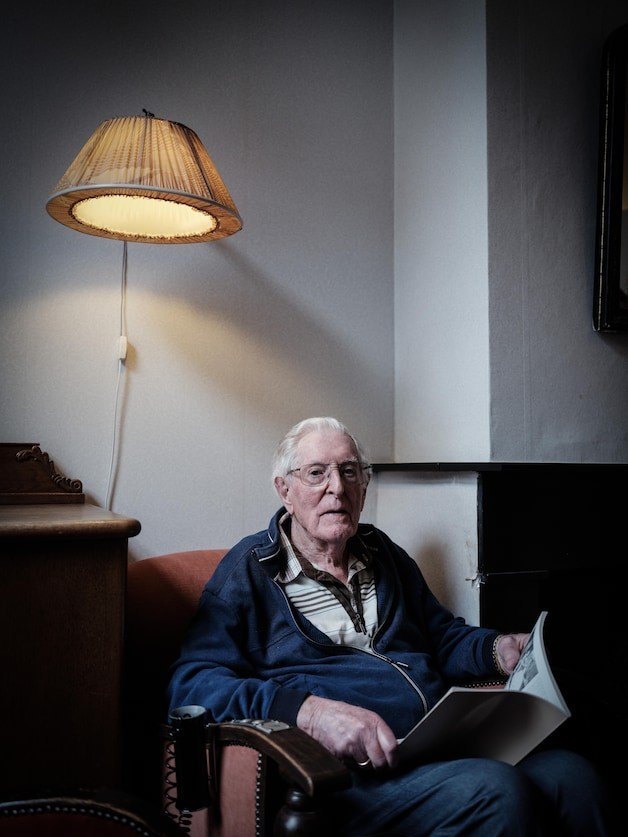
Henk de Jong (Huig Elias) or Huib van ‘t Gandvoort as he was called while in hiding. © Jan Ruland van den Brink
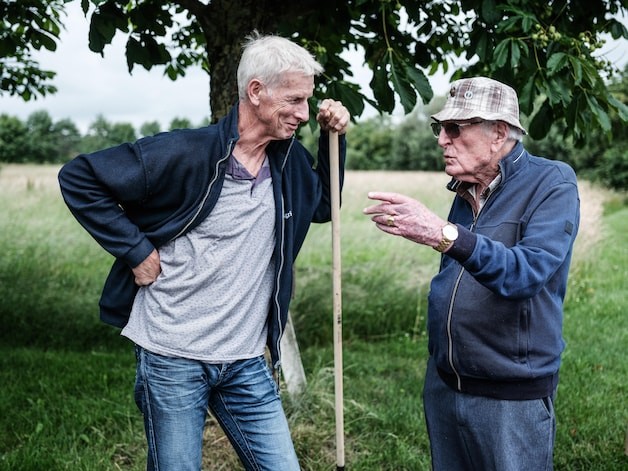
98-year-old Huib de Jong in conversation with Martin Meijerink at the farm on the Gandvoortweg in Barlo, his hiding place.
© Jan Ruland van den Brink