

The tragedy of Frits and Amalia Landau-Lorch
Frits Landau (* 28 Nov 1905 – † Nov/Dec 1943, Aalten)
Amalia Landau-Lorch (* 20 Dec 1902 – † Nov/Dec 1943 Aalten)
Frits Landau was born on 28 November 1905 as the second child of Louis Landau and Telza Kan (married on 9 September 1903). He had an older brother, Ernst Eduard (born 2 June 1904); two other children in the family died at a young age. Father Louis Landau had stayed in the United States for ten years prior to his marriage, thereby acquiring American citizenship. After the death of the parents (Louis in 1928 and Telza in 1934), both brothers also became eligible for American nationality based on this constitutional right.
When the threat of war for the Netherlands increased in early 1940, the United States advised its citizens to leave the country. Ernst Eduard exercised this right and departed for America. His wife Paulina (Paula) Philips and their young son Louis followed him later via a difficult prisoner exchange. Frits, however, decided to remain in the Netherlands.
Life in Aalten
Frits Landau, a commercial traveller by profession, was known as a bit of a free spirit. He primarily traded in cattle, both in the Aalten area and across the border in Germany. He lived at Heurne 33 (currently Bocholtsestraatweg 70). Frits liked to “paint the town red”. He had a reputation as a womaniser and was partial to a drink or two.
On 20 June 1942, Frits became engaged to Amalia Sara Lorch (born on 20 December 1902 in Bocholt). The couple married shortly thereafter, on 6 August 1942. On 17 March 1943, it was noted in the Aalten population register that Frits had departed for an unknown destination. It is notable that Amalia was not registered in the population register.
In hiding and conflict
After their marriage, the couple moved in with the Schaap family at ‘t Dal 8 (currently ‘t Dal 1). Not long after, they went into hiding at the Bauhuis family farm in Dale (Welinkweg 4), where other people in hiding also resided. Being in hiding was difficult for Frits. He was restless, troublesome, and made constant demands. Due in part to his craving for alcohol and for—as he called it—”fresh female flesh”, he drove the Bauhuis family to despair. When Frits repeatedly threatened to betray the group, the situation became untenable and Bauhuis wanted him gone.
In the summer of 1943, Frits and Amalia were moved to the ‘De Moâte’ farm belonging to the Van Eerden family (Aladnaweg 9). Here they met the young Sallo van Gelder, who was temporarily staying with the family after a miraculous escape from deportation. Amalia embroidered a handkerchief for him, a relic that Sallo has kept to this day. However, Frits continued to cause problems at the Van Eerden home due to his unpredictable behaviour and repeated threats of betrayal. Things could not continue this way. Discussions were held with the resistance regarding what should be done with him, but no verdict was reached.
Liquidation
Several men from the underground eventually decided to take action themselves. One evening in late November or early December 1943, Frits and Amalia were picked up and taken to a spot near the Vragenderweg in Barlo. There, Frits and Amalia were liquidated and buried. Despite various search attempts, their grave has not been found to this day.
Remembrance
In Aalten, Stolpersteine have been placed in memory of Frits and Amalia Landau-Lorch in front of the house at ‘t Dal no. 1.
Notable:
In neighbouring Bocholt (Germany), a Stolperstein for Amalia has also been placed at Ostmauer no. 3. Here her name is listed as Aurelia Landau (née Lorch), born 1902, fled to Holland and died 1943. At the same address lies a Stolperstein for Ruth Lorch (presumably her daughter), born in 1923 and deported and murdered in 1942 in Izbica (Poland).
Sources:
- Zij waren Aaltenaren als wij… , authors: Hans de Beukelaer en Jessie Jongejans
- De Joodse gemeente in Aalten, author: Peter Lurvink
- ’t Ruwhof, hoo ut d’r hear ging, author: G.H. van Eerden
- Aalten in Oorlogstijd, author: J.G. ter Host
- Aalten in Bezettingstijd, author: B. de Joode
- Stolpersteine Bocholt (Germany), Wikipedia
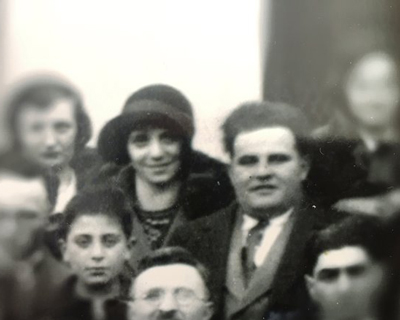
Amalia and Frits Landau-Lorch (photo: Aalten Vooruit)
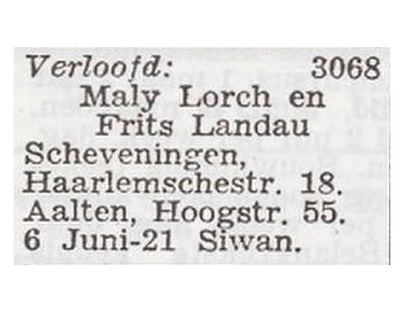
Het Joodsche Weekblad, 5 June 1942
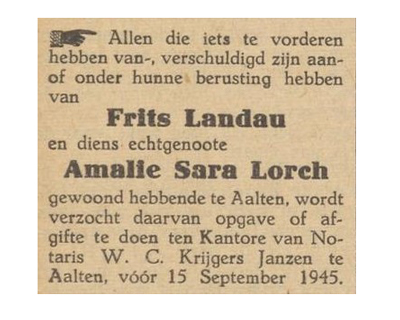
Aaltensche Courant, 28 August 1945
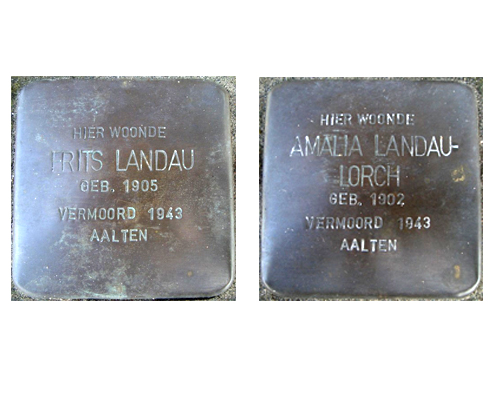
Stolpersteine Frits Landau and Amalia Landau-Lorch for the house ’t Dal nr. 1