

Cees van Beem
(Amsterdam, 1901)
Commander of the 2nd Company, DNB
A soldier through and through from Ede. Hiding, espionage, and sabotage in Aalten.
Cornelis Gijsbertus van Beem was born in Amsterdam on 28 August 1901, the son of Gijsbertus and Wilhelmina van Beem-van der Werf. His parents had married in 1898; a daughter was born the following year. The parents divorced when Cees was seven years old, and his mother remarried later that year. In 1913, his father married the widow of his deceased brother.
Cees married Mensje van Roon in Utrecht on 17 June 1926. In 1927, they had a son named Evert Cornelis. Van Beem was a professional soldier with the Eighth Artillery Regiment at the barracks in Ede, where the family also lived. Corporal Herman Lichtenberg from Aalten also worked there. As early as 1942, Herman Lichtenberg agreed with Cees van Beem, Jan Tinge, and other professional officers that they would never allow themselves to be taken into prisoner-of-war captivity. Should the call-up come, Lichtenberg promised, he would find a hiding place for his army comrades.
The call from the Wehrmacht commander in the Netherlands, ‘General der Flieger’ F. Christiansen, comes at the end of April 1943! Lichtenberg keeps his word and ensures that Cees van Beem can go into hiding in Aalten at an address in the Wolboom. Nearby, Jan Tinge is hiding at Ter Horst van ‘Hutteman’ in Dale. They are in regular contact with Bob Krul, who is the RVV commander for the eastern municipalities in the Achterhoek and has his quarters nearby in Lintelo. Van Beem and Tinge become members of the RVV. They join the resistance group in Lintelo, founded by Herman Lichtenberg and Gerrit Klein Entink. They brought the weapons from their time in the barracks with them. They provide weapons instructions to the local resistance group, which continues to grow. They themselves are primarily involved in intelligence work.
In August 1944, they ask Karel Hengeveld (a PGEM mechanic in Bredevoort) whether it is possible to use the PGEM telephone network from Bredevoort for messages and orders for the assault groups of the Home Forces in the Groenlo and Vorden districts. Hengeveld explains the possibilities to them and subsequently calls the PGEM mechanics on the Lichtenvoorde-Groenlo-Dinxperlo-Varsseveld-Doetinchem-Hengelo-Vorden telephone lines. He trusts them and asks for their cooperation and willingness to follow orders. All agree. Hengeveld arranges high-quality forged papers for Van Beem and Tinge, showing that they are PGEM mechanics. They receive additional documentation with a stamp and signature, allowing them to be outside at night after curfew. They are even introduced to the deputy Ortskommandant at the Markt in Aalten and at the office of the land guard.
In September 1944, Van Beem and Tinge have a meeting with Bob Krul, district commander of the Home Forces Region 5, regarding the formation of assault troop battalions in South-East Achterhoek. Meanwhile, Gerrit Klein Entink is fully active in spying and sabotage for ‘Albrecht’ in the region, also making use of the PGEM network. From November 1944, the cooperation in the field of espionage and sabotage between Van Beem, Tinge, Klein Entink, and the Albrecht group sector leader in Aalten runs smoothly. This sector leader is Jan Willem van Ganswijk, alias KO, who set up his office in Aalten from South Holland and instructed two female couriers in Lintelo.
Shortly after the liberation, the Dutch National Battalion is established, a process in which Cees van Beem was involved during the preparation phase. In mid-April 1945, Cees van Beem becomes commander of the 2nd company DNB. On Monday, April 16, he stands assembled with his fellow company leaders Jan Ket and Jan Tinge on the Markt in Aalten. Before them stands commander Bob Krul, and behind them is the large platoon of men from the Achterhoek and people in hiding. They then depart in Canadian trucks towards the area between Doesburg and Zutphen. When they cross the IJssel via a pontoon between Gorssel and Wilp on April 17, Cees van Beem’s eighteen-year-old son is also with his group.
In the coming months, Van Beem scrupulously wrote his daily reports on the liberation of Harderwijk, Elburg, Bunschoten, Spakenburg, and other locations. His entry on 24 May 1945 is remarkable: “The major event of this day is the arrival of Mr. H. Lichtenberg, the actual founder of the underground work in the Achterhoek. He recently left the Buchenwald concentration camp, and we consider it a great honor to have him in our midst for a few days.”
At the end of June 1945, Van Beem stepped down as commander of the 2nd Company and was succeeded by Douwe Jilderda (his deputy until then). The company was stationed in Wezep at that time. When the DNB was disbanded on 12 July, a large part of the 2nd Company transferred to the II.8.R.I. of the Royal Netherlands Army. Cees van Beem became commander of 4-II-8 R.I., the army company tasked with mine clearance and the guarding of the German prisoners of war who had to carry out this work.
Information regarding his profession after the war is not currently available. It is presumed that he continued his career as a professional soldier.
Cees van Beem passed away in Utrecht on 23 November 1950. According to the certificate, his place of residence was still Ede. His profession was listed as ‘Captain’.
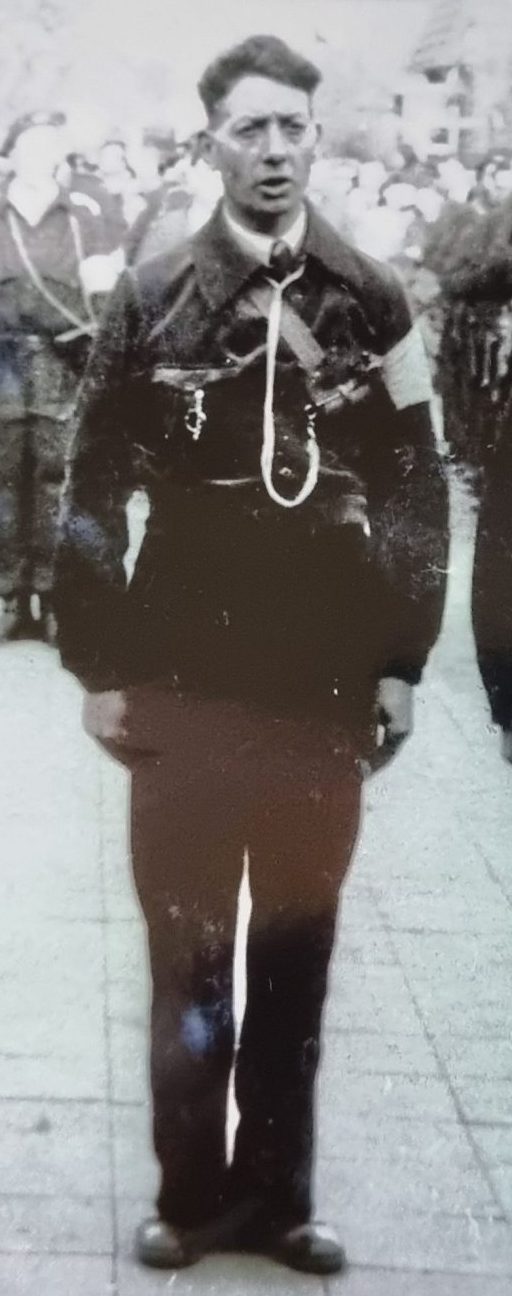
Cees van Beem