
Frans Brouwer: Cartoons as Resistance
Unique comic strips and satire during the Nazi occupation
‘A picture is worth a thousand words.’ This expression has rarely been as fitting as it is for the work of Frans Brouwer (1906–1964). During the Second World War, this radio technician used his pencil as a weapon. Under the title ‘Krabbels en Klodders’ (Scribbles and Splashes), he used biting irony to provide a counterweight to the suffocating propaganda of the occupier.
Between 18 April 1944 and 10 May 1945, working from his home in Voorburg, Frans Brouwer filled his sketchbook with a total of 33 visual stories. Brouwer, who worked as a radio technician at Siemens, provided sharp commentary on life under occupation through these drawings.
The manuscript forms a unique historical record. The 33 illustrated two-page letters address a wide range of daily hardships: from the NSB (Dutch Nazi Party) and the raids for the Arbeitseinsatz (forced labour) to the German requisitioning of goods and the inventive ways people stayed warm with emergency stoves during the bitter Hunger Winter. Major military turning points such as D-Day and the eventual liberation also featured in his satirical strips.
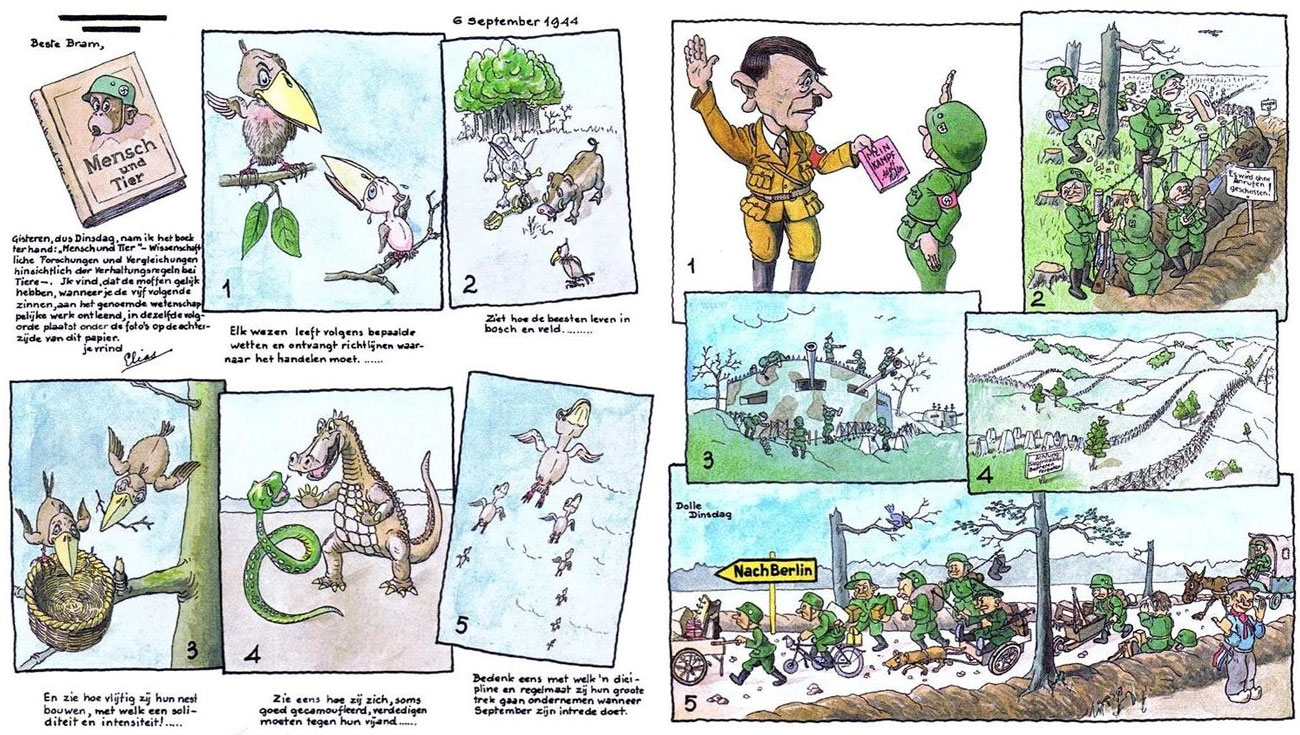
Frans Brouwer – Krabbels en Klodders, 6 September 1944
Dangerous Amusement
Although the cartoons were full of humour, creating them was life-threatening. The letters, written from and to fictional persons, were never sent during the war; they could not be allowed to fall into the wrong hands under any circumstances. Brouwer was well aware of the risk, remarking: “I don’t believe those in the NSB share my sense of humour.”
His resistance was bold and visually ingenious. A famous example is a postcard depicting Adolf Hitler on a toilet; by folding the card in a specific way, a mocking image was revealed. The historical value of this work was recognised early on by the renowned historian Dr Loe de Jong. In 1951, De Jong wrote personally to Brouwer:
“I know of no work more successful than yours, nor any that contains better examples of genuine humour from the occupation. (…) Your piece belongs in a national collection.”
The Path to the Public
It was only after the liberation that Brouwer went public with his work. Despite De Jong’s praise, finding a publisher proved difficult at the time, officially due to a shortage of paper and ink. Frans Brouwer passed away in 1964 without his manuscript ever being published.
The drawings remained in the family archives for decades, until his sister’s grandson rediscovered the power of the cartoons. Thanks to his efforts, the collection was finally published in book form by Matrijs in 2010, ensuring that eighty years later, Frans Brouwer’s ‘Krabbels en Klodders’ have lost none of their impact.
Propaganda and Counterforce
Brouwer’s work symbolises civic courage in a public space that was then dominated by the Nazi propaganda machine. The resistance responded to enemy slogans with secretly posted leaflets and biting satire. The story of Evert Smilda, who as a young boy had to help his father post these bills, illustrates how citizens stood their ground. Frans Brouwer’s work forms the artistic crown of this civil resistance.
Book Tip
Frans Brouwer’s work is available in a beautifully illustrated book: ‘Bezetting in Beeld – Het beeldverhaal van Frans Brouwer’ (published by Matrijs). It provides an account of the war years and the life of the artist himself. It is a timeless tribute to the power of humour and is highly recommended for anyone interested in creative resistance.
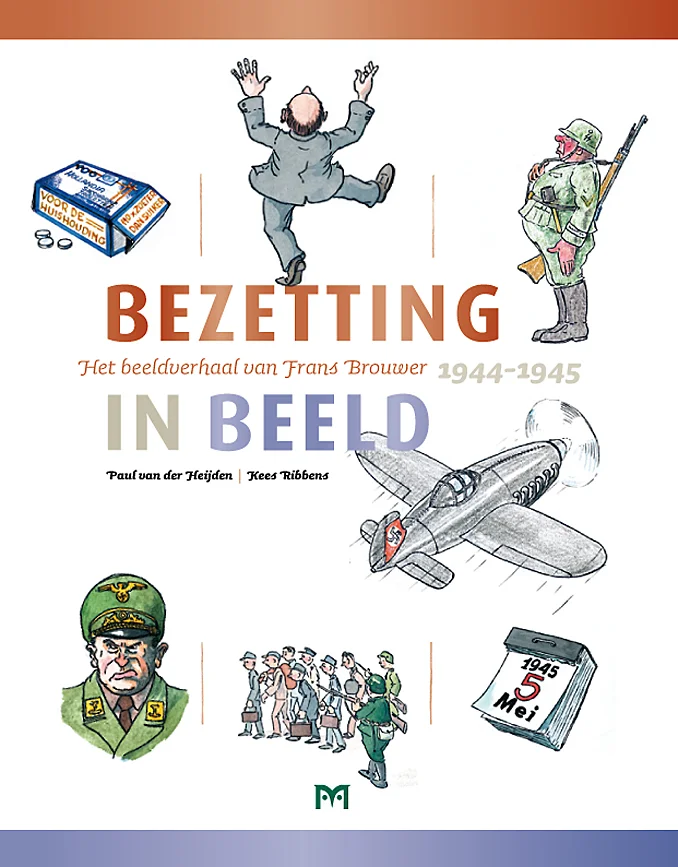
The Occupation in Pictures – The Comic Strip by Frans Brouwer, 1944–1945