

Montferland
Poem ‘Our cabin’
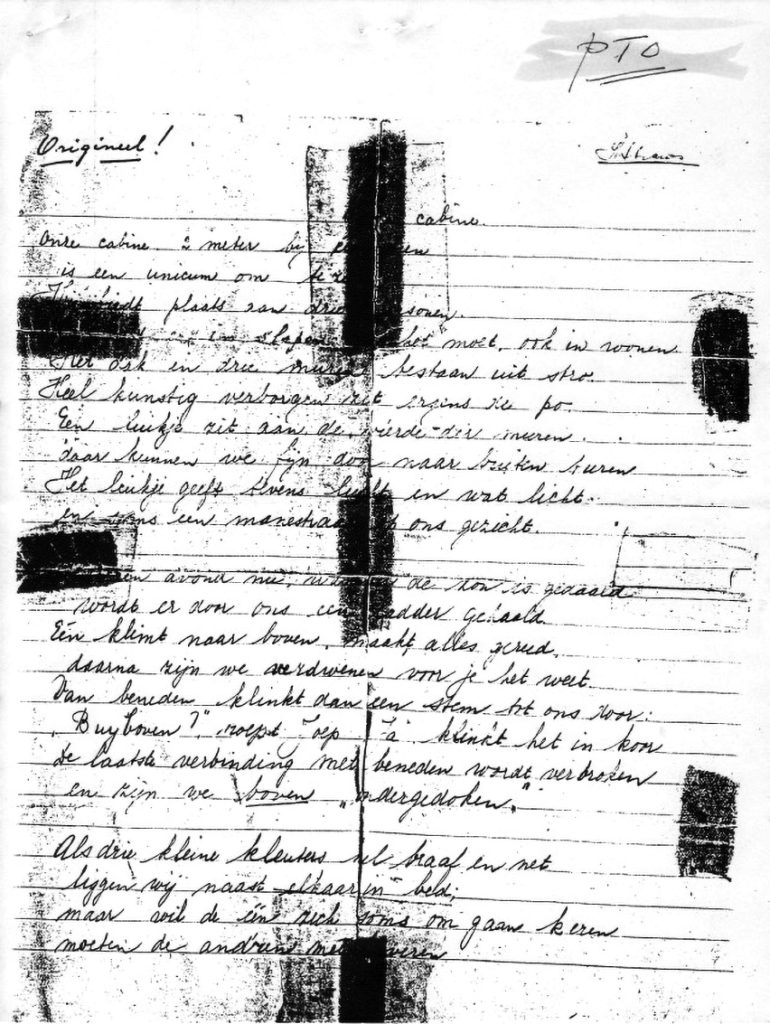
The Garben family’s farm in Montferland is a temporary shelter for wounded Allies. In the hayloft, above the cows, the Jewish Betty Straus has been hiding for a year and a half, together with her brother and sister. They survive the war and Sara Betty Straus leaves for Los Angeles USA after the war. Sara Betty writes a poem about the liberation in which she reflects what it is like to live in a clump together.
The line ‘And are we in hiding upstairs’ was the inspiration for the design of the Resistance Monument in Azewijn, which was unveiled in 2021.
The original manuscript of the poem is now kept in the Holocaust Museum in Washington DC.
OUR CABIN
Our cabin, two meters by one ten
is unique to see.
It can accommodate three people
You can sleep in it; If necessary, also in housing.
The roof and three walls are made of straw.
Very artfully hidden is the potty somewhere.
A hatch is on the fourth of the walls,
We can stare out through it.
The hatch also provides air and some light
and sometimes a moonbeam on our faces.
Every evening now, when the sun has gone down
a ladder is fetched by us.
One climbs up, prepares everything,
Then we’ll be gone before you know it.
From below a voice resounds to us:
“Bu’j baoven?”, Joep shouts, “Yes” it sounds in unison.
The last connection to downstairs is broken
and we are above “hiding”.
Like three little toddlers very well behaved and neat
we lie next to each other in bed;
but sometimes one wants to turn around
the others have to navigate along.
Sometimes it goes fast, it sometimes goes rough,
One gives you a blow, the other a push.
And as you will understand
The neutrals also get the blows here.
Sometimes, it’s really unheard of,
we are very disturbed by rats.
They arrive with a lot of trotting,
but Harry grabs an iron bar
and port in the straw with a lot of noise.
The rats run off in fright.
Yet we sleep despite all the worries,
from early in the evening until morning.
Joep comes and opens the door again
the daily grind begins for us
of spinning, knitting and good food,
so that you would almost forget about the war.
However, we have to comply and still keep courage.
Keep trusting in God; one day it will be all right again.
Therefore, in conclusion, the heartfelt prayer:
“May there come soon, a long peace!”
Azewijn, Easter 1944
Source: https://www.berghapedia.nl/index.php?title=Bestand:Onze_cabine_handschrift-1.jpg
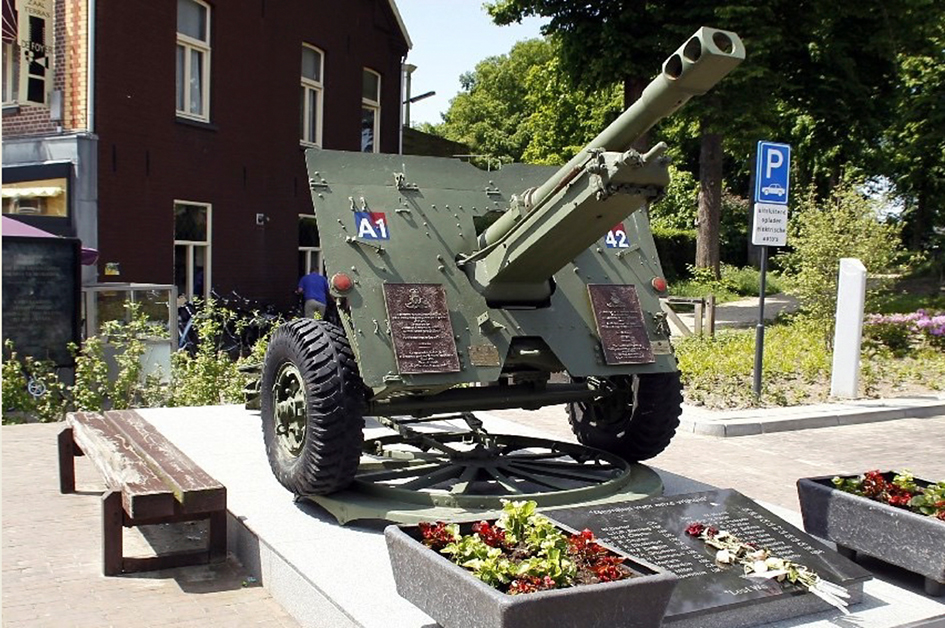
Canadian 25-pounder gun
On 3 May 2010, the 4 May Commemoration Committee placed a Canadian cannon on the Bleek in ‘s-Heerenberg in honour of the Canadian liberators. The monument was unveiled on 5 May 2010. The cannon was placed in ‘s-Heerenberg precisely because this city above the Rhine was liberated by the Canadians.
The 25-pounder that is located in ‘s-Heerenberg was deployed in the eastern part of the Netherlands during the Second World War and was entered via Netterden Nederland just after April 1, 1945. This gun was also used in the Gulf War, then used by the Irish artillery.
In 2009, the Irish army took the 25-pounders out of armament and all the pieces went back to Canada to be dismantled. Two 25-pounders have been donated to Europe by the Canadian artillery, one is near the invasion beach in Normandy and the other in ‘s-Heerenberg.
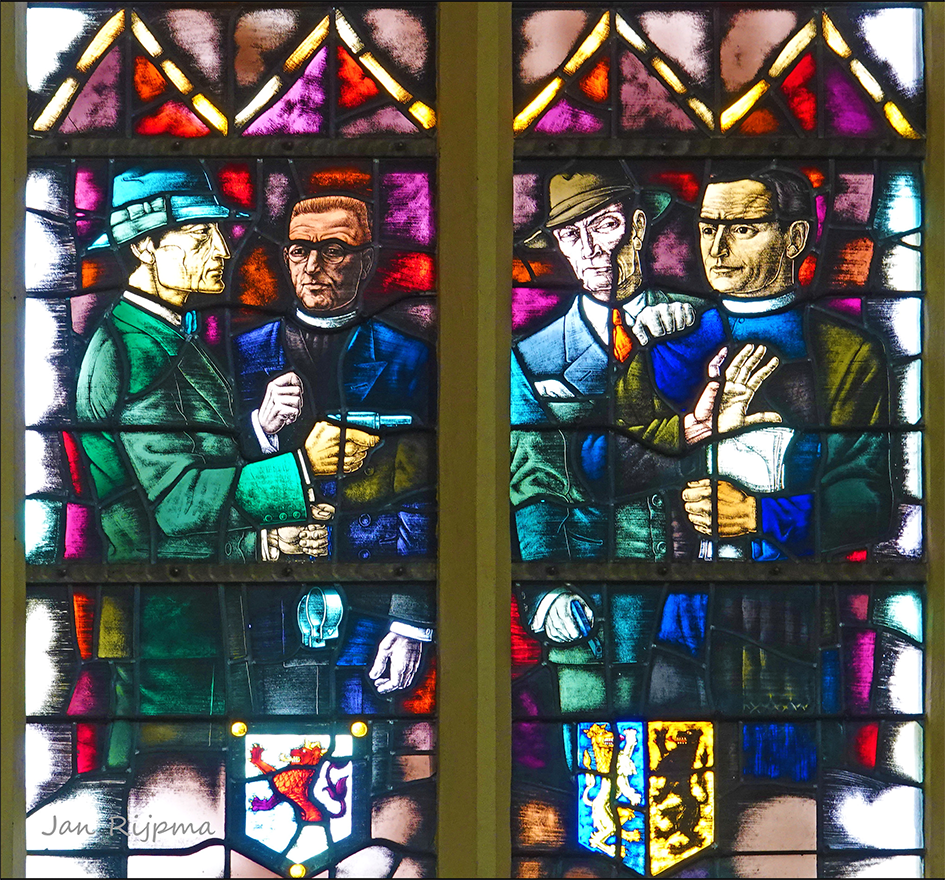
Stained glass window St. Pancratius Church
During the Second World War, pastor Galama and chaplain Van Rooijen from ‘s-Heerenberg were captured by the Nazis and deported to Dachau concentration camp, where they were murdered.
Protest of the episcopate against German oppression
On August 5, 1941, a pastoral letter from the episcopate—the joint bishops of the Catholic Church—was read in all Catholic churches in the Netherlands. In this letter, they spoke out strongly against the oppression by the German occupier. Because the Nazis had banned the free press, many priests decided to reproduce the letter and distribute it door-to-door so that people could read it at home.
Arrest and deportation
The Germans reacted furiously. Without trial, pastor Galama and chaplains Van Rooijen and Hegge were arrested and detained as criminals in the House of Detention in Arnhem. The official charge was that they had distributed an “enemy letter” and had incited the people against the Germans.
The agony in the concentration camps
Chaplain Hegge was transferred to the concentration camps of Amersfoort, Vught and finally Bergen-Belsen. There he was liberated by the Allies on 15 April 1945. Chaplain Van Rooijen was sent via camp Oranienburg to Dachau, where he died in 1942 of exhaustion and starvation. Pastor Galama was deported directly from Arnhem to Dachau and murdered a week after Van Rooijen after a heroic agony.
Remembrance and tribute
To keep their memory alive, stained glass windows have been placed in the Pancratius Church in ‘s-Heerenberg in memory of their suffering and sacrifice. In addition, they are honored on the war memorial and by streets named after them.
A return ticket to the Netherlands
After the Second World War, the Netherlands demanded compensation of 25 billion guilders from Germany. After the German surrender, plans soon arose to compensate for the war damage, the suffering of hundreds of thousands and the destruction. The Netherlands wanted to achieve this partly by annexing a piece of German territory.
Annexation of three German villages
The Netherlands eventually received permission from the Allies to annex 69 square kilometers of German territory, with about 9500 German inhabitants. This concerned three areas:
- Suderwick, a twin village on the border with Dinxperlo in Münsterland.
- Tüddern, near Sittard, near Geilenkirchen and Heinsberg.
- Elten, located on the Lower Rhine, just across the border at Babberich and ‘s-Heerenberg.
Dutch military police takes over
EltenOn Saturday, April 23, 1949 at 12:00 noon, the Dutch military police, armed and in jeeps, entered the town hall of Elten. Journalists recorded how the transfer of power went without resistance. According to tradition, a drunken man sang the German national anthem, but otherwise it remained quiet.
In total, about 10,000 inhabitants of these areas lived under Dutch administration for 14 years, from 23 April 1949 to 1 August 1963. They were given a Dutch identity card and were treated as Dutch citizens.
The ‘Eltener Butternacht’: a clever smuggling trick
Just before Elten became German again on August 1, 1963, a remarkable smuggling operation took place, known as the Eltener Butternacht. Dutch and German traders made clever use of the changing border situation.
Butter, eggs, coffee and textiles—products that were much more expensive in Germany—were massively stored in warehouses and trucks. In the night of July 31 to August 1, 1963, these goods were loaded into trucks. When Elten was officially German again the next morning, the goods were suddenly on German territory, without having to cross a border. As a result, no import duties had to be paid, and traders made millions with this smart move!
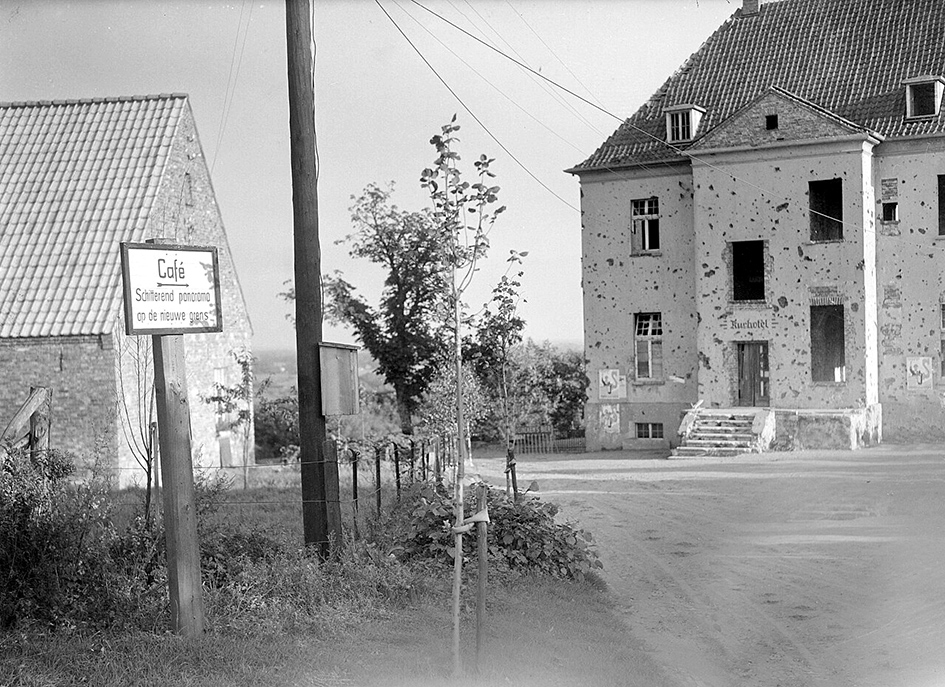
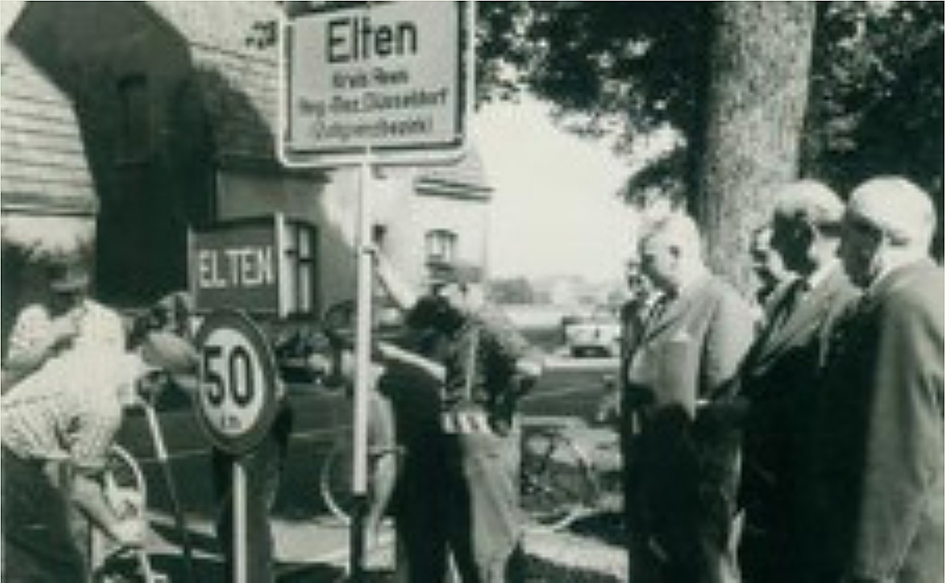
Elten | Photos: Heemkunde Kring Bergh