
East Gelre
Little England
The flight path of tens of thousands of Allied planes to Germany during the Second World War often passes over the Achterhoek airspace. Hundreds of planes have crashed in the border region and the Achterhoek. From the triangle of Achterhoek, Hengelo and Raalte (Overijssel), crew members of crashed planes and escaped soldiers from German captivity come to Lichtenvoorde via the resistance, the so-called Pilot Line . They were given a hiding place, clothing and food. If the coast seemed clear, they were then led through occupied territory to South Limburg and North Brabant, and then via Belgium to liberated territory. The important role that Lichtenvoorde plays in this Pilot Line gives it the nickname Little England (Source: Henny Bennink, “Occupation and resistance”, Publisher Fagus Aalten, 2005).
The story of Dina Geurink
Dina Geurink-Wisselink works with her three children on the potato field near the farm in Lichtenvoorde, September 1944. She looks up at the swarm of Allied planes flying over towards Germany. This goes on day and night during that time. The photo is included in the national selection and publication The Second World War in 100 photos. It draws attention to the underexposed story of Lichtenvoorde and the Escape Line: the Pilot Line. There are also people in hiding on the farm of the Geurink family, in addition to three Jewish young men, an Arbeitseinsatzweigeraar, also a Russian pilot who had fled across the border from a crashed plane. And of course Willem Geurink also had to go into hiding himself.
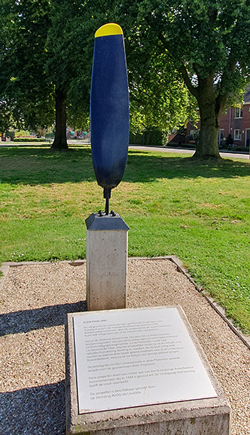
The “Little England” monument on Joep ter Haarplein in Lichtenvoorde
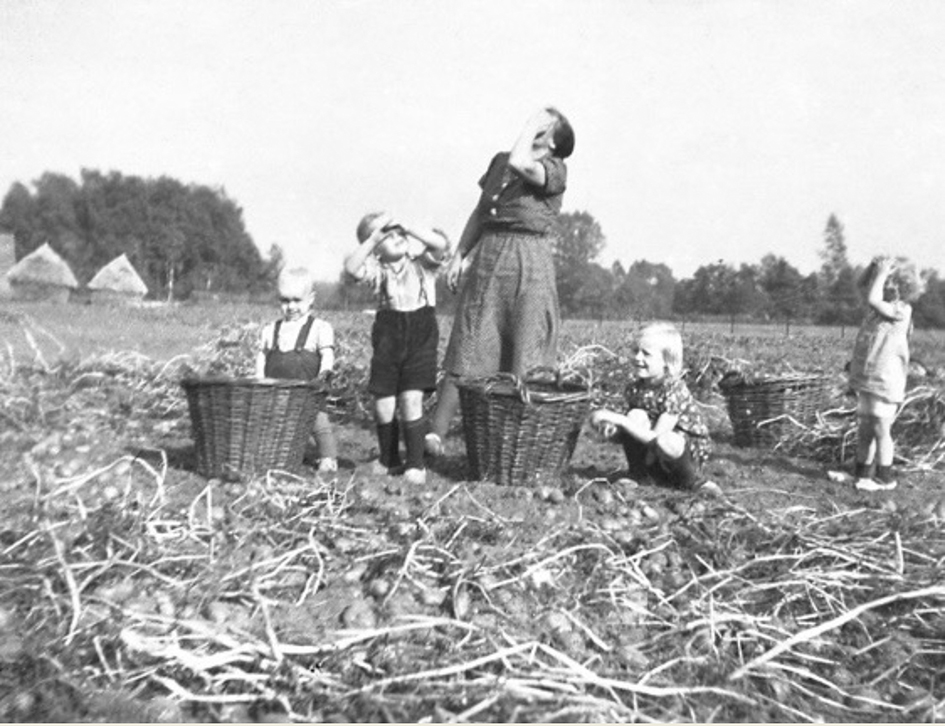
Dina Geurink with children on land watching planes flying overhead, Lichtenvoorde September 1944
Crash Museum Lievelde
First aid at random
In the first year of the Second World War, there is still no organized help for crashed pilots. Survivors of crashed planes or escaped Allied pilots from German camps sought refuge themselves and randomly clinged to civilians.
Origin of organized pilot assistance
As the resistance in the Achterhoek cooperates better, especially within the National Organization for Aid to People in Hiding (LO), a well-organized pilot aid arises in Lichtenvoorde. Pilots are given farmer’s clothing instead of their recognizable uniforms and are housed in safe locations. They are then taken to liberated territory in the south.
Hiding after Market Garden
After the failure of Operation Market Garden in 1944, the route to the south was closed. Pilots can no longer escape and have to go into hiding. Meanwhile, the resistance is secretly preparing for liberation.
The ‘Forgotten Battalion’
During the last months of the war, hundreds of resistance fighters and people in hiding marched together with the Allies in a unit known as the Dutch National Battalion, also known as the Forgotten Battalion .
From spontaneous help to a close-knit group
In the beginning, pilot assistance is not a conscious choice. Pilots who arrive in Lichtenvoorde immediately ask for repatriation. Some men and women offer help spontaneously, assuming that this is a one-off. But as more and more Canadian and French pilots managed to escape and the Allies stepped up their bombing raids on the Ruhr area, the need for help grew. The group of pilot helpers in Lichtenvoorde eventually expands to about ten people.
Source: Henny Bennink, “Occupation and resistance”, Publisher Fagus Aalten, 2005
More depth can be found on www.crashmuseum.nl.
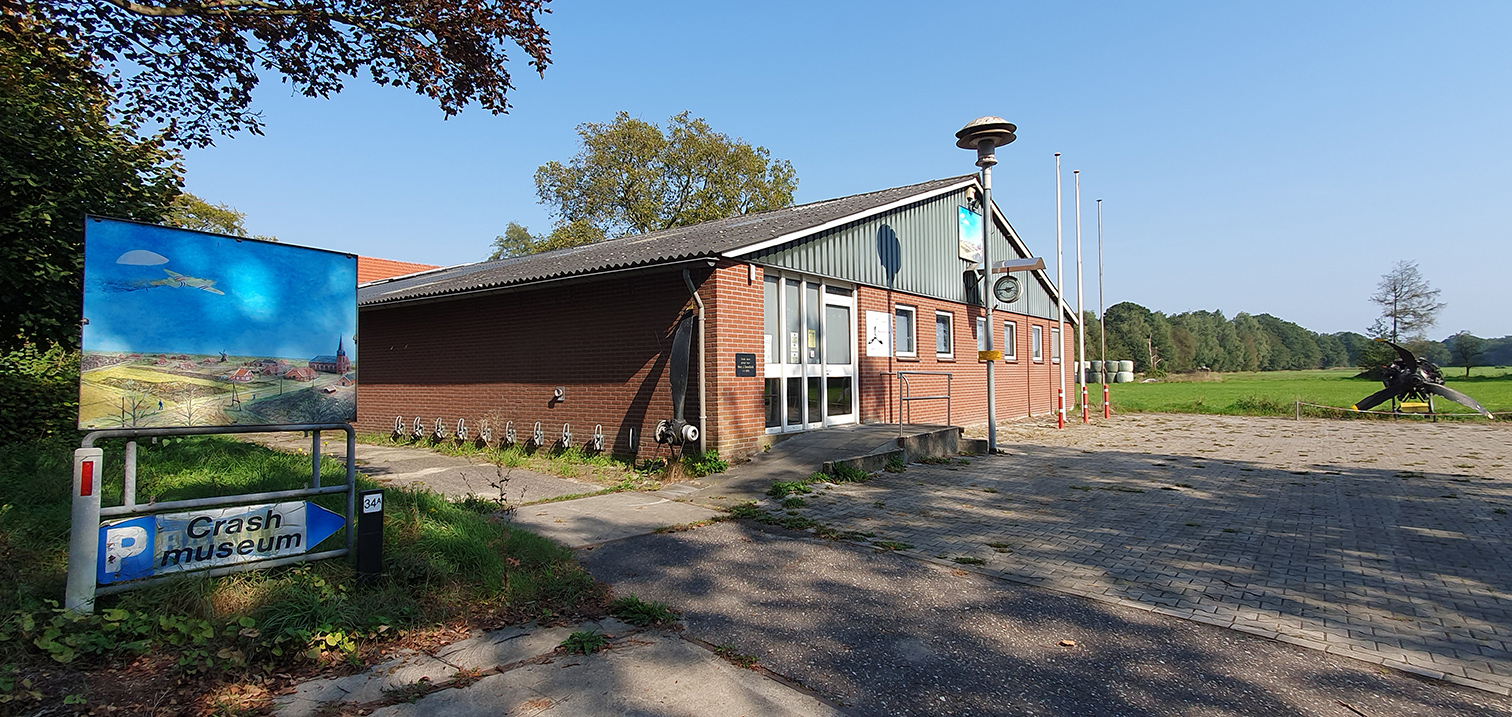
The AVOG Crash Museum was established as a tribute to the Allied airmen. Hundreds of planes have crashed in the Achterhoek.
Commemorating victims
The Jewish labour camp in Lievelde was used for Jewish forced labourers from 18 August 1942 to 3 October 1942. The forced labourers were used, among other things, in the construction of the municipal dirt road on the Huttendijk in Lievelde. The Jewish forced labourers did heavy work, they had to remove layers of loam from the road so that the rainwater in the tracks could drain away better. Here and there, sometimes one and a half meters deep has to be digged. The heavy work must be carried out with spades and wheelbarrows. They live in barracks in minimal conditions. The NSB mayor Lamers has no mercy for the workers and is known as a ‘Jew hunter’.
In the night of 2 to 3 October 1942, all 50 Jewish men were led to Lievelde station, from there they took the train to Westerbork and then to the extermination camps to murder them.
Commemoration and remembrance
There are several monuments in the municipality to commemorate the persecuted who perished. For example, the Glass Monument on the Winterswijkseweg in Groenlo, commemorates the perished persecuted and other civilian victims, including 60 Jewish civilians. Every year on May 4, the 4 and 5 May Groenlo committee holds the Remembrance Day at this monument.
Sources: https://www.joodswerkkamplievelde.nl/index.html
https://nl.wikipedia.org/wiki/Bestand:Glazenmonument_40-45_Groenlo.jpg
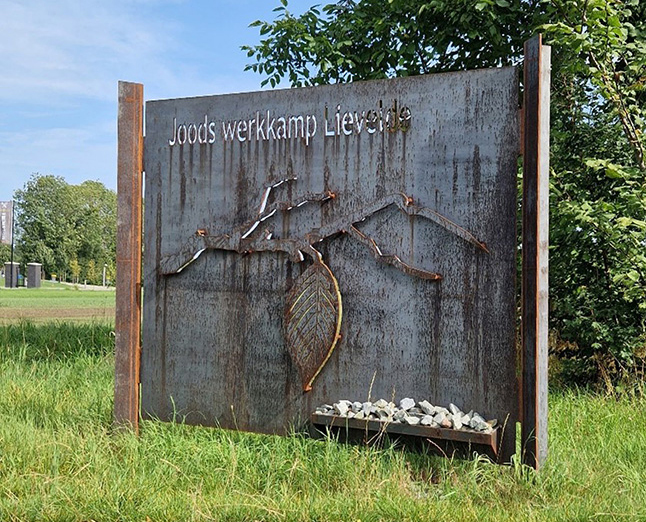
The monument at the former Jewish labour camp in Lievelde
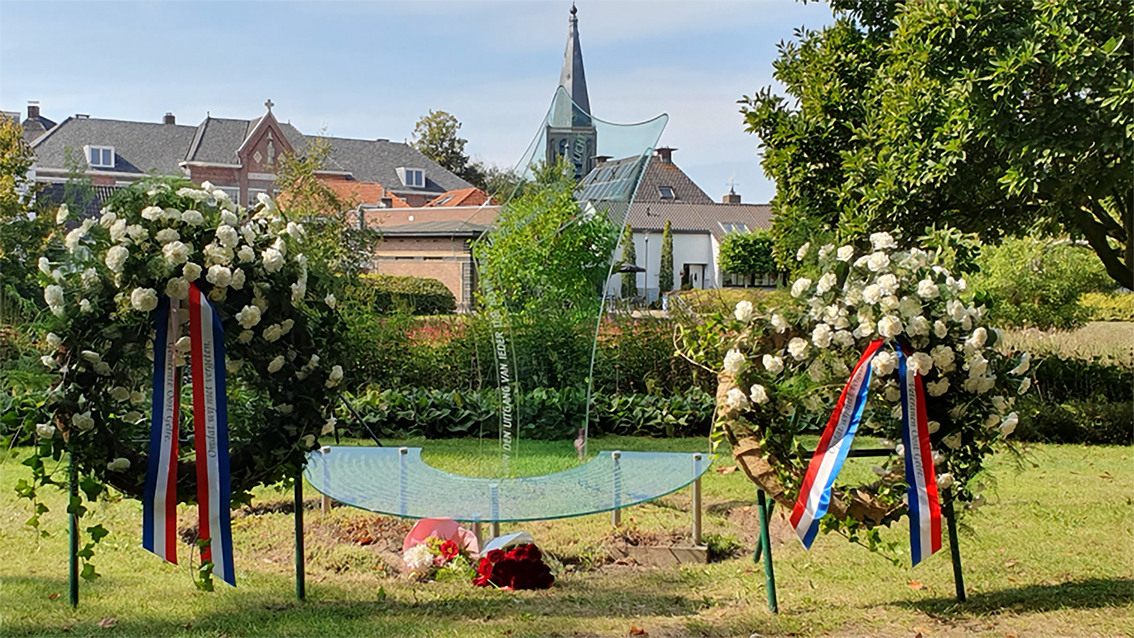
Every year on May 4, the 4 and 5 May Groenlo committee holds the Remembrance Day at this monument
Emergency Hospital Harreveld
In the Achterhoek, more than a thousand sick forced labourers are taken care of and nursed in eight emergency hospitals, including the monastery of the White Fathers in ‘s-Heerenberg. In Harreveld, a large regional emergency hospital was set up to treat the severely weakened men.
Fight for better care
Doctor Johannes Der Weduwen and Clemens Driessen, director of a textile factory in Aalten, are committed to better treatment of the forced labourers from the Bocholt and Rees labour camps. They managed to bring more than 1000 men from camp Rees to the emergency hospital in Harreveld. Many of them were arrested during the raid of Rotterdam.
Shocking reporting
On 26 and 27 January 1945, an extensive report was made on the condition of the men. The report paints a shocking picture:
“The general impression is: very strong malnutrition, manifesting itself in such emaciation in very many that one can only speak of emaciation. Some so weak that they cannot walk, most are carried. In addition to this emaciation and sunken faces, there are some marked oedemas of the lower legs, as a result of malnutrition (hunger oedema). The general impression is also extreme soiling of the body and clothing, with general lice by head lice, in many cases clothes lice. ……./”
Tragic end for Doctor Der Weduwen
Doctor Der Weduwen travels to The Hague to plead for better treatment of the prisoners. On the way back, he was shot at from the air near Apeldoorn and did not survive the attack.
For more information
http://dwangarbeidersapeldoorn.nl/gebeurtenissen/transporten-rees-harreveld-27-01-1945/
From Transcript Emergency Hospital H a r r e v e l d G.J. War
Source: National Archives and NRK. (Archive block LB NRK 1945-1985)
See also: about Der Weduwen: National Hiding Museum, Research team, Ina Brethouwer
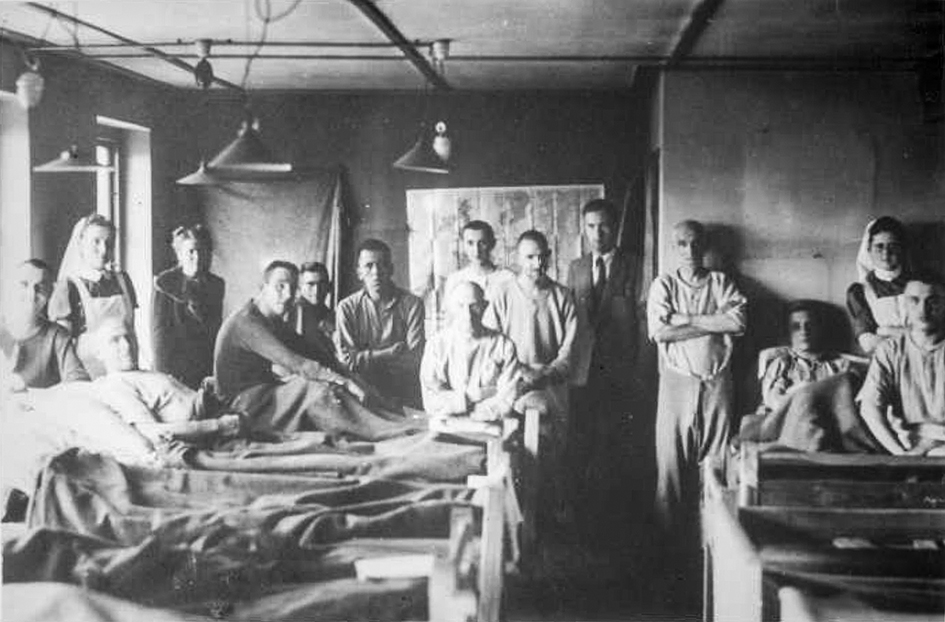
Rescued as a forced labourer from camp Rees in the Emergency Hospital in Harreveld