
Bronckhorst
The Kervel House
The Kervel is a centuries-old country estate west of Hengelo and consists of a main building, an attached house, a chapel, a former rector’s residence and a beautiful historic landscape.
In 1941, the Kervel was rented by Ben and Alie de Graaf, who turned it into a popular holiday home. Soon there were also people in hiding, initially they were mainly Arbeitseinsatz refusers and students from Utrecht and Delft, among others. A little later there are also Jewish people in hiding on the Kervel and around the cold Christmas of 1942 the whole house is full of guests. As early as 1941, Ben de Graaf had contact with Loek Visser’s resistance group from the Ede-Arnhem area. There is already a need for good shelters for emergencies. With the deportation of the Jewish citizens in 1943, a group of young people led by the Hengelo contractor Bretveld started digging underground passages and setting up a living space underground. This can be reached via a mobile fireplace. A group of people in hiding (mainly Jewish) lived underground from April 1943 to April 27, 1944. In the night of 26 to 27 April 1944, a raid took place, while at that very moment people were getting some fresh air outside. Thirteen people are arrested and taken to the Koepelgevangenis in Arnhem. Among them are four Jewish people in hiding who are deported and murdered.
The underground hiding place was not discovered that night so that the other Jewish people in hiding could escape and thus survive the war.
From October 1944 to 1 July 1945, Het Kervel served as an emergency hospital under the management of the Red Cross.
After the liberation, repatriated Jews were taken care of under the leadership of Ben de Graaf. After that, it served as a convent for the nuns. Since then it has had several owners. The Kervel is now a conference center. Guided tours are given by appointment about the history of the people in hiding.
Hermans, W.J.M. Address Kervel-kelder, hiding place for Jews, Hengelo (Gld), 2006
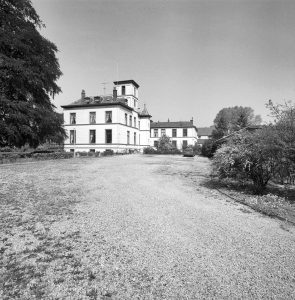
The Chervil (c) Cultural Heritage Agency of the Netherlands
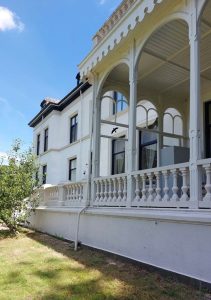
Photo: Elise Harmsen
World Peace Flame (WPF)
The World Peace Flame (WPF) is a symbol of peace, unity and freedom. The goal is to inspire people and let them experience that every individual can play an important role in achieving peace at every level of society
The World Peace Flame Foundation aims to achieve its goal through education and support for peace initiatives. The dream is to ignite an ever-burning World Peace Flame in every major city and decision-making center in the world. It is a dream cherished from 1999 when the first Peace Flames were lit on all 5 continents. Each flame was then brought to the United Kingdom by plane and brought together in Wales to form the World Peace Flame (WPF).
The World Peace Flame burns in thousands of schools, businesses, hospitals, churches, temples and reflection centers around the world. The flame is offered to international leaders and has been installed in monuments and cities around the world, including in the Netherlands at the Peace Palace in The Hague, Venlo, Nijmegen, Enschede and also in the municipality of Bronckhorst.
On September 21, 2017, the World Peace Flame was unveiled on the square in front of the Remigius Church in Hengelo. The flame has been burning non-stop there ever since. The Bronckhorst World Peace Flame working group organizes various activities, especially during the annual World Peace Week (third week of September).
Read more about The World Peace Flame: https://www.wpfbronckhorst.nl
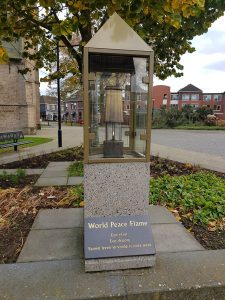
World Peace Flame – Bronckhorst

Commemoration and remembrance
The listening stone about the drama of Baak
The war is almost over. Baak was liberated on 2 April 1945. Nevertheless, the occupying forces still resist and fire grenades. This gunfight claimed 14 more lives in Baak, including seven children. A grenade even cost the lives of eight residents. To commemorate this tragedy, a listening stone was placed on this spot in 2013 where this story is told. The listening stone is part of the Liberation Route Europe (LRE).
The listening stones are boulders with a plaque with a QR code attached to them that immediately offers the possibility to listen to information by telephone. The listening stones in the Achterhoek and Liemers are part of the so-called ‘Liberation Route Europe’. It follows the route of the Allied liberators in 1944 and 1945. Scattered in the Achterhoek and Liemers, several listening stones have been placed about special events.
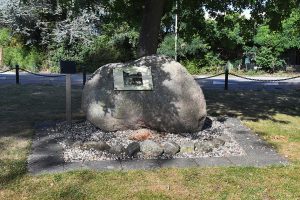
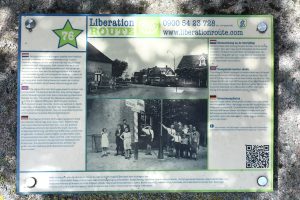
Listening stone Baak
Memorial Agterkamp and Besselink in Steenderen
Jan Willem Agterkamp and Bernard Besselink are neighbors. They help two pilots escape to England. Unfortunately, they are betrayed and arrested. The pilots are arrested by the occupying forces and the men are sentenced to death for aiding the enemy. They are executed in the dunes in Bloemendaal. Agterkamp is buried at the general cemetery in Steenderen. Besselink will be (re)buried in the honorary cemetery of the War Graves Foundation in Loenen.
At the former town hall in Steenderen there is a monument in memory of these brave men. Every year a commemoration takes place here on May 4.
Source: https://oorlogsgravenstichting.nl/personen/1698/jan-willem-agterkamp
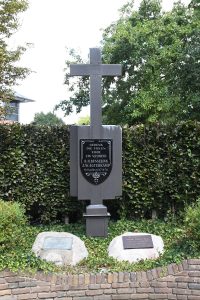
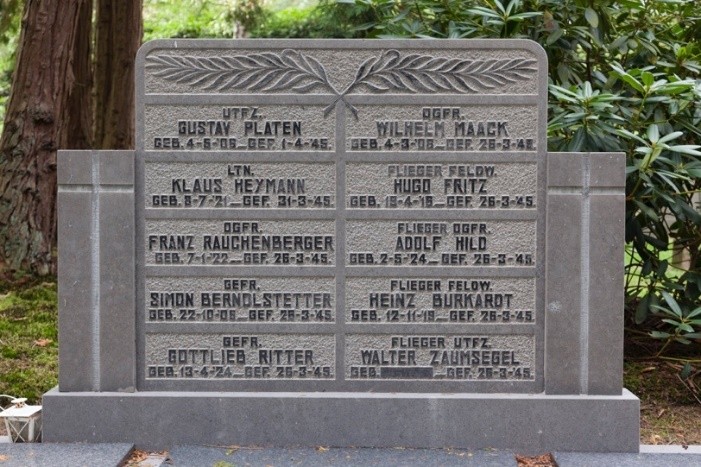
Grave German Soldiers
In the municipality of Brockhorst, German pilots and soldiers are also buried at the cemetery in Vorden. This is special because after the war, almost all German soldiers who died on Dutch soil in WW1 and WW2 were transferred to the Ysselsteyn German War Cemetery (Limburg). There, all graves are provided with the same concrete cross.
The ten German soldiers in Vorden died during the liberation at the end of March 1945 in the vicinity of the municipality of Bronckhorst. The father of one of them (Adolf Hild, 20 years old) does not want his son to be placed in an anonymous grave in Ysselsteyn. He decides to buy a joint grave and provide it with a natural stone grave covering in memory of his son and the other men.
The so-called ‘comrades’ grave’ of the ten German soldiers is located near the fallen Allied graves. Relatives lay flowers at the grave every year.
These 10 German soldiers are buried
in Vorden Gustav Platen – Non-commissioned officer, pilot
Klaus Heymann – Lieutenant (presumably shot as a deserter by colleagues)
Franz Rauchenberger – Chief Corporal
Simon Berndlstetter – Corporal
Gottlieb Ritter – Corporal
Wilhelm Maack – Supreme Corporal
Hugo Fritz – Sergeant, pilot
Adolf Hild – Chief corporal, pilot
Heinz Burkhardt – Sergeant, pilot
Walter Zaumsegel – Non-commissioned officer, pilot
Commemorating and with Germans together is still a very sensitive issue. The celebration of freedom is often done across borders by the border municipalities of the Achterhoek, from the awareness of the joint responsibility for freedom.
In the podcast Ten Germans, one grave , reporters Judah Bolink and Nieke Hoitink discuss the commemoration in Vorden (2012) and the tensions it raised nationwide, link via Apple Podcasts or Spotify.
Source: https://www.tracesofwar.nl/sights/4771/Duitse-Oorlogsgraven-Vorden.htm