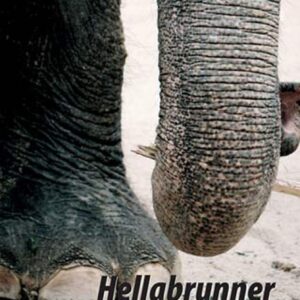
‘Hellabrunner Mischung’ is the second book by writer Georg Beining (1948), a geologist/palaeontologist/journalist from Südlohn, just across the border. The thriller is written in German and has Aalten (Markt 12), Bredevoort, Oeding and Münster as its main locations. Beining was clearly inspired by one or more visits to the National Hiding Museum and uses this place as the center of the storylines.
The story is not based on living people, but the history around Markt 12 is based on truth. The fact that it is written in German adds something to the experience. The crime begins in October 1941 but continues after only two pages in 2011. Every now and then the story harks back to the past.
The most important characters are Gregor Kotten, who lives in Oeding and is spokesperson for the zoo in Münster, his wife Milla, and their friends Arie and Ria van Puffelen in Bredevoort. There is also a retired detective Jurgeleit. This detective and Kotten like to solve riddles together, with the help of the friends. The schemer and perpetrator is a certain Rufus Schill, the grandson of the former Ortskommandant Ludwig von Schill. During the war, this SS man had his office in the front room of Markt 12 in Aalten. Rufus is a weird one and he works at the zoo just like Kotten, he is an animal caretaker with the elephants. He has specialized well in the technique of performing anesthesia through a blowpipe. This anesthetic veterinary fluid is called Hellabrunner Mischung, hence the title.
The book reads well and is especially fascinating if you know the museum and the streets and beautiful places between Heurne/Aalten/Winterswijk and the region on the other side of the border. There are nice sentences in it such as “Obelink Winterswijk, where the entire Ruhr area goes on a pilgrimage”. You can see it in front of you. How the conversation between a Dutch and German couple proceeds is beautifully depicted. Of course, they speak German. It is somewhat unbelievable that Arie from Bredevoort, who supposedly speaks German well according to Kotten and knows a lot about it, really has all the cases wrong and systematically speaks of “die Kerl”. I don’t think any Achterhoeker will say “die Kerl” when he speaks German.
The writer knows a lot about the Netherlands, but also makes a mistake himself (just like Arie): animal doctor and madam. But hey, the German reader won’t notice it and it’s nice for the German reader to learn more about certain pleasures, such as gin, hops, applesauce and custard.
The history from the war that has repercussions in the present is presented rather briefly, with the names of many characters being mentioned. The reader then has to keep his head in the game. Here and there the reader expects some interesting data to be explored further, but that does not happen. Actually, you shouldn’t blame the writer for this.
It is nice that he makes it clear that in 1941 2500 people from all over the country were housed in Aalten out of a population of 13000 souls. It is sympathetic that Beining has been inspired – as he writes at the end of the book – by all those volunteers of the Aaltens museum who do exceptionally good work. In his opinion, the museum depicts history so well that it makes a big impression. That is nice to read, especially for all those volunteers and the sympathizers of the museum!
Ina Brethouwer
“Hellabrunner Mischung” – Ein Allwetterzoo-Münster-Krimi by Georg Beining
Schardt Verlag, Oldenburg 2013, 162 pages, 12.80 Euro, ISBN 978-3-89841-677-1