
Berkelland
The raid in 1943
Istvan Balint and Mien Zion from Eibergen went into hiding soon after their marriage on 24 August 1942. From faith there was the conviction that we must support each other in order to survive together in dark times of horrific oppression. Mien thus finds shelter with Reverend Koers and Istvan on the farm of the Kottelenberg family in Neede. Mien’s brother Juul, and from January 1943 her sister Johanna and her baby Maxje, are also there.
During the raid in Eibergen on 28 March 1943, they were also betrayed. Istvan, Johanna and the two-month-old baby were arrested and transported via Westerbork to Sobibor, where they were murdered on 13 April 1943. Only Juul escapes through the tunnel that has been dug under the kitchen table to the chicken coop. Until the end of the war, he found a safe hiding place with the Mateman family in Eibergen, together with his sisters Mien and Frieda.
Source: www.joodsmonument.nl
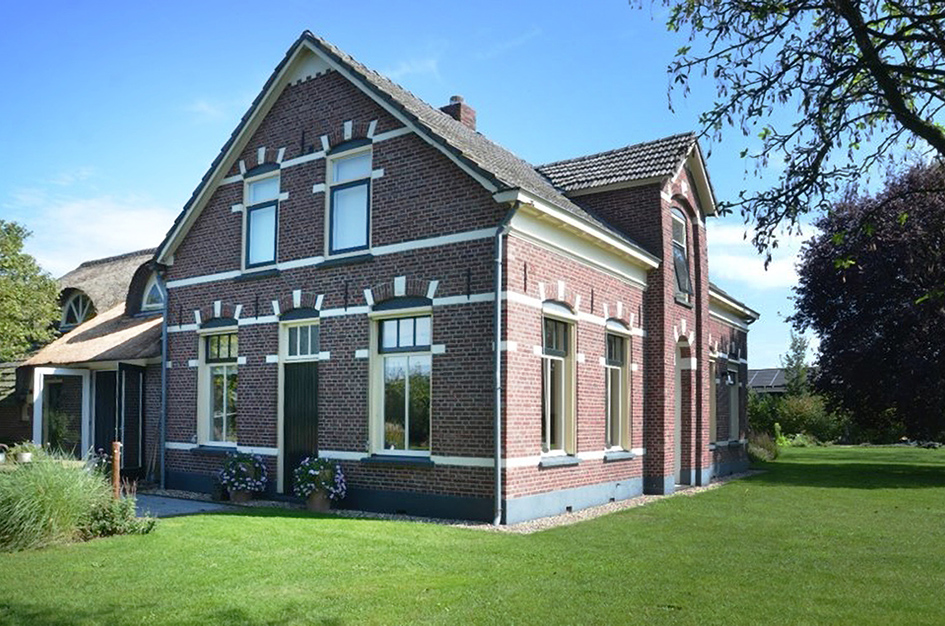
The house of the Kottelenbergs, now Berendsen, on the Stobbesteeg Noordijk/Neede. On the right was the area where the Zion family resided.
Photo J. Seebus
Freedom Forest
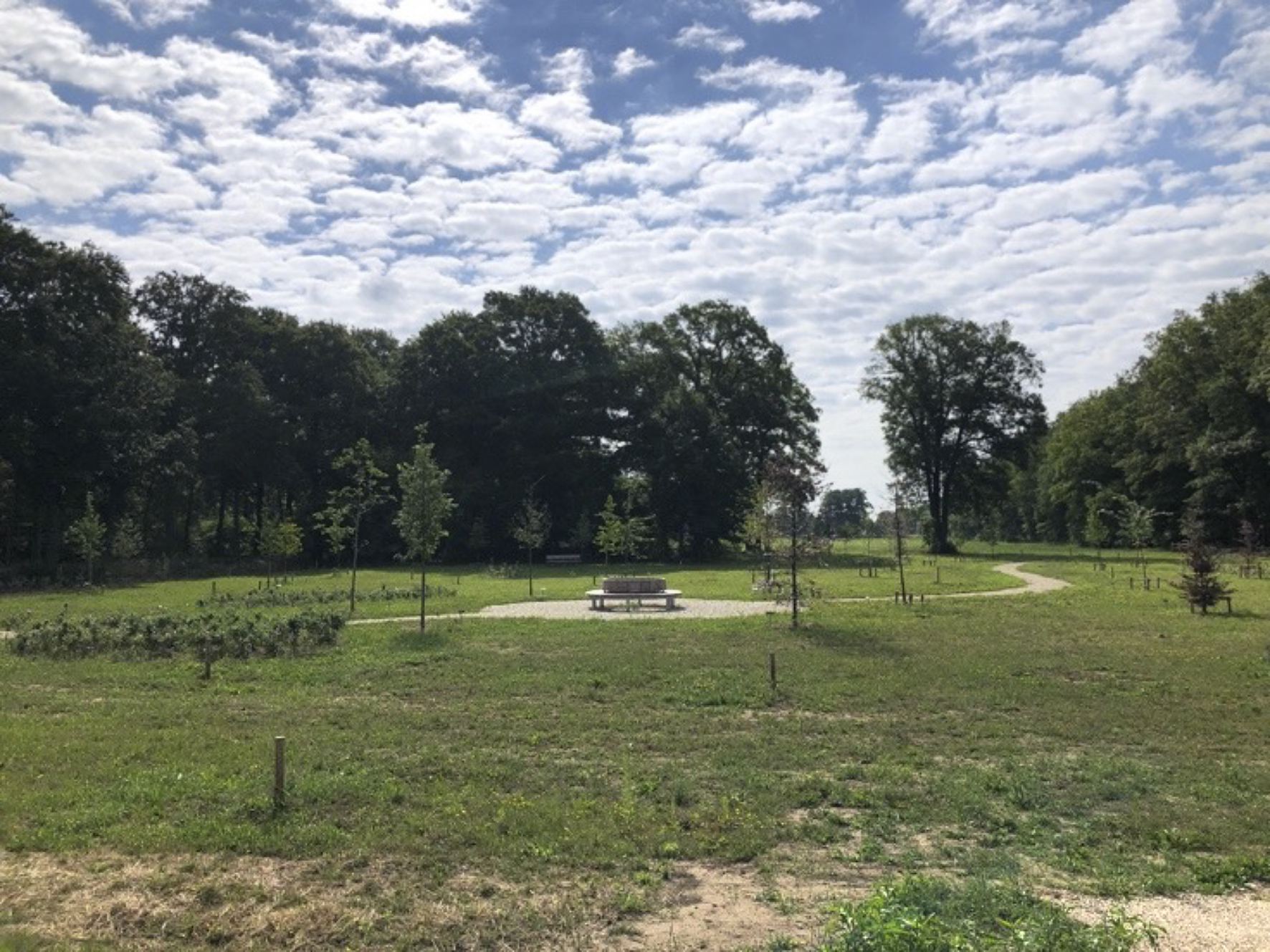
A special piece of forest in Geesteren. A place to commemorate, enjoy, recreate and learn from. That is the Vrijheidsbos Geesteren.
A living monument
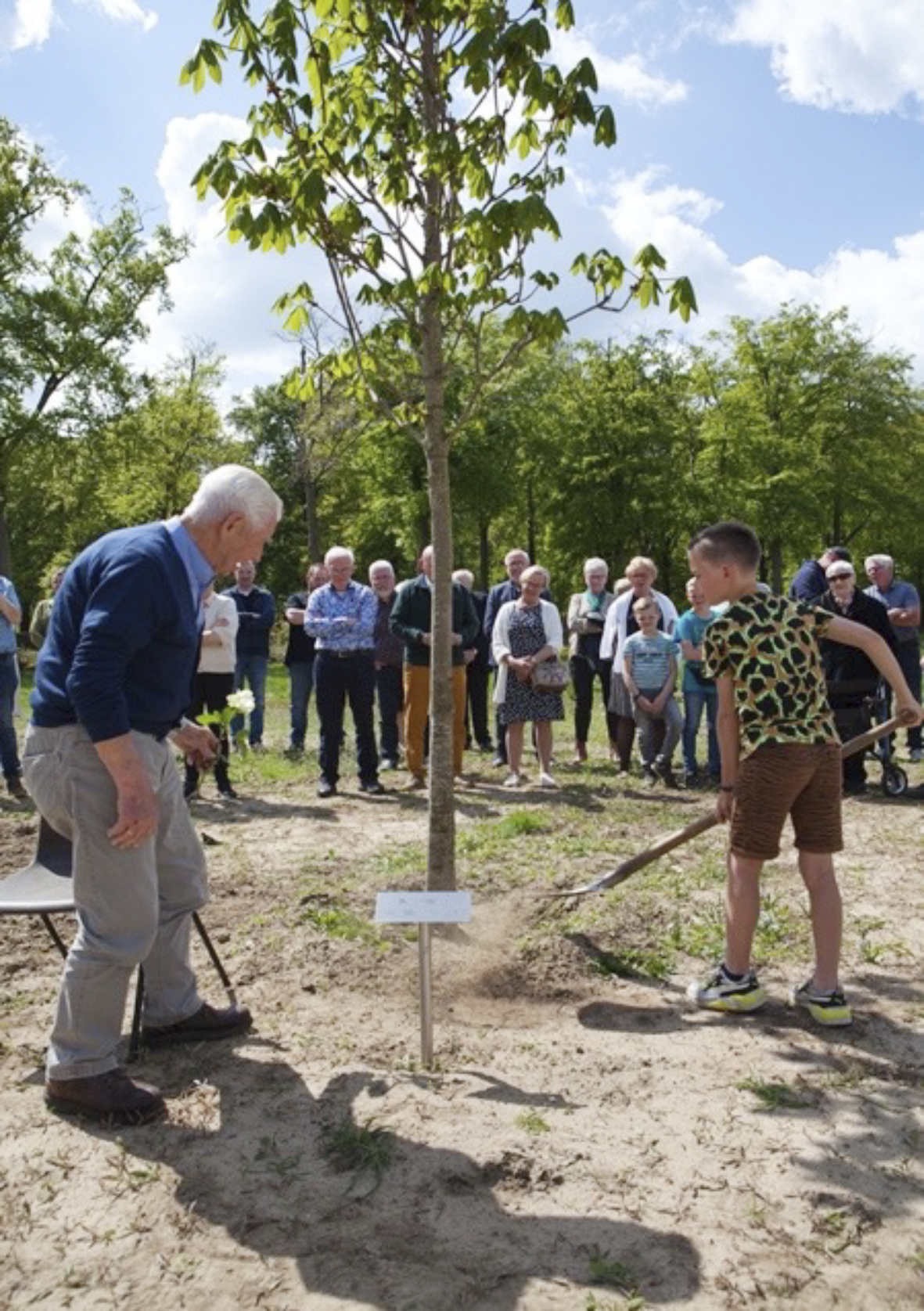
In this new forest, twelve trees were planted in 2021 for the twelve war victims of the Second World War of Geesteren. The trees are a living monument to the Jewish family Meijers, Antonia Tichelman-Geerdink, Co van den Brink, Jan Westra, Gerrit Hiddink, Jaap Rijsdijk and Jantje Esselink. The Vrijheidsbos, which started in 2020, also has an individual commemorative function: Everyone can buy and plant their own memorial tree. In this way, the forest grows into a meaningful and inspiring place for everyone.
A place to commemorate and learn
The Vrijheidsbos Foundation provides free teaching materials with audio stories, questions and assignments that are in line with current events. There is also a memorial book with the stories about the twelve war victims. Since May 5, 2024, there are two walking routes from the Freedom Forest: the Memorial Path and the Freedom Route. Both are part of the Liberation Route Europe.
Symbolism for 80 years of freedom
In honor of 80 years of Freedom, a Canadian Maple is planted. This liberation tree symbolizes the cooperation in the resistance between Geesteren, Borculo and the surrounding area.
For more information, please visit: www.vrijheidsbosgeesteren.nl
Memorial James
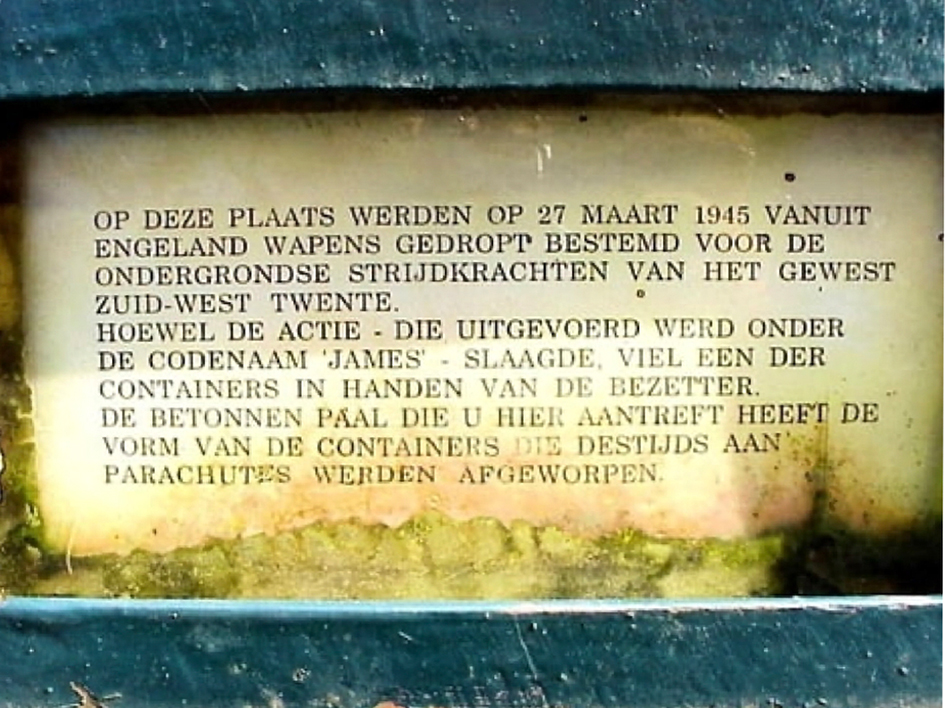
At the end of the war, a weapon drop is organized in the Eiberg hamlet of Mallem (De Posse). This is codenamed ‘James’.
A weapon drop full of risks
In the last week before the liberation, something happens there that is not only very exciting but also extremely dangerous for those involved. On 27 March 1945, weapons were dropped. These weapons are intended for the resistance in Enschede and Haaksbergen, Twente region. The dropping takes place close to a German lookout post on the water tower, less than a mile away. Suddenly rising thick fog then obscures the view to and from the water tower. Twice the heavy bomber comes over to drop the containers attached to colored parachutes. Transporting the containers is difficult and erasing the traces turns out to be quite a job. The big shock comes later in the morning when a passer-by lies something strange behind a bush. He warns the Germans. It turns out to be a container with radio equipment.
Fortunately, it ends with a fizzle
For the entire operation of the droppings: packing, flying, dropping, catching, transporting, hiding and distributing, many hands were needed with a great risk to their own lives.
Source: http://www.oorlogsbronnen.nl/thema/Wapendropping%20bij%20Eibergen
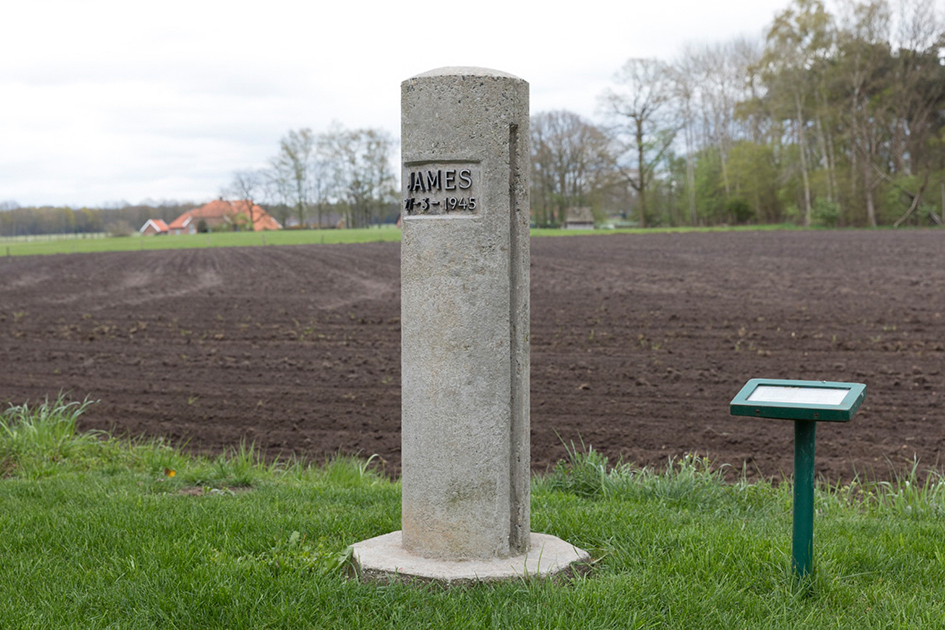
Monument James (the concrete pole was cast in a tube that was thrown off at the time, in which the weapons were located)
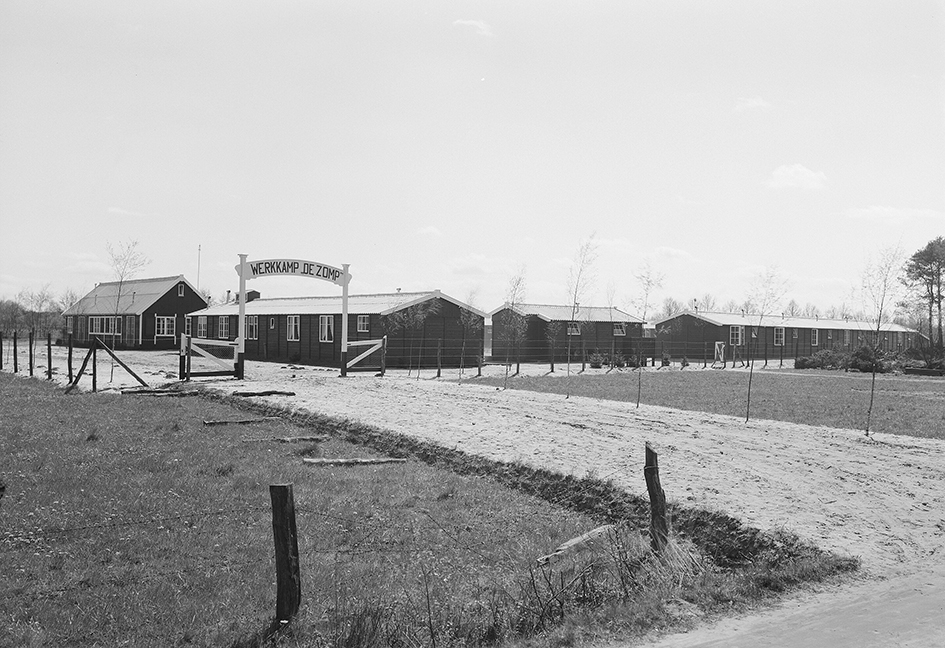
Jewish Labour Camp De Zomp
The De Zomp labour camp in Ruurlo is located on the Koergerweg, a few kilometres outside the village on the road towards Borculo. The camp consists of two barracks and the cook’s house with the kitchen, a canteen, a laundry room and a bicycle shed. The camp was built in the 1930s by order of the Dutch government to house the unemployed in the context of job creation.
The function of the camp is changing
Dozens of these camps in the country were evacuated in 1942 to make way for Jewish men who had become unemployed because of anti-Jewish measures. In Ruurlo, as forced labourers, they had to cut down pines and dig ditches in the woods around the Zelhelmseweg and the Hengeloseweg and improve the water drainage of the river Slinge. In the course of that year, the regime becomes stricter.
A gathering place for deportation
However, it did not stop at only employing Jewish fellow citizens. The camps were in fact assembly points from which people were later sent to Westerbork, the outer port for deportation to the extermination camps.
The evacuation of camp De Zomp
In the night of 2 to 3 October 1942, the camp was surrounded by the Ordnungspolizei. The next morning, the Jewish men were transported to Westerbork via the station in Ruurlo. From there they were soon deported to the extermination camps in Eastern Europe. The majority of the more than 100 Jewish men from camp De Zomp were murdered there. Only a few men return.
The decision-making behind the Jewish labour camps
The decision to set up Jewish labour camps was taken on 10 October 1941 by the German Reich Commissioner Seyss-Inquart. The Jewish Council, led by Prof. Dr. D. Cohen and A. Asscher, agreed to send unemployed Jews to the north and east of the Netherlands.