

‘Pilot Help Line’ Lichtenvoorde
During the Second World War, Lichtenvoorde played a central role in assisting Allied airmen and escaped prisoners of war. Due to large-scale resistance activities and the many Allies who found safe haven there, the village earned the nickname ‘Little England’. Its favorable location on the flight path to the German Ruhr area, combined with a landscape of peat bogs and forests, made the region an important hub in the so-called ‘Pilot Help Line’.
Strategic Location and the Origin of the Line
Due to its proximity to the border with Nazi Germany, the Achterhoek was a high-risk but essential area for military personnel escaping German captivity or landing by parachute after a crash. In the early years of the war, assistance was often incidental and left to chance. As the air war over the Ruhr area intensified and the National Organisation for Assistance to People in Hiding (LO) became more professional, a tightly organized network emerged in Lichtenvoorde.
This network connected Twente and the Achterhoek with the south of the Netherlands. Allies were brought by bicycle to Lichtenvoorde from places such as Raalte, Rijssen, and Hengelo (Overijssel). After a short period of hiding, they continued by train to North Brabant or Limburg, eventually reaching liberated territory via Belgium.
Logistics and Recognition Markers
The transport of airmen required strict security protocols. A well-known tool was the use of a specially folded newspaper. Resistance members accompanying the pilots would carry a newspaper in their pocket in a specific way. At stations, they looked for contact persons with an identically folded newspaper to ensure a safe handover.
Within Lichtenvoorde itself, specific locations were well-known in the international resistance network:
- De Groene Deur (The Green Door): Many French-speaking refugees were sheltered by the Meijer family in Lichtenvoorde because the head of the household was fluent in the language. The house with its striking green door became a famous beacon.
- De Bijenkistschuur (The Beehive Crate Shed): At the Leemreize family home, as many as four different nationalities were sometimes hidden simultaneously in a shed used for beehive crates.
- Het Zwarte Veen and the Harreveldse Bulten: These locations were used for weapon drops and secret radio equipment.
Scale and Key Figures
The effectiveness of the pilot assistance in Lichtenvoorde became evident after the war when a list was found containing the names of 236 Allied servicemen who had been hidden in the village for shorter or longer periods. In total, more than thirty individuals from the former municipality of Lichtenvoorde received the Resistance Memorial Cross (Verzetsherdenkingskruis).
Crucial figures within this network included Joep ter Haar (nicknamed ‘Pilot Joep’), Gert Reinders (‘the Dog’), and Hendrik Leemreize (‘Pietje Stofmeel’). Women such as Dina Geurink-Wisselink also played a role; she combined caring for her family and working the land with concealing people in hiding, including a Russian pilot and Jewish people in hiding.
The Final Months of the War
Following the failure of Operation Market Garden in September 1944, the route to the south was cut off. The pilots could no longer be moved through and were forced into long-term hiding in the region. During this period, the resistance prepared for the final liberation. In the final months, many resistance fighters and people in hiding joined the Dutch National Battalion, also known as the ‘Forgotten Battalion’, which advanced alongside the Allies during the liberation of the Veluwe.
Commemoration and Heritage
The history of the ‘Pilot Help Line’ is kept alive through various memorial sites in the region:
- Nationaal Onderduikmuseum: This museum provides an overview of the assistance provided to people in hiding and pilots throughout the entire Achterhoek.
- Little England Monument: A propeller on the Joep ter Haarplein in Lichtenvoorde commemorates the efforts of the local resistance.
- Crash Museum Lievelde: This museum focuses specifically on the air war and the aircraft that came down in the region.
Although the occupiers attempted to break the network through raids and betrayal, the core of the resistance in Lichtenvoorde remained active until the liberation in the spring of 1945.
Film fragment from 1962 regarding the important role Lichtenvoorde played in the ‘Pilot Help Line’ to Belgium:
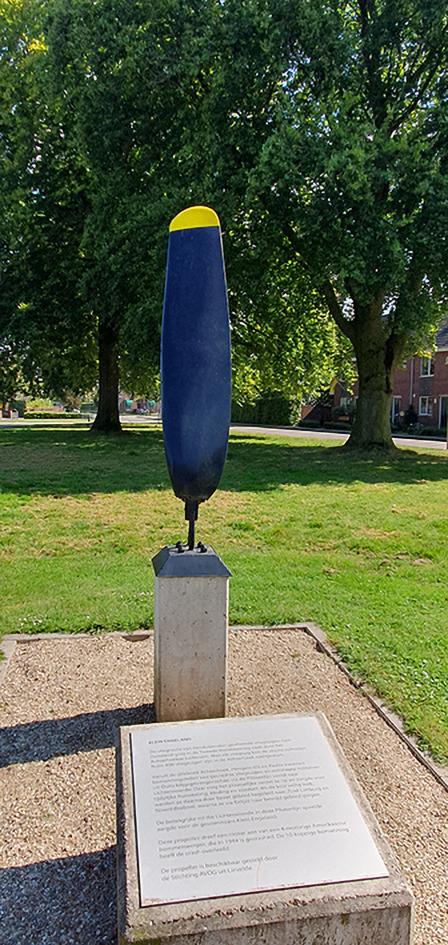
Het monument ‘Klein Engeland’ op het Joep ter Haarplein in Lichtenvoorde