

Wim and Gerhard Pampiermole
(Aalten, 1920/1924)
Staff member and member of the 3rd Company DNB
“When we arrived in the Betuwe, everything was truly broken. My goodness, what a mess and what a stench!”
Wim Pampiermole was born on December 27, 1920, and Gerhard on July 22, 1924, into the family of Derk Jan and Gesina Pampiermole-Hilbelink. They lived on the Kleinpenning farm in the hamlet of Dale near Aalten. They had an older brother, Gerrit Jan (1915), and a sister, Leis (1918).
An encounter on the Misterweg
Their eldest brother Gerrit Jan was a mobilised soldier in Brabant in 1940; he returned five months later traumatised and never spoke about the war. He helped his father with the work on the farm, as did Gerhard. Wim worked as a clerk in the administrative office (secretarie) of the municipality of Aalten.
In the first two years of the war, the young men could still walk the streets normally. On a dark evening in 1942, Gerhard met a man on the Misterweg and greeted him with “goeienaovend” (good evening). The man replied with something unintelligible. Gerhard fetched his brother Wim, who had learned his languages at secondary school (mulo). The stranger turned out to be a French-speaking Belgian who had escaped from a German camp. The family provided him with food and clothing, after which Wim accompanied him by train towards Belgium.
Thus began the resistance work of the Pampiermole family. Increasingly, they provided short-term shelter for people in hiding or sought out safe addresses.
‘Pilot Help Line’ and Home Forces
Wim worked as a civil servant in the Population Department of the municipality of Aalten. From the spring of 1943, together with his supervisors Muus Visser and Frans Bult, he served as the resistance contact for forged identity cards. Assistance was primarily provided to military personnel and young men who refused the Arbeitseinsatz (forced labor) in Germany.
In September 1944, the fifteen administrative officials went into hiding. Wim, operating under the pseudonym ‘Karel’, joined the ‘Pilot Help Line’ in Lichtenvoorde (with Hendrik Leemreize, Joep ter Haar, and Henk Hulshof). He was known for his courage and his ‘eagle eyes’ in the pitch dark.
In February 1945, he accompanied stranded RAF pilots Hanson and Cheeseman at night across the fields to a safe location. Hanson wrote in his book ‘Sprong in het duister’ (Leap into the Dark) that ‘Karel’ spoke good English. He also wrote about him:
“In daylight I saw a tall, thin fellow with a fresh face, clever, with a sense of humour. His deep-set eyes were thoughtful in repose but began to sparkle when he became excited. He could act with caution and disciplined self-confidence, even to the point of exaggeration; he had certainly proven that last night.”
One day, together with a resistance friend, he accompanied Allied military personnel on the train to Brabant. When they arrived in Oisterwijk, there was an inspection by the Sicherheitsdienst. Wim and his companion had a forged identity card, but the group of Frenchmen had nothing. It ended well; the inspection stopped just in time.
For brother Gerhard, staying at home became too dangerous in late 1944. Land guards (“blacks”) with rifles were lurking everywhere to arrest people in hiding. Wim arranged a permanent hiding place for him with the Kamperman resistance family in Vragender, where there was a constant flow of people in hiding.
The brothers Wim and Gerhard were members of the Dutch Home Forces (NBS) in Lichtenvoorde and Groenlo, combat section. Wim quickly became the right-hand man of NBS commander Jan Tinge. During weapons instruction for the resistance, Karel assisted with the cleaning of the weapons.
Deployment with the Dutch National Battalion
On March 30, 1945, the day Aalten was liberated, Jan Tinge sent ‘Karel’ straight through the German lines to Aalten to inform the British army about the situation around Groenlo and Eibergen. The brothers immediately joined the Dutch National Battalion (DNB) and moved across the Veluwe with the Canadian army. Gerhard was a member of the 3rd Company and Wim was a member of the staff of section commander Jan Tinge.
In May 1945, they traveled via Renkum and Arnhem to the Betuwe, where the 3rd Company guarded the security line between the Western and Eastern Netherlands near Dodewaard. The men saw a no-man’s-land. Everything was destroyed and the population had been evacuated. The rotting carcasses of livestock produced a disgusting stench, and furthermore, mines were scattered everywhere. The company guarded captured German soldiers. Finally, in Tiel, they had to burn the rifles and goods that the Germans had seized throughout the Netherlands. These became large, smoldering, and foul-smelling heaps.
After the war
In July 1945, Wim resumed his work as a municipal official in Aalten. In 1953, he married Thea Koopmans, a social worker from Loenen aan de Vecht. They lived on the Bredevoortsestraatweg. He passed away on 25 January 2001 in Winterswijk.
Gerhard re-enlisted for service with the Army (II.8. Infantry Regiment), underwent training, and cleared mines. He later said of this: “The German prisoners had to do the work and the Dutch did the guarding. Someone was killed regularly.” After his military service, he became a carpenter in Aalten and married his neighbour, Liene Lankhof. They lived in a newly built house on the Beerninkweg, next to the parental home. They had a son and a daughter. He passed away on 6 March 2023 in Aalten, aged 98.
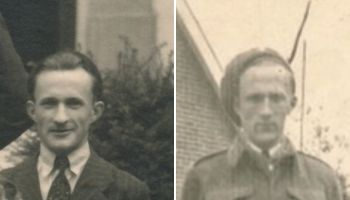
Wim (left) and Gerhard Pampiermole