
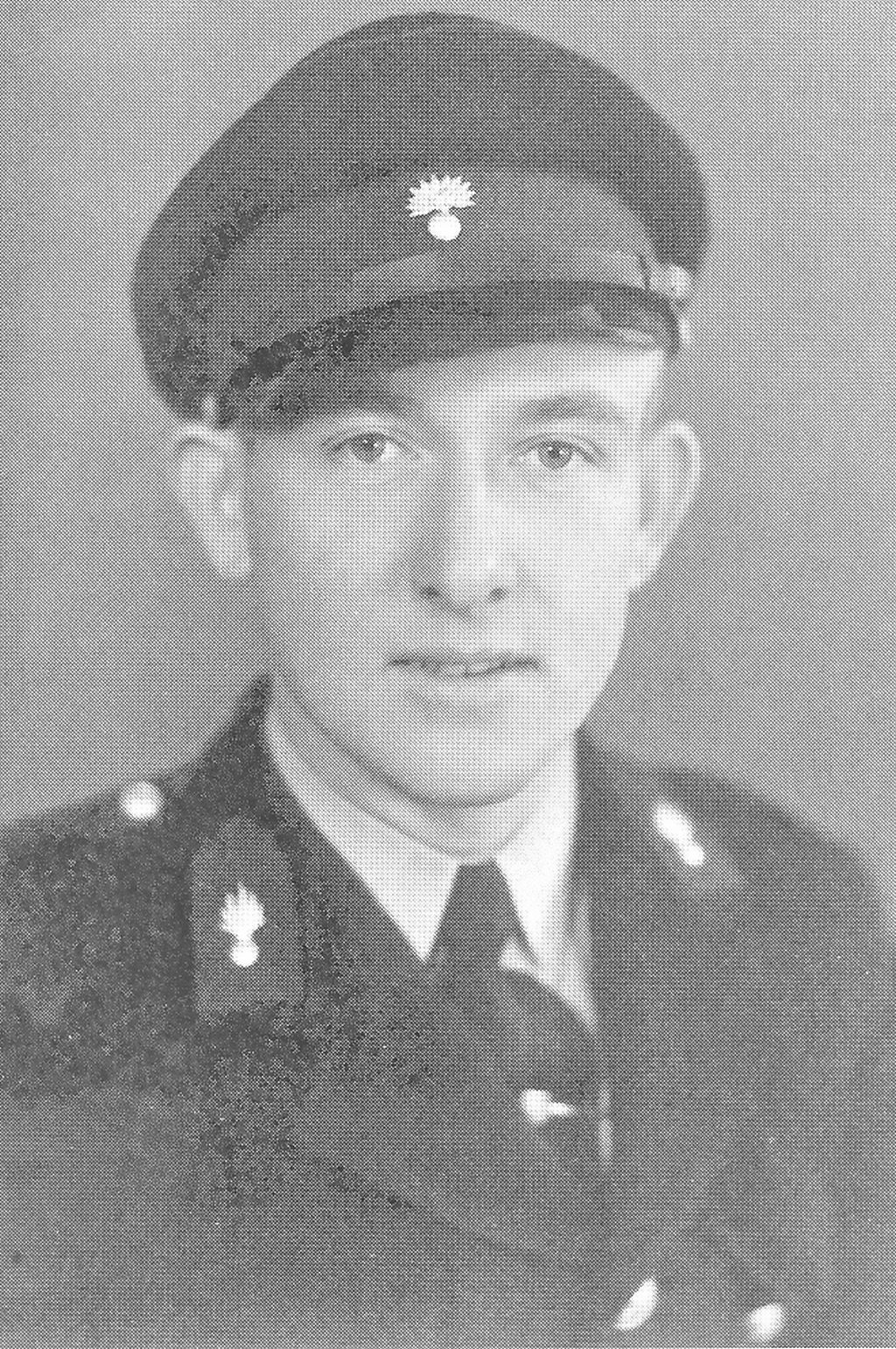
Marinus Kamperman
(Varsseveld, 1920)
Section Commander of 3rd Company DNB
Kamperman farm in Vragender: A hotbed of resistance in WWII
Marinus Kamperman was born in Varsseveld on 5 September 1920, the son of Marinus Kamperman and Ziena Kamperman-Kuenen. He had a twin sister, Dina. In 1922, his parents moved to Vragender with their four children. When his mother passed away in 1933, his father was left to run ‘de Kamper’ farm on Kamperweg in Vragender with seven young children.
During the Second World War, ‘de Kamper’ farm became a hotbed of resistance. Marinus and his brother Antoon, four years his junior, were members of the underground and played an active role in the illegal military resistance against the occupiers. Prisoners of war who had escaped from Germany and Allied pilots found temporary shelter here. The municipal secretary of Groenlo was hidden there for an extended period, and the house also hosted evacuees. In the field, a poorly ventilated dugout was constructed, where resistance fighter ‘Kareltje’ sheltered RAF pilots Hanson and Cheeseman for a night. Kareltje had previously brought his younger brother, Gerhard Pampiermole from Aalten, to hide there. Sisters Ziena and Hanna Kamperman used a whistle to signal those in hiding to return after they had fled into the woods during raids.
The Kamperman household saw a constant flow of people, which at times caused unrest and tension. On the nearby ‘Vossenakker’, crates of weapons from two drops in the Aaltense Goor in late October 1944 were safely hidden. These supplies were intended for the resistance in Vragender.
In the autumn of 1944, Marinus and Antoon joined the Interior Forces (Binnenlandse Strijdkrachten, BS) in Lichtenvoorde. Marinus became the commander of the combat section of the BS Vragender branch. In mid-April 1945, he joined the 3rd Company of the DNB. As a section commander, he led combat operations against retreating German forces in the Veluwe and Betuwe regions.
On 15 July 1945, Marinus Kamperman received an honourable discharge as the Dutch National Battalion was disbanded. He presumably reenlisted for a year with the Netherlands Army. On 26 April 1946, Jan Tinge, the commander of the 3rd Company of the DNB, wrote a testimonial for Marinus, noting that he had thwarted the German oppressors even under extremely difficult circumstances.
Marinus was expected to take over his father’s farm, but he had no desire to do so. Instead, he joined the new police organisation established in the Netherlands in November 1945. He began working at the courthouse in Groenlo. In the early 1950s, he was transferred to The Hague and then to Delfgauw, where he met Gerda Kunz. They married in September 1953. By the time their eldest of two daughters was born, they were living in Rotterdam, where Marinus worked at the local courthouse. From 1966 to 1969, Marinus served as a community officer in Leidschendam. The family then moved to Eibergen, where Marinus worked as a sergeant first class (wachtmeester 1e klasse) from 1969 until his retirement in 1980.
Marinus Kamperman passed away on 24 March 2000 in Eibergen.
Marinus Kamperman