
Silent Companion
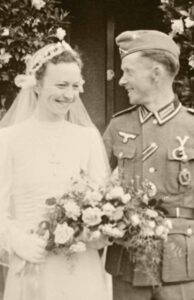
Ewald Heming and Elisabeth Schlattmann had known each other since 1933. They lived in Stadtlohn, just across the border in Germany, and worked in the same office. He was eight years her senior.
In 1939, their friendship blossomed into love. By then, he had already been called up for military service. He was first sent to France, where he sought out and found the grave of his older brother who had fallen in the First World War, to pay his final respects far from home. This was also a reason why he was deeply devoted to his country and wished to contribute to the war effort with dedication. However, he was absolutely not a Nazi, nor was he fanatical in any other way. On their honeymoon, Elisabeth even dressed up in his uniform. In his photographs, Nazi symbols are nowhere to be seen.
He was well-read and loved nature and culture. Ewald observed and recorded everything meticulously whenever he had the chance; he had done so his entire life. He also had a talented hand for photography. As a result, much material regarding Ewald and Elisabeth has been preserved. A long-distance engagement took place at Christmas 1941, a so-called ‘Fernverlobung’. Later, he came home on leave, and they were married in Stadtlohn on 31 July 1942.
In his diary entries, we read:
25.7.1942: Fastow-Kowel. Delousing today. Just met the great Felix E. In two hours in Warsaw, 15:00 Lublin. Sent her the telegram “arrival Monday, Ewald”. If all goes well, I’ll be home as early as today, Sunday evening.
31.7.1942: Wedding! Like everything in my life, this day was filled with sunshine and incredible happiness! I thank fate for being so kind to me. Without house or hearth, we fly around freely like two butterflies. If people ask us: “How was it, was it good?” I answer every time: “It was indescribable.” Everything went beyond expectations. Secretly I think: “The happiness of my existence is indestructible. It is incredible to experience this in wartime. At the end of the terrible war, our love triumphs.”
Bentheim- Horstmar-H. Dorsten – Visits here and there, it was fantastic. People have so much to give for the front-line soldier and his dear wife. The realization fully dawns on me: these days will be the most beautiful and wonderful of my life.
But everything passes.
13.8.1942: Kaffee Veelken in Borken. I see nothing that makes me sad. The future smiles upon me. Goodbye, my dear wife. There is little time left, a thousand thanks for all your love.
Ewald returned home on leave once more in 1943. In the meantime, Elisabeth had furnished a home in Stadtlohn. As they said goodbye at the station in Münster, he took a beautiful photo of her from the carriage window. She also took a photo of him. He then handed her his ring and his camera. He likely sensed his approaching end. He no longer believed in the war at all. Looking back, Elisabeth knew she simply did not want to dwell on it at the time. Three months later, in November 1943, Elisabeth received the sad news that Ewald had been killed in action near Smolensk. They had no children.
Elisabeth created a memorial book, containing his wartime diary notes, many photos and small drawings from Russia, and postcards he had sent from France. She also made a second memorial book with photos of their ‘Fernverlobung’, their wedding, and their honeymoon. After the war, Elisabeth married Johannes Hengstermann. Four children were born to them.
This love story profoundly influenced the Hengstermann family. To this day, a photo of ‘Uncle Ewald’ hangs on the living room wall, adorned with a small wreath of dried flowers or a beech branch. For daughter Resi, ‘Uncle Ewald’ was a silent companion of the family.
Source: Interview with Resi Hengstermann, Bocholt (Germany), daughter from the second marriage of Elisabeth Hengstermann, widow of Ewald Heming, December 2013.