
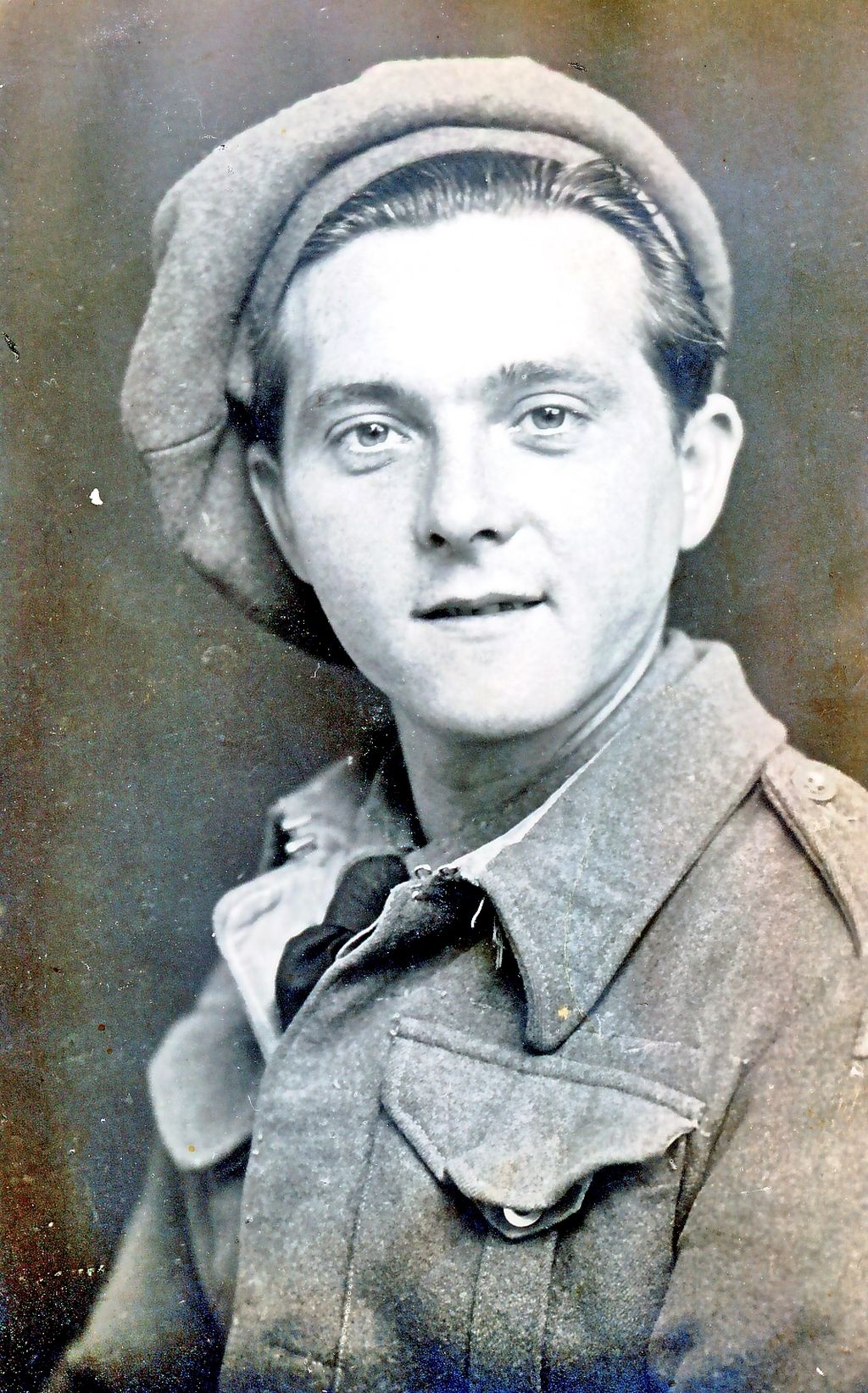
Leen Twigt
(Rotterdam, 1921)
Member of the 2nd Company DNB
Rotterdammer Leen found love in Aalten and stayed after the war
Leendert (Leen) Twigt was born on December 23, 1921 in Kralingen, Rotterdam, as the son of Adrianus and Antonia Twigt-Verkaik. He grew up in a loving family of eight children. His father worked at the Van Rossum coffee factory and was a newspaper deliverer for ‘De Rotterdammer’. Leen trained as a machinist and got a job in Rotterdam. He was a cheerful young man full of humor, was musical and loved gymnastics. In 1943 he was arrested during a raid in Kralingen and transported by train to Nuremberg for the Arbeitseinsatz . He lived in a camp and worked at the MAN factory, where war tanks were made. Of course he was not really motivated, so he and his buddies unnoticed omitted the ball wheel bearings in the wheel axles, so that the tanks at the front would break down.
When he was allowed to go home for a short holiday in 1944, he heard on the train about the possibility of going into hiding. He came to live as a farm labourer with the Wamelink family in Barlo near Aalten and stayed there until the liberation. Once he was arrested (again), but the old farmer’s wife Wamelink got him released through the Ortskommandant with the sentence: “‘t Gecrop mot van ‘t land”. Leen sometimes visited the families in the neighborhood and their people in hiding. That’s how he got to know the girl next door Grada Brusse, from the farm ‘de Pakkebier’, a family with nine children, and started dating her. His father came cycling from Rotterdam during the Hunger Winter – the trains were no longer running – to get rye bread.
Binnenlandse Strijdkrachten and DNB
At the end of the war, Leen became a member of the Domestic Forces (BS), Aalten department, and joined the Dutch National Battalion, 2nd company, in mid-April 1945. In July 1945 he signed up in the Dutch army and helped with the clearing of mines.
After the war
After the war he remained in the service of the army as a sports sergeant in the barracks on the Veluwe. Because he wanted to get married, but not live in the barracks, he left the service and moved to Lichtenvoorde in 1946, where he worked at Hulshof Leather and Metal. On 15 July 1949 he married Grada Brusse. The party was on the part between the cows, according to local custom. He followed the two-year gymnastics leader course in Utrecht. Departure at 04.00 in the morning and home at 22.00. After that he continued to work at Hulshof but also gave gymnastics lessons at a number of associations, always energetic and cheerful. The couple had a daughter and three sons.
On February 10, 2004, Leen Twigt died quite suddenly in the hospital in Winterswijk.
Leen Twigt