

Frank Dell
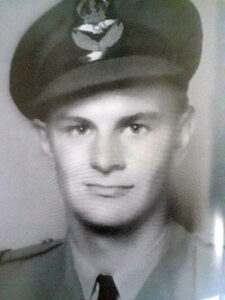 On the night of 14–15 October 1944, the British Mosquito bomber piloted by RAF officer Frank Dell crashed near Münster. Frank walked for days and, via Winterswijk and IJzerlo, eventually arrived in Lintelo at the home of Jan Ket, the local resistance leader. He slept above a terribly foul-smelling goat shed, which, according to Frank’s memoirs, served to keep any Germans at bay. Shortly after, he moved to the Prinzen family at ‘Somsenhuus’ in IJzerlo, where seven airmen were soon hidden at that single address.
The 21-year-old Frank became the natural leader of the group. They became involved in resistance activities at ‘De Bark’, an uninhabited farmhouse in De Heurne which, from November 1944, served as a base for the combined Varsseveld/Aalten assault group (LKP). It was a tight-knit group of 25 to 30 young men from all walks of life who met and trained there. Frank assisted with the weapon air-drops at De Wolboom.
When German soldiers paid a brief visit to the farm on 26 February 1945, the group decided to liquidate them. An accident was staged, but the explosion and fire were only partially successful. The Germans immediately saw what had happened, and their reprisals were horrific. On 2 March 1945, 46 men from across the Netherlands were executed by firing squad at Rademakersbroek near Varsseveld in the Achterhoek.
The men in hiding remained at Somsenhuus until the liberation, even while a large number of German soldiers were billeted there. In his 2014 book Mosquito Down, Frank Dell wrote extensively about the fatal events that took place in his neighbourhood and at De Bark.
Frank Dell passed away on 30 May 2022 at the age of 98.