

Dick Fries
(Aalten, 1924)
Member of the 1st Company DNB
Blind, yet not helpless
Dick Fries was born in Aalten on 30 March 1925, the middle of three sons. His father was a plumber by trade, while his mother ran the household. The family lived at Dijkstraat 30 in Aalten.
Refusing to work for the German occupiers, Dick spent much of the final two years of the war in hiding at the farm of Linus and Grada Fukking in Heelweg, near Varsseveld. His brother Jacob had joined the resistance, and although Dick wished to do the same, his mother objected as he was still a minor. During a bombing raid on Dijkstraat, a bomb struck his father’s workshop, destroying the family home. Dick and a man in hiding, Hans Renshof, were buried under the rubble, but were both rescued by Jacob.
Following the liberation of Aalten, Dick—having just turned 21—joined the ‘Binnenlandse Strijdkrachten’ (Dutch Interior Forces) and, a few weeks later, the DNB. He marched on to help liberate the rest of the Netherlands. When the DNB was disbanded on 12 July, he was assigned to the 8th Infantry Regiment (I-II-8 RI), part of which was tasked with clearing abandoned explosives. He trained for this perilous work in Knokke, Belgium.
On 13 February 1946, during a live-fire exercise near De Bilt involving hand grenades, a devastating accident occurred. A grenade exploded while a crate was being loaded. Dick’s close friend and comrade Jan van den Heuvel was mortally wounded and died the following day. Dick was struck by numerous shards of shrapnel and lost his sight. After being treated at the Ooglijders Gasthuis in Utrecht, he underwent rehabilitation at the Bartiméus Institute for the blind in Zeist, where he also mastered Braille.
Upon returning to Aalten, Dick aspired to open a cigar shop. Despite there already being seven such shops in town, the local council supported his request. Mayor E.S. van Veen petitioned the Ministry of Economic Affairs to requisition shop space for him.
In 1949, Dick opened his first shop. His comrades from the 8th Regiment presented him with a wall clock inscribed: “Presented by the veterans of the Dutch National Battalion and the 8th Infantry Regiment, 1949.”
By 1951, the business had moved to Landstraat and was flourishing. Many of his regular customers were former brothers-in-arms. He eventually became a Purveyor to the Household of H.R.H. Prince Bernhard. Every year, he sent the Prince a box of cigars, receiving several personal letters of thanks in return.
Dick Fries married Leis Wechgelaer on 29 October 1952; they had two children.
He passed away on 8 October 2002, aged 78.
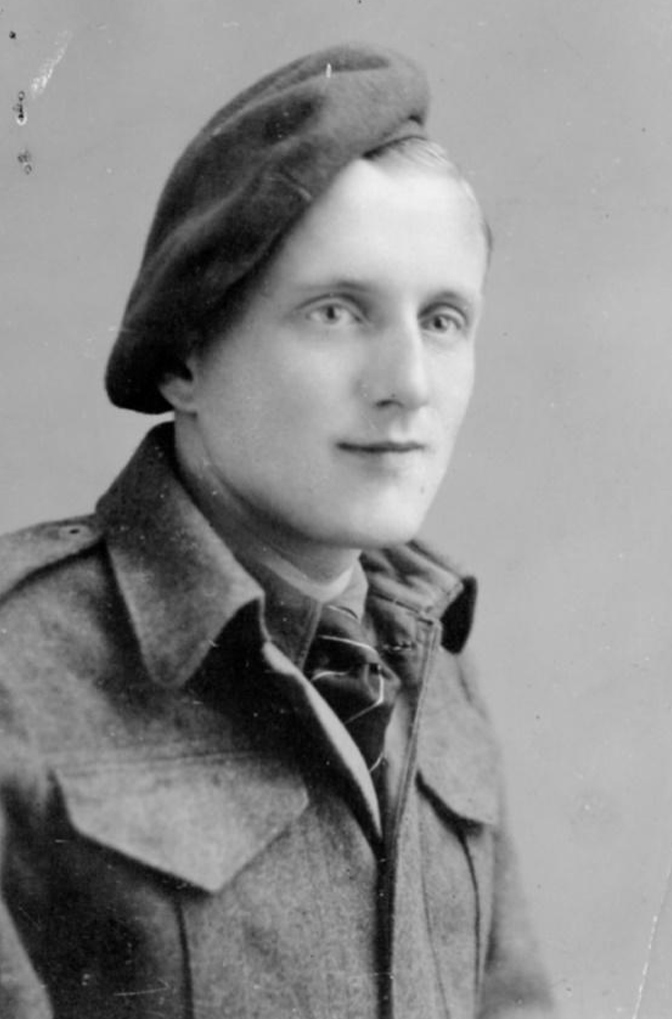
Dick Fries