
Jan Stapelkamp
(Amsterdam, 1920)
Member of the 1st Company DNB
Living in a country with an occupier is unthinkable for Jan
Gerrit Jan (Jan) Stapelkamp was born in Amsterdam on 15 April 1920. His parents, Antoon and Hanna Stapelkamp-Stronks, had moved from Aalten to the capital shortly before with two children. The family later moved to Utrecht and The Hague, where three more children were born. Remarkable is how the parents developed. The father started as a factory worker at the age of twelve, became a municipal councilor in Aalten, and after the war was a member of the First and Second Chambers for the Anti-Revolutionary Party. The children, and thus also Jan, knew early on that with ‘pray and work’ and cooperation with others, much could be achieved.
Jan Stapelkamp is driven, not afraid, and quick in his dealings. He follows training with the Navy. But the war has a profound influence on his life. His father is a powerful chairman of the CNV trade union and is arrested by the occupier in June 1941. For a year and a half, father Antoon is imprisoned in the camps Schoorl, Buchenwald, Haaren, and Sint-Michielsgestel. His uncle Herman Stapelkamp is also imprisoned in Camp Vught for a year. His cousin Jan Kooijman is arrested in the Aaltense Heurne and dies in Germany (which only becomes known after the war). His equally aged cousin Freek Somsen from Doesburg is a resistance fighter in Doesburg and on the Veluwe and helps Jews find a hiding place. Freek is executed by the occupier on 5 September 1944.
Resistance Work in Doesburg and Aalten
Living in a country with an occupier is unthinkable for Jan. He too goes underground and into resistance and fights for freedom. Jan hides with his family in Doesburg and Aalten. In Aalten, he works with the Knokploeg Aalten. In November 1944, the sector leader Ko of the Albrecht spy group settles in Aalten. He works with the other sector leader in the Achterhoek, Louis in Doesburg.
Because Jan knows the way in both Doesburg and Aalten, the spy leaders gladly make use of his services. But shortly thereafter, the leader Cees Brouwer alias Eduard is his contact. The work becomes more intense as liberation approaches. It is mainly about registering troop movements of the Germans and quantities of materiel. His spy trip to Groningen fails because his bicycle is confiscated.
Liberation and DNB
Just after the liberation of Aalten, early April 1945, Jan reports to the local commander of the Binnenlandse Strijdkrachten, and shortly after he is a member of the Dutch National Battalion (DNB) which moves to the Veluwe. On 19 April 1945, the Canadian Army asks DNB commander Bob Krul and Jan Stapelkamp to escort two heavily armed Canadian Jeeps on a reconnaissance trip towards the IJsselmeer. They drive through an area that is not yet liberated. On 27 May 1945, Jan Stapelkamp writes a letter to spy leader Eduard.
Little is known about his life after the war. He is married and in 1972 works at Detam, a trade association for retail, crafts, and housewives.
Jan Stapelkamp died on 2 February 1980 in Utrecht.
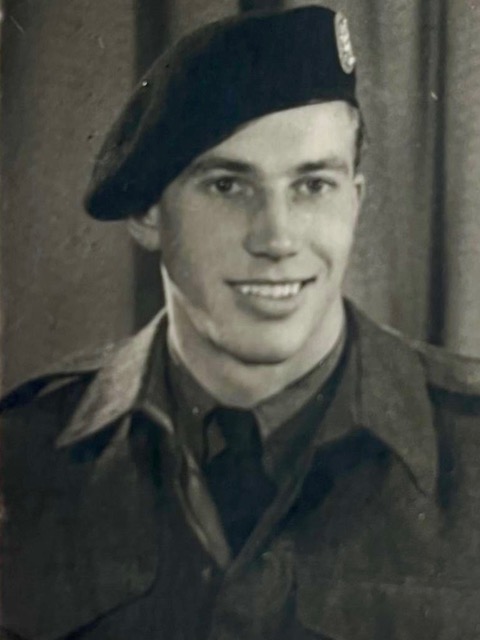
Jan Stapelkamp